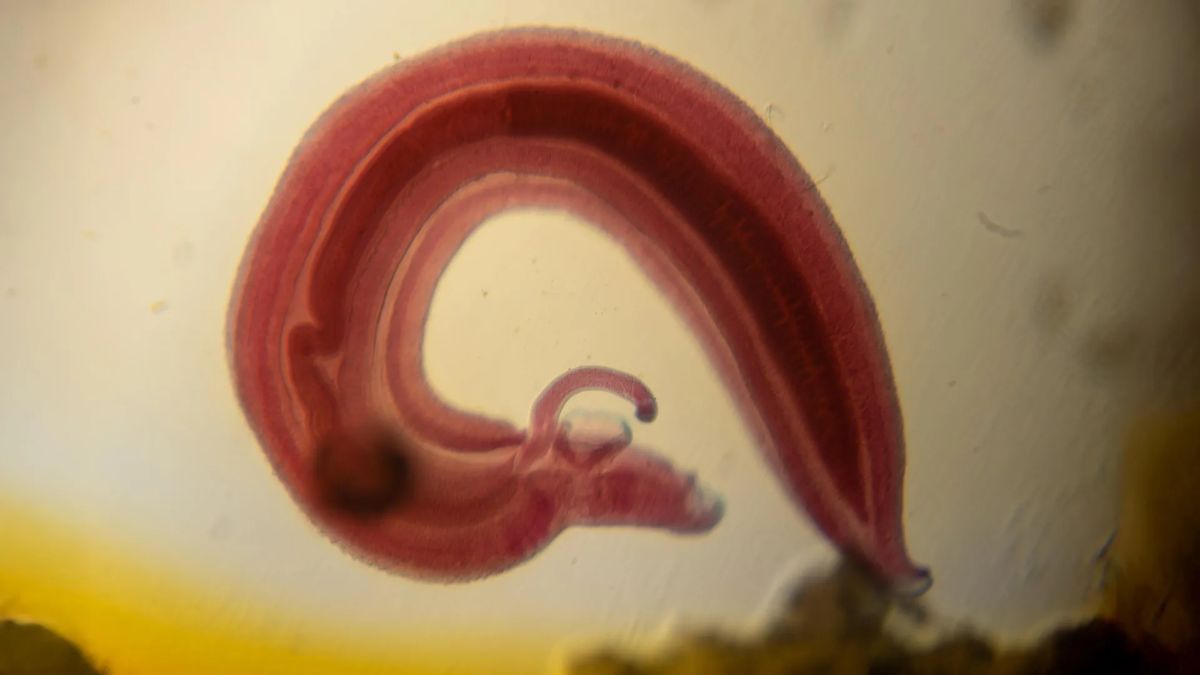
Imagine getting burned, bruised, or even breaking a bone—and not feeling a thing. Sounds like a superpower, right? Well, nature may have already figured it out. Meet Schistosoma mansoni, a sneaky little worm that manages to invade the human body without triggering any pain—and scientists have just discovered how.
This parasite doesn’t just sneak in undetected; it literally turns off your body’s pain and heat alarms. It’s dangerous, yes—but it might also hold the secret to a whole new generation of painkillers. Let’s find out how.
Table of Contents
Entry

So how does this worm get into the body? It usually enters through the skin or natural openings when someone swims or bathes in contaminated water, especially in tropical or subtropical regions. The craziest part? You don’t feel it at all.
No itching. No burning. No sting. Nothing.
Once inside, Schistosoma mansoni makes its way through your body without raising any alarm bells. That’s because it releases molecules that block pain-sensing neurons, allowing it to travel undetected.
Switch

These aren’t just any neurons. The worm targets a specific group called TRPV1+ neurons. These are the pain sensors that alert you when something’s hot, sharp, or irritating. They’re the reason you yank your hand away from a hot stove or feel a burn from chili peppers.
But when the worm enters, it basically cuts the wire. Your body stays quiet—even if something is wrong. There’s no reflex reaction, no immune system alert, no pain signal. It’s like turning off the fire alarm during a fire.
Test
To prove this, scientists ran experiments using mice. Some were infected with the parasite and others weren’t. Then researchers applied heat to test their reactions.

Here’s what they found:
| Group | Reaction to Heat |
|---|---|
| Infected Mice | Delayed reaction, showed no discomfort |
| Uninfected Mice | Immediate reaction to heat |
They even tested capsaicin (the stuff that makes chili peppers hot). Infected mice barely responded. Their TRPV1+ neurons had been shut down.
That’s how scientists confirmed the worm’s ability to silence pain sensors and, by doing so, avoid detection by the immune system.
Potential
This discovery might sound creepy, but it’s actually a breakthrough for medicine.
If researchers can isolate the exact molecules the worm uses to block pain, they could develop brand-new types of painkillers. Imagine treating severe or chronic pain without relying on opioids, which come with nasty side effects and high addiction risks.
We’re talking about potential treatments for:
- Inflammatory pain
- Neuropathic pain
- Post-surgery pain
- Long-term chronic pain
The possibilities are huge—and it’s all thanks to a worm most of us never even knew existed.
Risk
Of course, it’s not as simple as copying the worm’s method. Pain, after all, has a purpose. It warns us when something’s wrong. If we completely shut off pain, we might also block the body’s natural defenses. And that could lead to infections, injuries, and serious complications going unnoticed.
That’s why scientists are trying to find a balance—turning off pain just enough to provide relief, without switching off the body’s entire warning system.
They’re studying the worm’s molecules in detail to figure out how they work and how to apply them safely in humans.
Wonder
Who would’ve thought a dangerous parasite could actually help improve human health?
Schistosoma mansoni causes schistosomiasis, a disease that affects millions worldwide. But hidden within that threat is a potential cure for some of the toughest pain problems modern medicine faces. That’s the beauty of nature—it surprises us in ways we never expect.
So next time you think of worms as gross or useless, remember Rakus the orangutan who healed himself with leaves… and now this worm that might help millions live pain-free lives.
Nature isn’t just wild. It’s wise.
FAQs
What is Schistosoma mansoni?
It’s a parasitic worm that causes schistosomiasis in humans.
How does the worm block pain?
It releases molecules that silence TRPV1+ pain neurons.
Does the infection cause any symptoms?
Not immediately—people often feel nothing at first.
Can this help create painkillers?
Yes, researchers are studying the worm’s molecules for drug use.
Is it safe to block all pain?
No—pain helps protect the body, so balance is key.