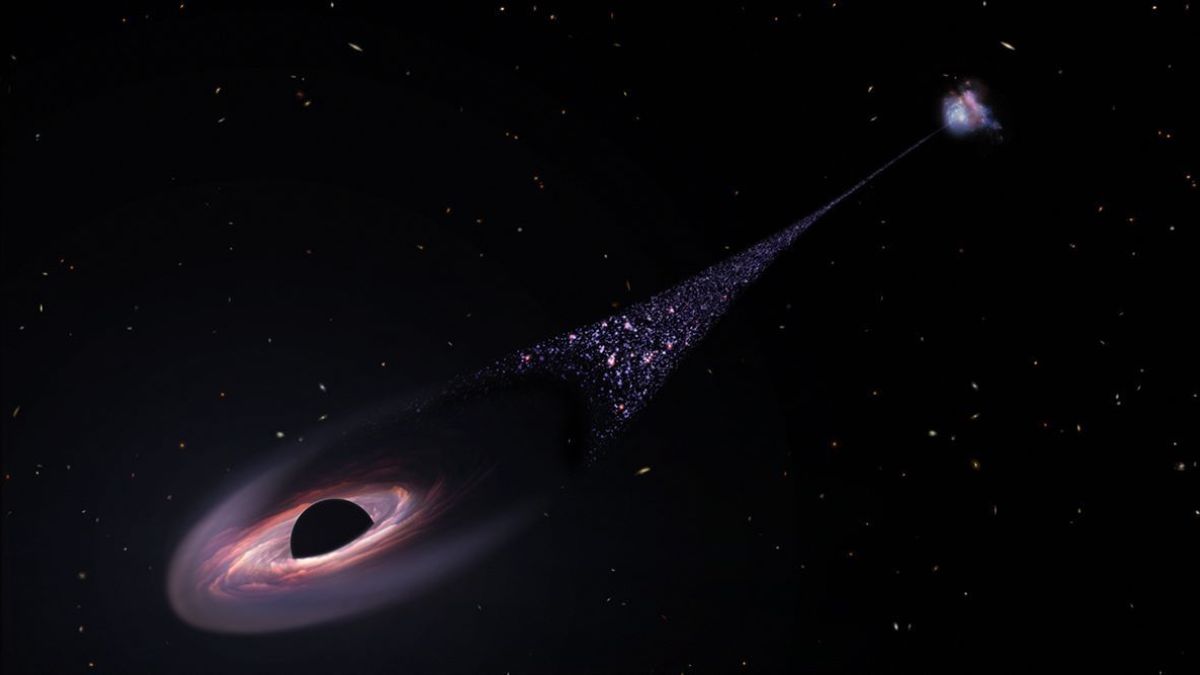
A black hole in a galaxy 450 million light-years away just woke up—and it’s already eating stars. Yes, you read that right. NASA recently confirmed that a black hole named HLX-1, long believed to be inactive, suddenly lit up with a powerful flare of X-rays. Why? Because it got hungry and pulled a star in too close, swallowing part of it in a dramatic cosmic event.
We’ve seen black holes do some wild things, but this one stands out. Here’s why this discovery could be a game-changer in the study of black holes—and maybe even help solve one of the biggest mysteries in space science.
Table of Contents
Types

Let’s talk about black holes for a second. Scientists have already confirmed two types:
- Stellar-mass black holes: These are born when giant stars collapse after exploding as supernovae. They can have up to 100 times the mass of the Sun.
- Supermassive black holes: These monsters sit at the centers of galaxies and can be millions or billions of times more massive than the Sun.
But here’s the mystery: if small ones can grow over time, shouldn’t there be intermediate-mass black holes somewhere in between? That’s the missing link, and until now, no one had solid proof of one.
HLX-1
This is where HLX-1 comes in. Discovered in 2009, HLX-1 immediately stood out because it was giving off very bright X-rays—a sure sign that something powerful was happening.
By 2012, those X-rays had grown 100 times brighter than in 2009. Then, in 2023, the brightness started fading. This change helped researchers estimate the size of whatever was causing the light.
And guess what? It didn’t fit the profile of a small black hole. But it also wasn’t strong enough to be a supermassive one. That led the team, led by scientist Yi-Chi Chang, to a new conclusion: HLX-1 could be that long-sought middle type—an intermediate-mass black hole, with a mass between 1,000 and 10,000 times that of the Sun.
Clues
Why do the X-rays matter so much? Simple: the more massive a black hole is, the brighter the X-rays it emits when it pulls in matter.

In HLX-1’s case, the light wasn’t just bright—it was too bright for a small black hole and not quite enough for a giant one. That puts it right in the middle, the sweet spot where astronomers believe intermediate black holes should exist.
Scenarios
Even though they’ve seen the X-ray flare, scientists still aren’t sure exactly what happened. There are two possible explanations:
- The black hole devoured a star all at once, causing a massive and sudden burst of light.
- The star was orbiting the black hole, and every time it passed close by, the black hole pulled off a little more material, causing repeated flares.
Astronomer Roberto Soria says they now have to wait and watch. His words: “Now we need to see if it’s flaring multiple times, or there was a beginning, a peak, and now it’s just going to go down all the way until it disappears.”
Impact
If HLX-1 really is an intermediate-mass black hole, this would be a huge leap forward. It could finally explain how supermassive black holes form—by slowly growing from these intermediate stages.
It would also fill in the gap in our knowing of how black holes evolve. Until now, scientists have been missing that middle chapter in the story, and HLX-1 could be the missing piece of the puzzle.
| Black Hole Type | Mass (Compared to Sun) | Known Examples |
|---|---|---|
| Stellar-Mass | Up to 100× | Many |
| Intermediate-Mass | 1,000–10,000× | HLX-1 (Possible) |
| Supermassive | Millions to billions× | Most galaxy centers |
Future
Now, all eyes are on HLX-1. Will it flare again? Will the light fade away? These questions could take years to answer, but they’re crucial for knowing one of the universe’s most fascinating and mysterious objects.
The idea that something so massive, so far away, and so ancient can suddenly become active again—after millions of years—is nothing short of amazing. It’s like watching a sleeping giant wake up in deep space.
FAQs
What is HLX-1?
A black hole 450 million light-years away emitting bright X-rays.
Why is HLX-1 special?
It may be the first proven intermediate-mass black hole.
What caused the flare?
Likely a star being consumed by the black hole.
How big is HLX-1?
Estimated to be 1,000–10,000 times the Sun’s mass.
What are scientists doing now?
Observing HLX-1 to see if it flares again.