The ocean hides more secrets than we ever imagined. Far below the surface, in pitch-black waters where no sunlight reaches, scientists have stumbled upon something massive—something so unexpected that it rewrites what we thought we knew about life in the deepest parts of the sea.
Beneath layers of volcanic rock in the Pacific Ocean, they discovered an underwater world teeming with life, where creatures survive in complete darkness, without sunlight, and against all odds. Ready to cut into this incredible find?
Table of Contents
Discovery
A team of marine scientists was exploring a remote volcanic region deep in the Pacific Ocean. This area was so far down that it’s untouched by sunlight—an alien-like world full of mystery. While using a remote-operated submarine, they made a game-changing discovery: hidden underwater caves sealed beneath massive rock slabs.
As the robotic arm lifted the rocks, dark, open caverns appeared beneath the seafloor—uncharted and unseen for who knows how long. This was no ordinary crack in the ground; it was an entrance to a hidden ecosystem.
Caverns
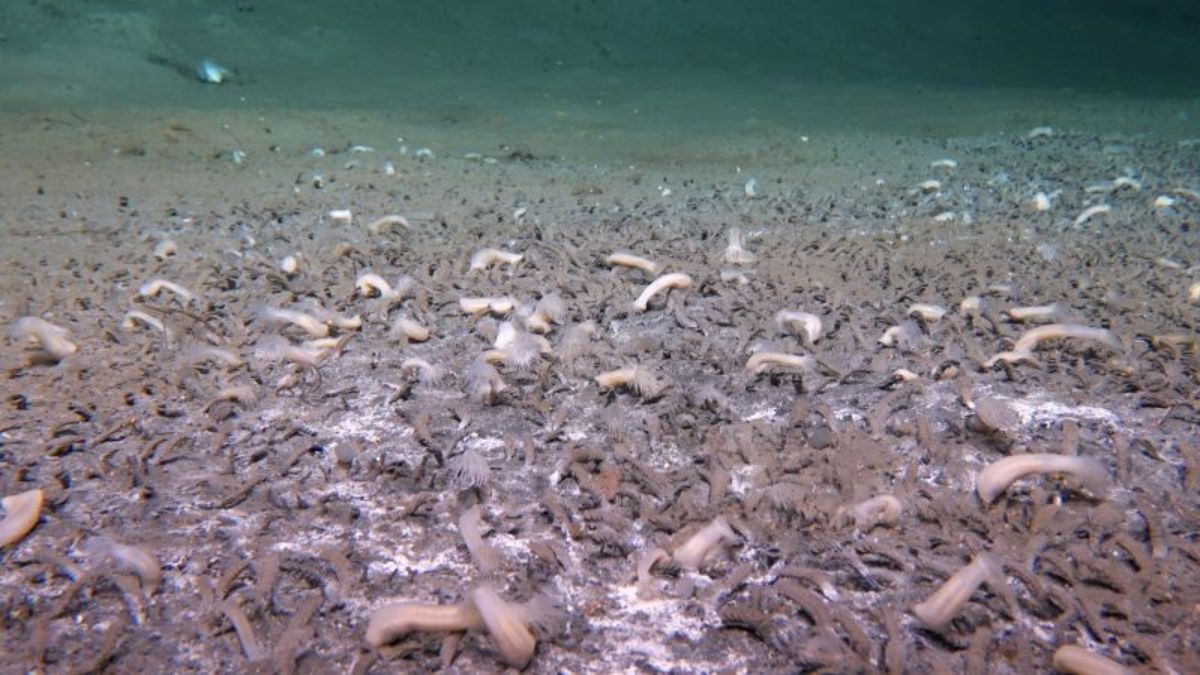
Once inside, the scientists uncovered what looked like something straight out of science fiction. Towering tube worms, known scientifically as Riftia pachyptila, stretched nearly half a meter long. These strange, red-tipped creatures were clinging to the cave walls like soft underwater stalagmites.

But here’s the kicker—they don’t eat like normal animals. Instead of mouths and stomachs, they host bacteria that convert chemicals from the ocean into food. This process, called chemosynthesis, is how life exists here, completely independent of sunlight. It’s like the bacteria are running tiny kitchens inside the worms, cooking up nutrients out of seawater chemicals.
Stability
What really amazed scientists was the temperature. Despite being so deep underwater, the caves maintained a consistent temperature of 24°C (about 75°F). In the open ocean, temperatures in deep zones can fluctuate or stay near freezing.
This warm, stable environment creates a perfect shelter for life. It protects animals from harsh currents and gives conditions where other, possibly more complex, species could evolve safely. It’s like discovering a cozy, hidden bunker under the ocean—safe from the chaos outside.
Lifeforms

While the tube worms stole the spotlight, they may not be the only inhabitants. Since these caves were sealed off for who knows how long, scientists believe there could be species in there that we’ve never seen before.
That’s huge. It means evolution could have been quietly doing its thing in secret, shaping life forms that exist nowhere else on Earth. Every time we explore a place like this, we open a door to a world that’s been hidden in the dark for thousands—maybe millions—of years.
Impact
This discovery is more than just “cool science.” It builds on other research that found life in extreme underwater locations like hydrothermal vents—undersea hot springs where bacteria also turn chemicals into energy.
These finds prove that life doesn’t need light to thrive. It can survive in high pressure, zero sunlight, and chemical-filled waters. Basically, life finds a way. And this changes how we think about biology—not just on Earth, but possibly on other planets too.
| Comparison Factor | Typical Ocean Floor | Hidden Caves |
|---|---|---|
| Light Availability | None | None |
| Temperature Range | Cold (1–4°C) | Stable (24°C) |
| Known Species | Common deep-sea life | Possible new species |
| Energy Source | Organic material | Chemosynthesis |
Possibility
So what does this all mean? First, it shows just how little we know about the ocean. More than 80% of it is still unexplored. With each dive, each rock moved, we could be uncovering new ecosystems, new creatures, and entirely new forms of life.
Second, this opens up huge questions about Earth and beyond. If life can thrive without sunlight, just by feeding off chemicals and bacteria, could similar life exist on other planets or moons with harsh environments? Think Europa or Enceladus, moons with oceans beneath icy crusts—suddenly, the idea of alien life doesn’t seem so far-fetched.
And third, it reminds us that the deep sea is not just a spooky abyss—it’s a vibrant, mysterious frontier full of untapped potential. Like space, but wetter.
FAQs
What did scientists find under the ocean floor?
They discovered hidden underwater caves with giant tube worms.
How do tube worms survive without sunlight?
They rely on bacteria that perform chemosynthesis.
Why is the cave temperature important?
It stays stable at 24°C, ideal for life to thrive.
Are there unknown species in the caves?
Possibly, since the caves were sealed for a long time.
What does this mean for science?
It shows life can thrive in extreme, dark environments.