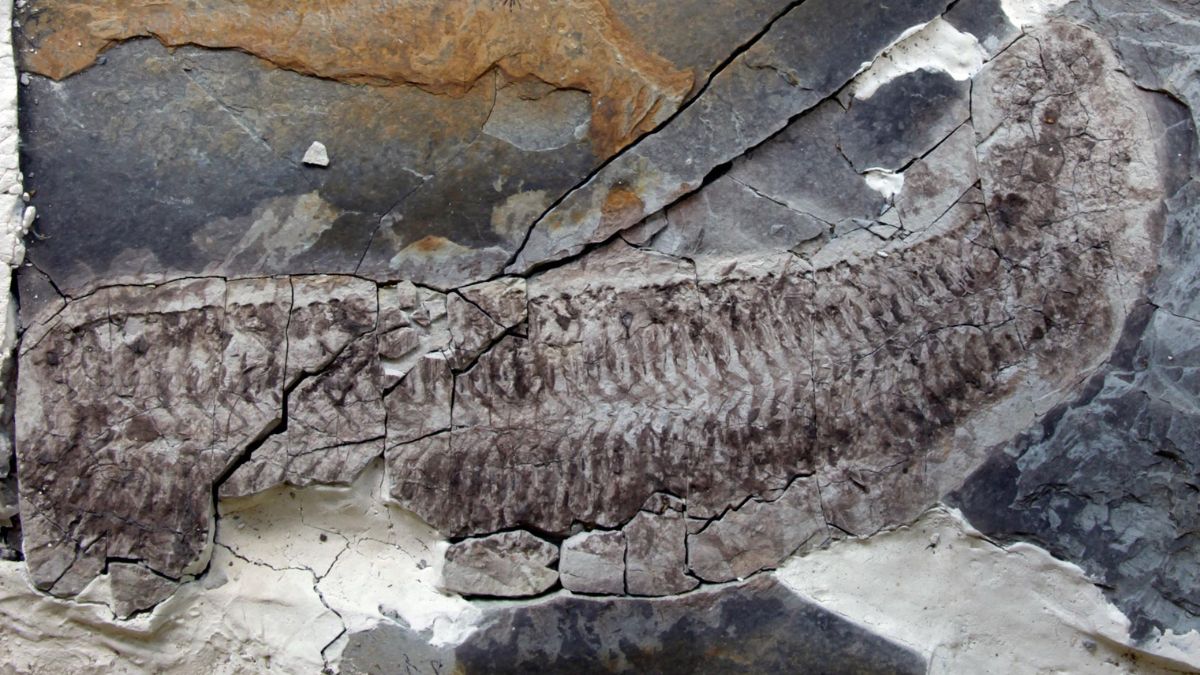
Imagine finding a fossil so old—444 million years—it predates dinosaurs, mammals, and even plants on land. Now imagine that this fossil, instead of just showing the usual bones or shells, preserved muscles, tendons, and intestines… but no head or limbs. Sounds unreal? Meet Sue, the most fascinating fossil discovery of the year.
It’s not just rare—it’s rewriting what we thought we knew about early life. And it’s giving a voice to creatures that, until now, left behind almost no trace.
Table of Contents
Sue
Let’s start with what Sue is… or rather, what it might be. Sue is a strange, soft-bodied marine arthropod—the same family as insects, crustaceans, and spiders. Officially named Keurbos susanae, it was found embedded in a rock in southern Africa over two decades ago by paleontologist Sarah Gabott.
But Sue isn’t just a fossil. It’s a time capsule, a snapshot of what life looked like nearly half a billion years ago. Unlike most fossils that preserve the outer shell, Sue is basically inside-out—no external body parts survived, but the soft internal organs did. That’s unheard of.
Inside
Typically, soft tissues like muscles and guts decompose quickly after death, leaving no fossil record. But Sue defied the rules. It turned up with no limbs or head, but an almost pristine internal anatomy. It’s the reverse of what usually happens. That’s why scientists are calling it a “reverse fossil”.
How

The secret to this insane level of preservation lies in the Soom Shale formation in South Africa. Back in the Ordovician period, that region was covered by a toxic, low-oxygen sea. That hostile environment—rich in hydrogen sulfide—killed off bacteria that would normally break down soft tissue.
Here’s the key: without bacteria, the body didn’t rot. Instead, clays and calcium phosphates replaced soft tissues before they decomposed. That’s how Sue’s muscles and tendons stayed intact for nearly half a billion years.
| What Normally Survives | What Survived in Sue |
|---|---|
| Shells, bones | Muscles, intestines |
| Hard exoskeletons | Tendons, soft tissue |
Mystery
So… what exactly is Sue?

That’s the million-year-old question. Without a head, limbs, or outer features, scientists can’t pin it down. It doesn’t resemble anything else. The only thing clear is that Sue had a segmented trunk, suggesting it once had appendages—maybe legs or fins—but we may never know.
Researchers agree it was a primitive euarthropod, but where it fits on the evolutionary tree remains a mystery. Sue is the only known fossil of its kind. A true loner in the fossil record.
Story
What makes Sue’s story even more touching is its personal twist. Paleontologist Sarah Gabott found it when she was just starting her career. For over 20 years, she studied the fossil in secret, trying to make sense of it.
She named the fossil after her mother, Susan, who eventually gave her the push she needed to publish:
“Sarah, if you’re going to name that fossil in my honour, do it before I end up in the ground myself, fossilized.”
So, Gabott published her findings in 2025, showing the world that patience—and a little motherly encouragement—can lead to some of the most exciting science of our time.
Evolution
Sue also brings up a bigger question: How much of life’s history have we missed?
Most fossils we study come from creatures with hard parts—bones, shells, or exoskeletons. But Sue proves there’s a hidden fossil world of soft-bodied creatures we’ve barely begun to uncover. These species probably lived all around ancient oceans, but left no trace—until now.
This discovery is sparking a whole new area of research: fossils with soft tissue, which could completely change how we view evolution, especially the early stages of complex life.
Future
Sue may not have limbs or a face, but she’s telling us more about the past than most fossils ever have. She’s proof that even after 444 million years, there are still secrets buried deep in Earth’s layers—waiting for the right person to uncover them.
And thanks to Sue, we now know that sometimes, the most important part of a fossil isn’t what’s missing—but what miraculously stayed behind.
FAQs
What is Keurbos susanae?
A 444-million-year-old fossil with preserved internal organs.
Why is Sue called an ‘inside-out’ fossil?
Because its soft tissues were preserved instead of its shell.
Where was Sue discovered?
In the Soom Shale formation near the Cederberg Mountains, South Africa.
How was Sue preserved for so long?
Toxic, low-oxygen conditions stopped decomposition and fossilized soft parts.
What does Sue tell us about evolution?
That soft-bodied life may be more common than fossil records suggest.