
Not all of Earth’s drama happens on land. Deep beneath the ocean’s surface, a mysterious and hyperactive underwater volcano is shaking things up—literally. Welcome to the Juan de Fuca ridge, home to Axial Seamount, an underwater volcano responsible for more than 1,000 earthquakes every single day. Sounds wild, right? But this isn’t science fiction. It’s a real geological event that has scientists on high alert.
Table of Contents
Mystery
Axial Seamount sits quietly on the ocean floor, but don’t let the silence fool you. It’s one of the most active volcanoes on the planet. With the help of cutting-edge monitoring tech from the Ocean Observatories Initiative’s Regional Cabled Array, scientists are keeping their eyes (and sensors) glued to this deep-sea troublemaker in real time.

What they’ve discovered is a rare and powerful phenomenon: a quake storm. That’s not your average earthquake activity — it’s a nonstop barrage of tremors that shake the seafloor every few minutes. It’s a sign of massive energy being stored and possibly released soon.
Life
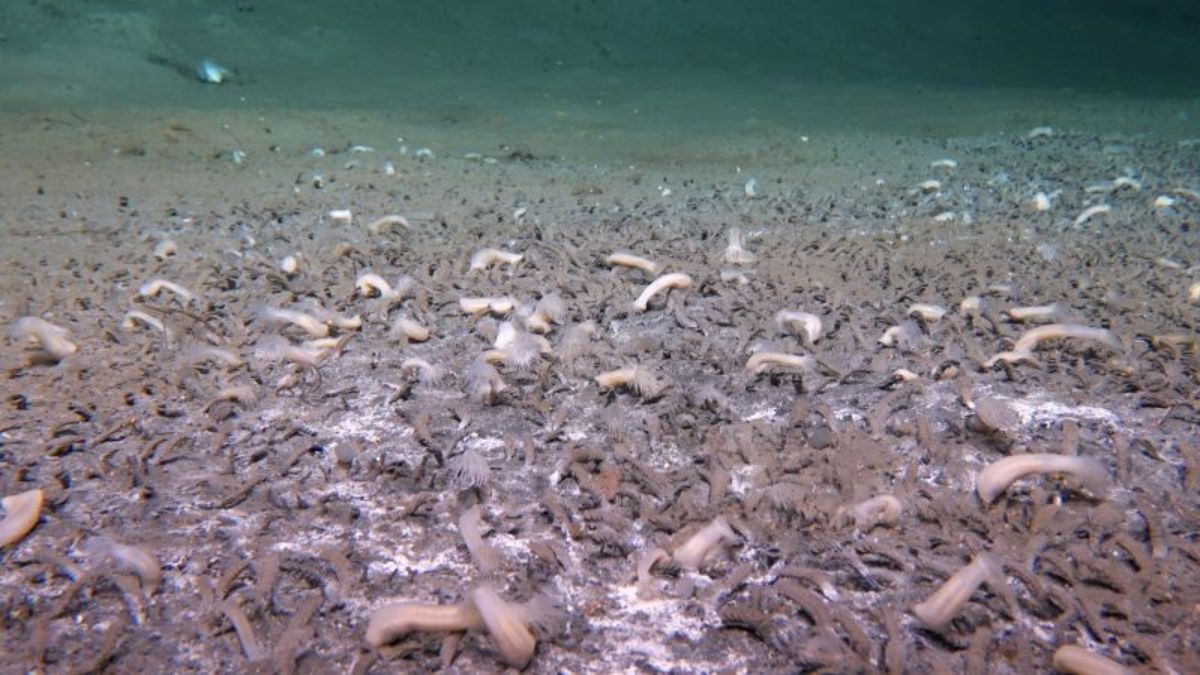
Interestingly, this ridge isn’t just active — it’s alive. Despite its intense seismic behavior, Axial Seamount supports vibrant marine ecosystems. Creatures thrive in these extreme conditions, offering researchers a unique glimpse into nature’s ability to adapt and survive. Even with magma pushing upward and the ocean floor shaking constantly, life finds a way to flourish.
That’s what makes this volcano both a scientific goldmine and a biological wonder.
Volcanoes

To get a better sense of what makes Axial Seamount unique, let’s break down the types of volcanoes out there:
| Type | Description |
|---|---|
| Shield | Wide, sloped, slow lava flows |
| Strato (Composite) | Steep, cone-shaped, explosive |
| Cinder Cone | Small, steep, made of volcanic fragments |
| Underwater | Beneath the sea, forms features like pillow lava |
Axial Seamount belongs to the last group — underwater volcanoes. These are harder to study due to their location, but they offer unmatched insight into Earth’s internal mechanics.
Watching
Axial Seamount is no stranger to eruptions. It blew in 1998, 2011, and again in 2015. Each time, it followed a pattern: the seafloor inflated as magma built up, seismic activity increased, and then boom — eruption.

Here’s the pattern in a nutshell:
- Magma rises beneath the volcano
- The ocean floor starts to bulge
- Earthquakes begin increasing
- Eruption follows shortly after
Now in 2025, we’re seeing the same warning signs. The seafloor is once again rising, and the daily quake count has surged past 1,000. If the past is any guide, another eruption could be just around the corner.
Monitoring
Why keep such a close eye on an underwater volcano? Because each quake, each inch of inflation, tells a story about the Earth’s internal processes. Tracking these movements helps geologists understand how magma behaves and how pressure builds beneath the surface.
Thanks to the Ocean Observatories Initiative’s technology, scientists get live data that lets them compare current activity to past eruptions. That kind of insight is priceless when trying to predict future behavior.
Eruptions
But there’s more to Axial Seamount than potential eruptions. The technology watching it also gives researchers access to rare deep-sea lifeforms. These organisms survive in near-boiling temperatures, complete darkness, and shifting sea beds — conditions that would kill most life on Earth.
Studying these creatures gives scientists clues about life’s resilience and maybe even how it could exist on other planets with similar extreme environments.
Future
So, will Axial Seamount erupt in 2025? All the signs point to yes, but predicting volcanic eruptions is tricky business. Even with all the instruments and experience, nature doesn’t always follow the rules.
What’s certain is this: Axial Seamount is no longer a hidden giant. With over 1,000 quakes a day and a history of major eruptions, it’s changed how we think about seismic activity under the sea. Whether it erupts next week or next year, it’s already made waves — and it’s not done yet.
FAQs
Where is Axial Seamount located?
It’s on the Juan de Fuca ridge under the Pacific Ocean.
Why does Axial Seamount shake so much?
Due to rising magma and tectonic activity beneath it.
How many quakes happen daily?
Over 1,000 earthquakes occur every single day.
Has Axial Seamount erupted before?
Yes, in 1998, 2011, and 2015.
Is another eruption expected soon?
Yes, signs suggest an eruption may occur in 2025.