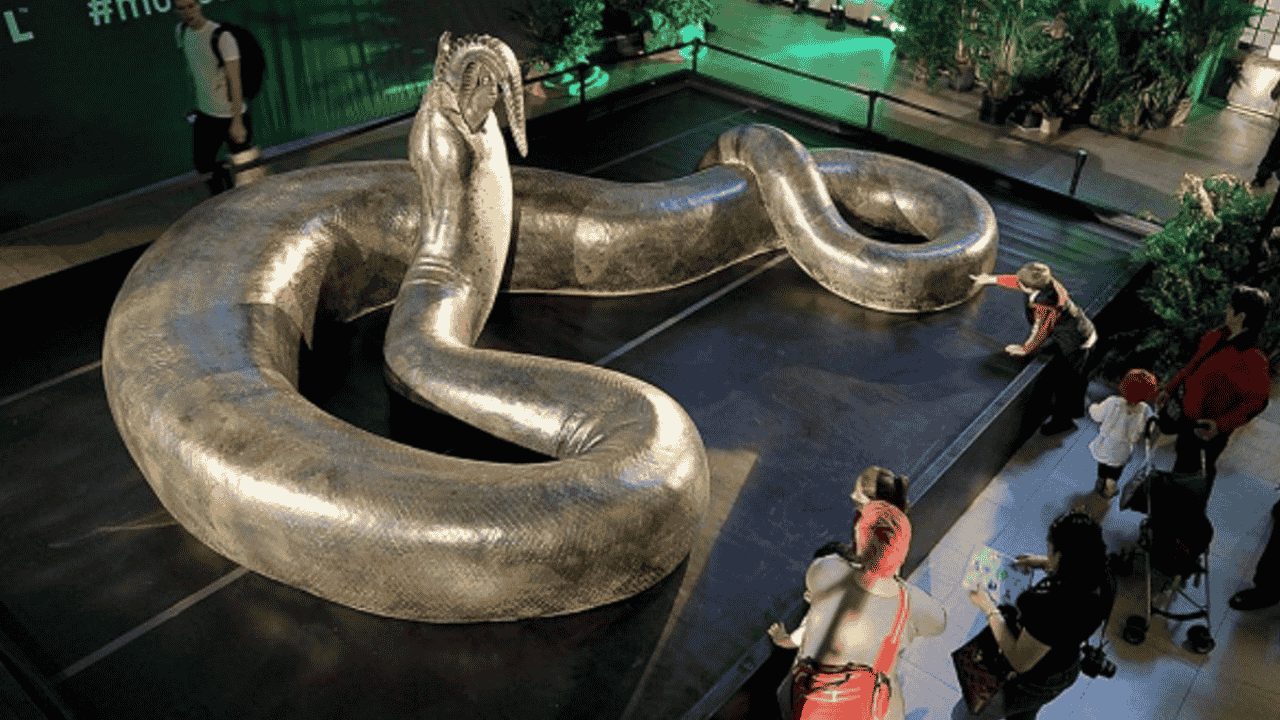
Picture a snake so massive it could swallow an entire crocodile without flinching. Meet Titanoboa cerrejonensis—a prehistoric serpent so enormous it makes even the world’s biggest anacondas look like shoelaces. When scientists unearthed its fossils in northern Colombia back in 2009, they didn’t just find a record-breaking reptile—they cracked open a time capsule from a world that existed 58 million years ago, right after the dinosaurs vanished.
Table of Contents
The World Titanoboa Ruled
The stage was the Paleocene epoch, a humid, steaming interval between 58 and 60 million years ago. The planet was still recovering from the asteroid impact that wiped out the dinosaurs. Forests were spreading across tropical regions, filling the air with strange new life—primitive mammals, early crocodilians, and enormous fish. And lurking in those swamps was Titanoboa, the undisputed apex predator of its age.
The discovery came from the Cerrejón coal mine in northern Colombia—today one of the largest open-pit coal operations on Earth, but once an ancient river delta teeming with life. In those fossil beds, paleontologists from the Smithsonian Tropical Research Institute and the University of Florida uncovered vertebrae so massive they initially thought they belonged to a crocodile. Then came the realization: this was a snake, and not just any snake—a monster that stretched more than 40 feet long.
How Big Are We Talking?
Try to picture this: Titanoboa could grow up to 46 feet (14 meters) in length and weigh over 2,500 pounds. That’s roughly the size and weight of a school bus—except this one could slither. Compared to the modern green anaconda, the reigning heavyweight champion of today’s snakes, Titanoboa was nearly 30% longer and at least ten times heavier.
| Snake Species | Maximum Length | Estimated Weight | Era |
|---|---|---|---|
| Titanoboa cerrejonensis | 46 ft (14 m) | ~2,500 lbs (1,135 kg) | 58–60 million years ago |
| Green Anaconda | 30 ft (9 m) | ~550 lbs (250 kg) | Modern |
| Reticulated Python | 33 ft (10 m) | ~350 lbs (160 kg) | Modern |
The name Titanoboa literally means “titanic boa,” and it earned every letter of it.
The Predator That Crushed, Not Bit

Unlike vipers or cobras, Titanoboa wasn’t venomous. It was a constrictor, wrapping its thick, muscular body around prey and squeezing until the animal’s heart stopped. Early theories suggested it hunted crocodile-sized reptiles. But later fossil evidence—including distinctive teeth and jaw shapes—revealed a different menu: fish. Huge, armor-scaled fish that cruised through the swampy rivers of ancient Colombia.
Researchers found fish fossils bearing marks consistent with a crushing constrictor attack, suggesting Titanoboa hunted much like today’s anacondas—lying submerged, ambushing anything foolish enough to swim close.
“Titanoboa was the king of its ecosystem,” said Dr. Jason Head of the University of Cambridge, one of the scientists who identified the species. “It tells us not just about size, but about how climate shaped life after the dinosaurs.”
Built by Heat: What Titanoboa Revealed About Earth’s Climate
Titanoboa’s gargantuan size wasn’t just genetic luck—it was environmental. Cold-blooded animals (ectotherms) depend on external heat to regulate body temperature. For a reptile that large to survive, the climate must have been much warmer than today’s tropics.
By modeling Titanoboa’s metabolic requirements, scientists estimated that the average temperature in its habitat ranged between 86°F and 93°F (30–34°C)—a finding later confirmed by independent geologic studies of ancient plant and soil chemistry.
That discovery reshaped how scientists viewed post-dinosaur Earth. It proved that tropical ecosystems could thrive at extreme temperatures—and offered a prehistoric warning about what might happen if global temperatures rise again.
According to the Smithsonian Tropical Research Institute (strI.si.edu), Titanoboa’s fossils became a vital reference point for climate modeling, showing that warming trends directly affect animal physiology and biodiversity.
A Window Into Evolution
Titanoboa’s world was one of rebirth. With the dinosaurs gone, reptiles, birds, and mammals were competing to fill ecological gaps. The Cerrejón fossils—including giant turtles (Carbonemys) and early crocodilians (Cerrejonisuchus)—show that life bounced back fast. Titanoboa sat on top of that recovery, its sheer size proving that life on Earth wasn’t just surviving; it was thriving in a furnace-like environment.
The Message Hidden in the Fossils
For scientists, Titanoboa isn’t just an extinct snake—it’s a climate clue. It showed that Earth’s tropical regions can produce giants when temperatures soar. But it also hinted at the limits: even cold-blooded titans can only grow so large before the heat becomes lethal.
In an era when the planet’s temperature is once again climbing, Titanoboa serves as both a marvel and a warning. If history tells us anything, it’s that life adapts—but not without consequences.
FAQs
How big was Titanoboa compared to a modern anaconda?
Titanoboa was about 30% longer and up to ten times heavier than today’s green anaconda.
Did Titanoboa live with dinosaurs?
No, it appeared several million years after the dinosaurs went extinct.
Could Titanoboa eat a crocodile?
Probably, though it preferred giant fish. But it was certainly capable of taking down large reptiles if needed.
What caused Titanoboa’s extinction?
Cooling global temperatures likely made the tropics too cold for such a massive cold-blooded reptile to survive.
Can anything like Titanoboa exist today?
Not under current climate conditions. Today’s cooler tropics limit how large snakes can grow.