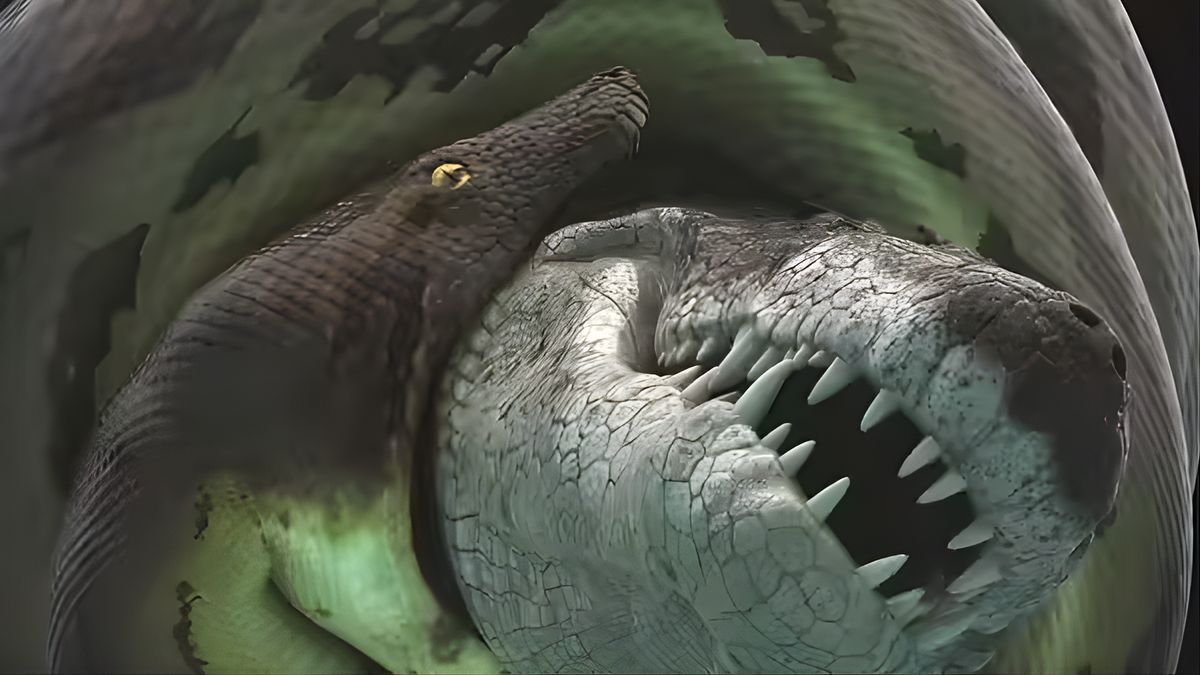
Imagine a snake so massive it weighs more than a car and stretches longer than a school bus. Sounds like a scene from a horror movie, right? Well, it’s real. Scientists have uncovered fossils of Titanoboa cerrejonensis, the largest and heaviest snake ever known to slither across our planet—far outclassing any anaconda or python we’ve seen today.
This prehistoric giant lived over 58 million years ago and is making waves in the world of science. Let’s unravel what’s known about this monstrous serpent.
Table of Contents
Titanoboa
The name might sound like something out of a sci-fi film, but Titanoboa cerrejonensis is very real. This species holds the record as the largest snake in Earth’s history. Until recently, anacondas and pythons were considered the heavyweight champs of the snake world, but Titanoboa makes them look like garden hoses in comparison.
This discovery has changed what we know about ancient reptiles, ecosystems, and even Earth’s climate at the time.
Timeline
Titanoboa lived during the Paleocene epoch, around 58 to 60 million years ago. That’s shortly after the dinosaurs went extinct—a period of major transformation on Earth when new species began to evolve and fill the gaps left behind by the prehistoric giants.

Fossils of this enormous snake were uncovered in 2009 at the Cerrejón coal mine in northern Colombia. Back then, this region was a dense, humid rainforest, perfect for large cold-blooded reptiles. This mine has become a hotspot for rare and significant fossil discoveries.
Size
Let’s talk numbers. This snake was estimated to grow up to 13–14 meters long—that’s roughly 42 to 46 feet. Imagine a snake the length of a city bus slithering through swamps and rivers. Even more impressive? It likely weighed over 1,000 kilograms, or more than a small car.
Take a look at this comparison:
| Snake Species | Length (meters) | Weight (kg) |
|---|---|---|
| Titanoboa | 13–14 | 1,100+ |
| Green Anaconda | Up to 6 | Up to 250 |
| Reticulated Python | Up to 7 | Up to 160 |
It’s not just big—it’s colossal.
Hunting
Despite its size, Titanoboa wasn’t venomous. It didn’t need to be. It killed using brute strength, wrapping its powerful body around its prey and squeezing tighter each time the victim exhaled—until the animal could no longer breathe. Once it was dead, Titanoboa unhinged its jaw and swallowed it whole, head-first.
Classic constrictor behavior, just on a much larger and deadlier scale.
Diet
For a long time, scientists believed that Titanoboa fed on large mammals or reptiles, based on its size. But recent fossil discoveries suggest otherwise. They found that its teeth were loosely set in its jaw, which isn’t typical for meat-tearing snakes.
So, what does that mean? Titanoboa was likely a water snake, much like today’s anacondas. And its primary diet? Fish—large ones. It cruised through tropical rivers and lagoons, snatching fish with its wide jaws and swallowing them whole.
Climate
Being cold-blooded, Titanoboa relied on its environment to regulate body temperature. For a creature that massive to stay active, the surrounding climate had to be very warm. Scientists estimate that the tropical regions where Titanoboa lived had to be between 86°F and 93°F.
This perfectly lines up with the global temperatures of the Paleocene period, giving researchers even more insight into how ancient climates supported such megafauna.
Impact
This discovery is more than just an exciting fossil find. It gives scientists a clearer view of Earth’s climate history and the biodiversity that emerged after dinosaurs disappeared. It shows how ecosystems once supported creatures of unbelievable size and helps us understand how the planet has evolved since then.
Titanoboa doesn’t just rewrite what we know about snakes—it reshapes the way we view prehistoric life as a whole. From climate to ecosystems to evolutionary biology, this massive snake is a massive clue into our planet’s mysterious past.
FAQs
How long was Titanoboa?
Titanoboa could reach up to 14 meters in length.
Where was Titanoboa discovered?
In the Cerrejón coal mine, northern Colombia.
What did Titanoboa eat?
Mainly large fish from rivers and lagoons.
Did Titanoboa have venom?
No, it killed prey by constriction.
Why is Titanoboa important?
It helps scientists understand ancient climates and ecosystems.