Sometimes history pops up when you least expect it. That’s exactly what happened in 1996 near the quiet town of Kennewick, Washington. Two men out to enjoy a boat race ended up uncovering one of the most controversial and significant archaeological discoveries in North American history: a nearly 9,000-year-old skeleton that would spark debate, lawsuits, and eventually, a powerful moment of cultural recognition.
Let’s cut into the story of the Kennewick Man—also known as The Ancient One—and how he changed what we thought we knew about the first people of America.
Table of Contents
Discovery

It was just a regular summer day when Will Thomas and David Deacy decided to enjoy some outdoor fun by the Columbia River. While walking along the riverbank, something unusual caught their eye. It was a human skull.
Now imagine stumbling upon that. Most people would probably panic, but Thomas and Deacy did the right thing—they contacted the authorities. What followed was a whirlwind of research and legal drama that no one could have predicted.
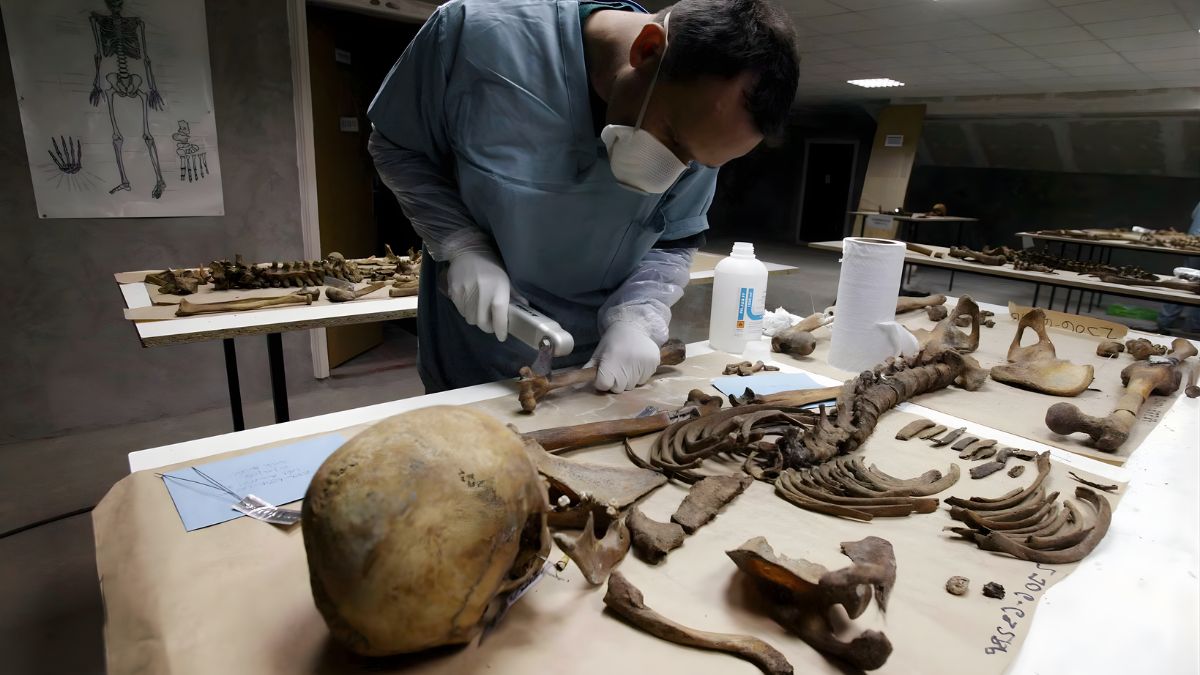
At first glance, it looked like a one-off historical find. But after examination, scientists realized this wasn’t just an old skull—it was part of an almost complete skeleton dating back more than 8,400 years. The find was named the Kennewick Man, or by many Indigenous communities, The Ancient One.
Identity

So who was this man?
Initial studies revealed he was a physically strong man in his forties, likely a coastal hunter. But what really shocked researchers was the injury in his hip—a stone spear tip embedded in the bone. This wound had healed, meaning he survived what would’ve been a life-threatening attack in his time.
But it wasn’t just his physical condition that made headlines. It was the shape of his skull. Some early scientists thought the skull didn’t match those of modern Native Americans, which led to a wave of theories suggesting Kennewick Man came from an entirely different group of people, possibly even a separate migration. That sparked a massive debate—was he an ancestor of the region’s Indigenous people or someone else entirely?
Conflict

As word of the discovery spread, local Native American tribes stepped forward. For them, this wasn’t just a skeleton. It was a sacred ancestor.
Tribes from the region, including the Umatilla, Yakama, and Nez Perce, requested the remains be returned for proper burial under the Native American Graves Protection and Repatriation Act (NAGPRA). However, scientists pushed back. They argued the remains were too old to be definitively linked to modern tribes and wanted more time to study the skeleton.
This disagreement turned into a legal standoff that lasted nearly 20 years. The case involved anthropologists, tribal leaders, lawyers, and even the U.S. Army Corps of Engineers, since the skeleton was found on federal land.
DNA
The turning point came in 2015.
Thanks to advances in genetic testing, scientists were finally able to extract and analyze the Kennewick Man’s DNA. The results were crystal clear—he was genetically linked to modern Native American tribes in the region.
That settled it. The Kennewick Man was not some unrelated stranger—he was, without a doubt, a direct ancestor of the Indigenous peoples who had long claimed him.
Burial
With the science finally backing the tribes’ claims, the legal battle came to an end. In February 2017, more than 200 people took part in a private tribal burial ceremony to lay the Ancient One to rest.
It was a powerful and emotional moment—one that brought together generations of science, tradition, and belief.
Impact
This story isn’t just about an old skeleton. It’s about how science and culture sometimes clash—and how they can eventually come together with respect.
The Kennewick Man changed the history books. He confirmed what Indigenous tribes had been saying for generations: their roots in North America run deeper than many had acknowledged. The case also showed the world why it’s so important to respect Indigenous voices and traditions in the scientific process.
Here’s a simple breakdown of the timeline:
| Year | Event |
|---|---|
| 1996 | Skeleton found by two men in Kennewick |
| 2000 | Legal battle begins over rightful custody |
| 2015 | DNA confirms Indigenous connection |
| 2017 | Kennewick Man finally laid to rest |
The story of the Kennewick Man teaches us more than just history—it teaches us to listen, to collaborate, and to honor those who came before us.
FAQs
Who found the Kennewick Man?
Will Thomas and David Deacy discovered the skeleton in 1996.
How old is the Kennewick Man?
The skeleton is about 8,400 to 9,000 years old.
Why was there a legal conflict?
Tribes wanted to bury him, scientists wanted to study him.
What solved the debate?
DNA analysis proved his link to Native American tribes.
When was he reburied?
The Kennewick Man was buried in a tribal ceremony in 2017.