Imagine this: you’re helping out after a big storm in your neighborhood, and suddenly, you spot massive footprints in the mud—ones that don’t belong to any living animal today. That’s exactly what happened recently in Texas. A devastating flood revealed a hidden piece of the prehistoric past, turning a day of destruction into a moment of wonder.
Let’s walk through this unbelievable discovery and see how one natural disaster exposed a treasure buried for over 100 million years.
Table of Contents
Storm

It all started in July when a powerful storm swept across Texas Hill Country. The floodwaters were intense, rising up to six meters in some areas. Roads were washed away, trees uprooted, cars floated down the streets, and sadly, more than 100 lives were lost. Entire communities were left devastated.
In the middle of this chaos, volunteers and rescue workers did all they could to help those affected. But amid all the debris and destruction, something unexpected came to light—literally.
Tracks
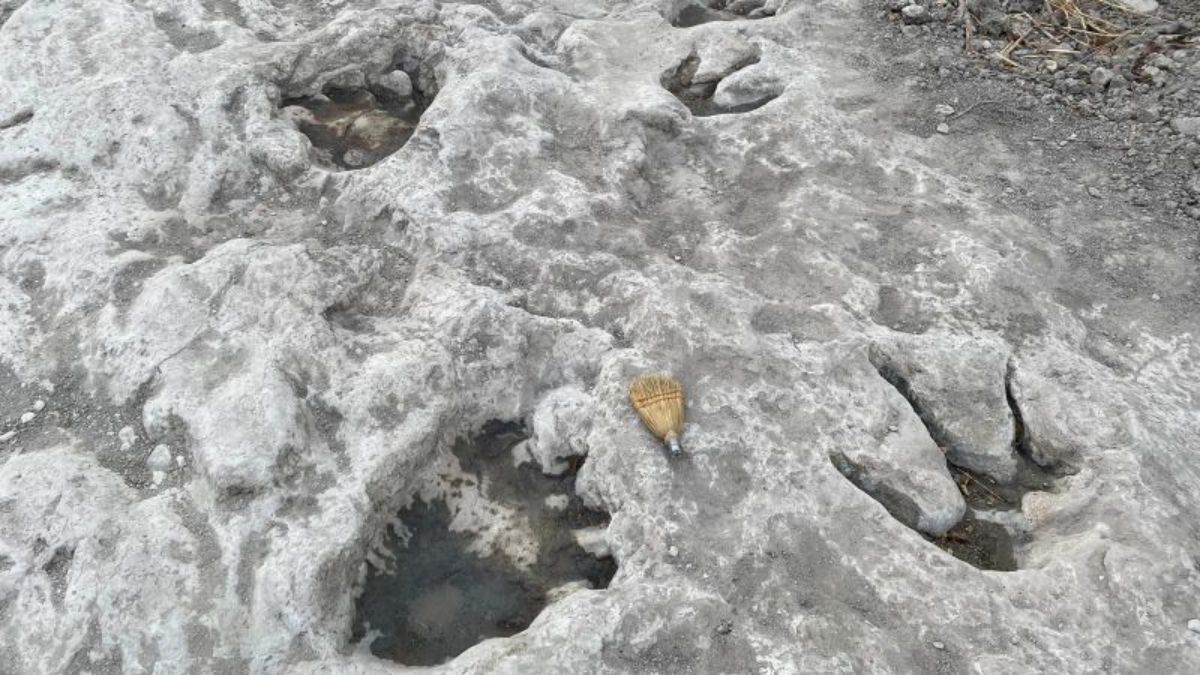
As the floodwaters pulled back in Sandy Creek, Travis County, they left behind more than just mud and damage. A sharp-eyed volunteer noticed something odd in the newly exposed ground: a series of massive three-toed footprints.

Turns out, these weren’t just random impressions—they were dinosaur tracks. In total, 15 prints were found, each one measuring between 45 and 50 centimeters. That’s nearly half the length of a grown adult’s leg. Can you imagine spotting those in your own backyard?
Acrocanthosaurus
Experts were called in to investigate, and they identified the footprints as belonging to the Acrocanthosaurus. This dinosaur lived around 110 million years ago during the Early Cretaceous period. It was a fierce predator, walking on two legs, and growing up to 11 meters in length.
Think of it as a cousin of the T. rex, but slightly older and with a distinctive ridge along its back. The fact that it left such clear tracks behind tells us that the area was once a soft, muddy surface—probably the edge of an ancient lake or riverbed.

Here’s a quick breakdown of what we know about this dinosaur and its tracks:
| Feature | Detail |
|---|---|
| Species | Acrocanthosaurus |
| Time Period | 110 million years ago |
| Size | Around 11 meters long |
| Footprint Size | 45–50 cm |
| Location Found | Sandy Creek, Texas |
| Found By | Volunteer during flood rescue |
Emotions
Normally, finding dinosaur tracks would be a cause for celebration. But this discovery came during a time of tragedy. For the scientific community, it’s an exciting find that offers new clues about prehistoric life. But for the local residents, it’s hard to feel joy when so many lost their homes, and worse, their loved ones.
So, this discovery stands as a bittersweet symbol—one that reminds us of both the fury of nature and its incredible ability to preserve the past.
Protection
After the tracks were identified, steps were quickly taken to make sure they’re protected. Cleanup crews were asked to avoid using heavy machinery around the area. The site was also marked off to prevent any damage.
Why so much caution? Because these footprints are more than just cool shapes in the rock—they’re a direct connection to the past. If preserved correctly, they can be studied by scientists for years to come and maybe even shared with the public through museums or educational tours.
Proof
So how do we know these tracks are over 100 million years old? They were found in a rock layer known as the Glen Rose Formation. This layer is well-known to geologists and paleontologists and dates back to the Early Cretaceous period.
Back then, the Acrocanthosaurus walked across soft, wet mud. Over time, those impressions filled with sediment, hardened, and turned into stone. Millions of years later, we’re lucky enough to see them, thanks to a flood that peeled back the earth just enough to reveal them.
Importance
Texas is already famous for its dinosaur tracks, with sites like Dinosaur Valley State Park drawing visitors from all over. But each new set of tracks adds something fresh to the puzzle.
Here’s why discoveries like this matter:
- They help identify which dinosaur species lived in the area.
- They offer clues about how dinosaurs walked and behaved.
- They allow scientists to recreate ancient landscapes.
- They inspire curiosity and wonder in people of all ages.
It’s like stepping back in time without needing a time machine. Just seeing those footprints can send your imagination running wild.
Sometimes, nature gives us unexpected gifts in the middle of chaos. That’s exactly what happened in Texas. One moment, it’s a disaster zone. The next, it’s a window into a forgotten world.
Finding a dinosaur’s footprints in your neighborhood isn’t something you see every day. It’s the kind of story that sticks with you—and maybe even changes the way you see the world beneath your feet.
Who knows? The next time a storm passes through your area, it might reveal more than just tree branches and puddles. It might just uncover a secret from millions of years ago.
FAQs
Where were the tracks found?
In Sandy Creek, Travis County, Texas.
Who found the dinosaur prints?
A volunteer during flood rescue efforts.
What dinosaur made the tracks?
The Acrocanthosaurus, a large carnivorous dinosaur.
How old are the footprints?
Between 110 and 115 million years old.
Why are the prints important?
They help scientists learn about ancient dinosaurs.