NASA and the European Space Agency have just shared a stunning new image from the Hubble Space Telescope—and it’s turning heads. The photo captures the galaxy NGC 2775, located roughly 67 million light-years away in the constellation Cancer. But this isn’t just another beautiful shot of the cosmos. It’s a curious case that astronomers are still trying to classify.
NGC 2775 has a strange blend of features. Its smooth center resembles an old elliptical galaxy, while its dusty, ringed outer structure looks like something from a spiral galaxy. So, what exactly is it? That’s what makes this discovery even more fascinating.
Table of Contents
Mystery
One look at NGC 2775, and it’s obvious this galaxy doesn’t fit neatly into any single category. The central region is unusually calm, with almost no gas. Normally, that would place it in the elliptical galaxy group—older, quieter galaxies that have stopped forming new stars.
But the outer ring tells a different story. There’s dust, gas, and scattered clusters of stars, which are classic features of spiral galaxies. This mix of traits has left scientists scratching their heads.
Could NGC 2775 be something in between?
Confusion

The main challenge in classifying galaxies like NGC 2775 is perspective. We only get to view it from one angle, which limits our understanding of its actual shape and depth. Some astronomers lean toward calling it a spiral because of its feathery, dusty arms. Others suggest it might be a lenticular galaxy—a type that combines traits from both spiral and elliptical galaxies.
Lenticular galaxies have a disk, like spirals, but often lack the well-defined arms. They also have smoother centers, more like ellipticals. NGC 2775 seems to land right in that confusing middle.
Formation
How do galaxies like this come to be? There are a few popular theories.
- One idea is that they started as spiral galaxies, but over time merged with others. These collisions stripped away their gas, halting star formation and leaving behind smoother, more aged cores.
- Another theory suggests they began as elliptical galaxies that later picked up some gas, which formed a disk and created a spiral-like appearance.
Either way, lenticular galaxies seem to represent a transition phase in galactic evolution. They’re like the cosmic equivalent of a teenager—not quite one thing or the other.
Evidence
Is there any proof that NGC 2775 went through such a transformation? Actually, yes. Scientists have found a long tail of hydrogen gas surrounding the galaxy. It stretches nearly 100,000 light-years out—far beyond what you’d expect from a regular galaxy.
This tail likely came from one or more smaller galaxies that got too close and were ripped apart by NGC 2775’s gravity. If true, it would explain the galaxy’s odd mix of smooth and messy features.
These signs of past galactic mergers are a clue that NGC 2775 has had a chaotic history, possibly swallowing up its neighbors along the way.
Flocculent
Despite the mystery, most astronomers currently categorize NGC 2775 as a flocculent spiral galaxy. What’s that?
Unlike well-known spirals like the Milky Way, flocculent galaxies don’t have clear, grand spiral arms. Instead, they have scattered patches of stars—tufts and clumps that look more like feathers or clouds than arms.
NGC 2775 fits that profile. The arms look broken or loosely wound, but they still follow a spiral-like pattern if you look closely enough.
Update
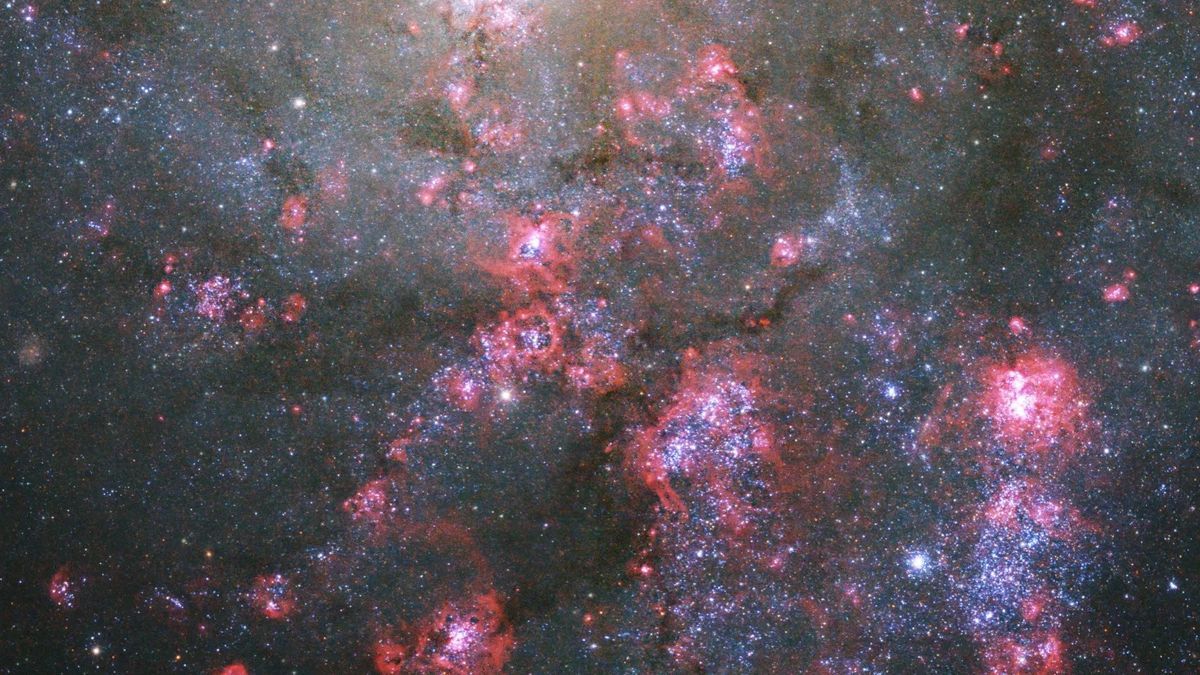
This isn’t Hubble’s first look at NGC 2775. Back in 2020, the telescope snapped an earlier image. What’s new this time is that astronomers added data from a special wavelength of red light that shows where hydrogen gas is glowing.
Hydrogen gas tends to light up near young, massive stars. In the new image, these glowing regions appear as bright pink clusters. This color signals where stars are currently being born—making the galaxy look less “dead” and more active than the smooth core might suggest.
So while NGC 2775 may seem calm at its heart, its outer edges are buzzing with activity.
Wonder
This new image isn’t just a technical win for astronomy—it’s a reminder of how complex and beautiful our universe is. Galaxies aren’t always simple swirls of stars. Some, like NGC 2775, are layered with history, marked by collisions, and filled with secrets we’re just starting to uncover.
And thanks to the Hubble Space Telescope, we get to witness these cosmic wonders up close. It’s a small window into the enormous and mysterious structure of our universe.
So next time you glance at the night sky, think about galaxies like NGC 2775—still forming stars, still evolving, and still challenging everything we thought we knew.
FAQs
What is NGC 2775?
It’s a galaxy located 67 million light-years away in Cancer.
Why is NGC 2775 hard to classify?
It has features of both spiral and elliptical galaxies.
What does ‘flocculent spiral’ mean?
It’s a galaxy with patchy, broken arms rather than clear spirals.
What did the Hubble image show?
Bright pink clusters where new stars are forming.
Is NGC 2775 still forming stars?
Yes, especially in the outer ring where gas clouds are found.