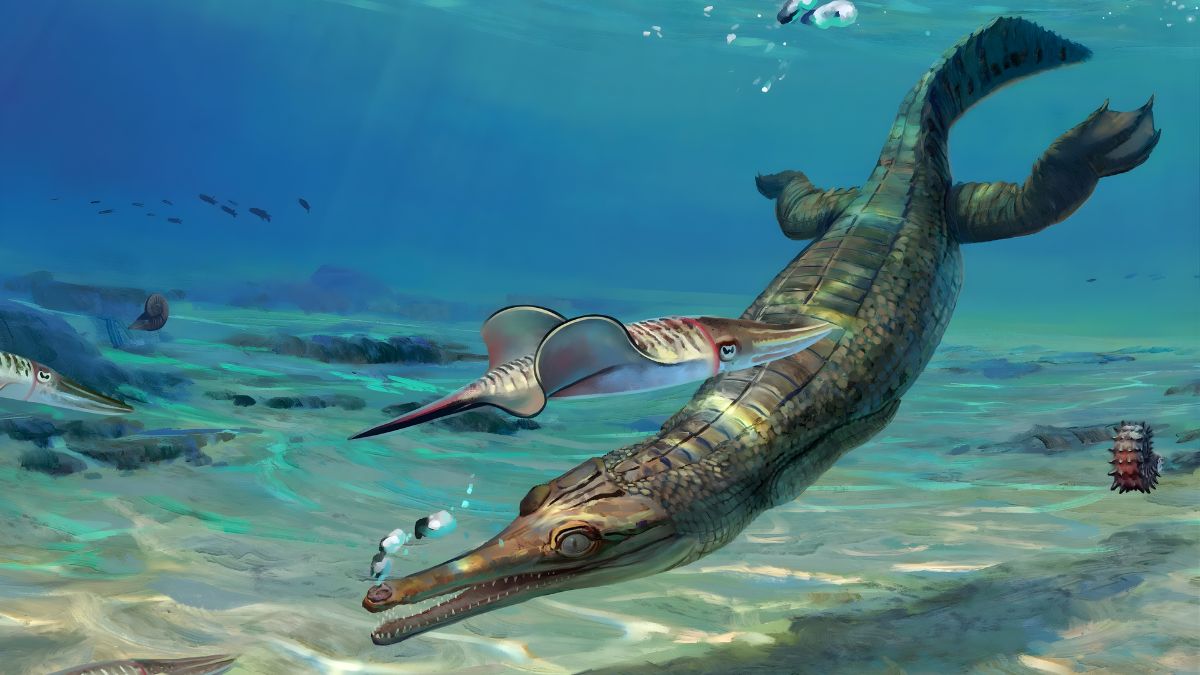
In the heart of the Egyptian desert, scientists have uncovered something incredible—a fossil of a strange, never-before-seen marine crocodile that lived about 80 million years ago. Named Wadisuchus kassabi, this fearsome creature is now believed to be one of the oldest known ancestors of marine crocodiles.
This discovery doesn’t just change the timeline—it reshapes everything we thought we knew about the origins of these ancient reptiles. And surprisingly, it all points back to Africa.
Table of Contents
Hunter
Imagine a crocodile measuring nearly four meters long, slicing through the warm coastal waters of ancient Africa. That was Wadisuchus kassabi, a sleek, powerful predator built for hunting. It had an oddly shaped snout—shorter than usual, yet more compact—and teeth like sharp needles, ideal for catching slippery prey like fish and turtles.
Unlike today’s crocodiles, which spend time on land and water, this one was fully aquatic. It had adaptations for life in the sea, moving quickly and efficiently through the water to ambush its prey. Scientists say it could swim long distances and dominate its environment.
Link
This fossil isn’t just about one species. It’s the missing link between land-based crocodiles and their fully marine relatives. Fossils found in the Kharga and Baris oases (now arid regions) include specimens from various life stages. That means researchers could study its development from young to adult—an incredibly rare find.

These fossils fill a gap in the evolutionary chain, showing how crocodiles transitioned from land-dwellers to ocean hunters.
Bite
One of the most fascinating details? Its bite.
The jaw of Wadisuchus includes a deep groove, a clue that it had an incredibly strong bite force. Its skull shows nostrils positioned at the top of its face—perfect for breathing at the surface without exposing itself, just like today’s whales or dolphins.
It also had fewer front teeth than expected—just four—making its jaw structure even more unique compared to its relatives. This suggests a powerful predator capable of cracking shells and tackling armored prey.
Desert
It’s hard to imagine, but the place where this fossil was found—the Quesir Formation—was once a tropical shoreline. Where sand dunes now stretch endlessly, there were once mangroves, lagoons, and warm shallow seas teeming with life.
This shows how much Earth’s environments have shifted over millions of years, and how much history is hidden beneath today’s deserts.
Origin
Forget Asia or the Americas—this fossil suggests that marine crocodiles began their story in Africa. Wadisuchus kassabi is now considered the direct ancestor of dyrosaurids, a group of marine crocodiles that would go on to survive the mass extinction event that wiped out the dinosaurs.
These survivors later spread across the globe, but their roots are firmly planted in African soil—and more precisely, in Egyptian rock.
Name
The name Wadisuchus kassabi has layers of meaning.
“Wadi” means “valley” in Arabic, pointing to the region where the fossil was found. “Suchus” comes from Sobek, the ancient Egyptian crocodile god, often associated with strength and fertility. And “kassabi” honors Egyptian paleontologist Ahmed Kassab, a pioneer in the field.
This discovery was made possible by the Mansoura University Vertebrate Paleontology Center (MUVP), which is quickly becoming a global leader in fossil research. The team is using 3D scanning and digital reconstructions to bring long-extinct creatures back to life on screen.
Threat
But there’s a problem.
Much of Egypt’s fossil-rich desert is under threat from urban expansion and farming. Roads, buildings, and fields are slowly eating into untouched fossil zones before scientists even get a chance to explore them.
That’s why paleontologists are calling for protection. These aren’t just bones—they’re pages of Earth’s deep history. Once a fossil is destroyed, its story is lost forever.
Legacy
Wadisuchus kassabi does more than add a new creature to the record books. It reinforces Africa’s critical role in the history of life and evolution. Egypt, long known for its pharaohs and pyramids, is also becoming known for something even older—prehistoric giants that once ruled the seas.
This ancient marine predator is a reminder that deserts can speak. And sometimes, they roar with stories from 80 million years ago.
FAQs
What is Wadisuchus kassabi?
An ancient marine crocodile species found in Egypt’s desert.
How old is the fossil?
About 80 million years old, from the Late Cretaceous period.
What made this crocodile unique?
It had a short snout, strong bite, and lived fully in water.
Where was it discovered?
In the Quesir Formation, part of Egypt’s Wadi Desert.
Why is this discovery important?
It proves marine crocodiles originated in Africa, not elsewhere.