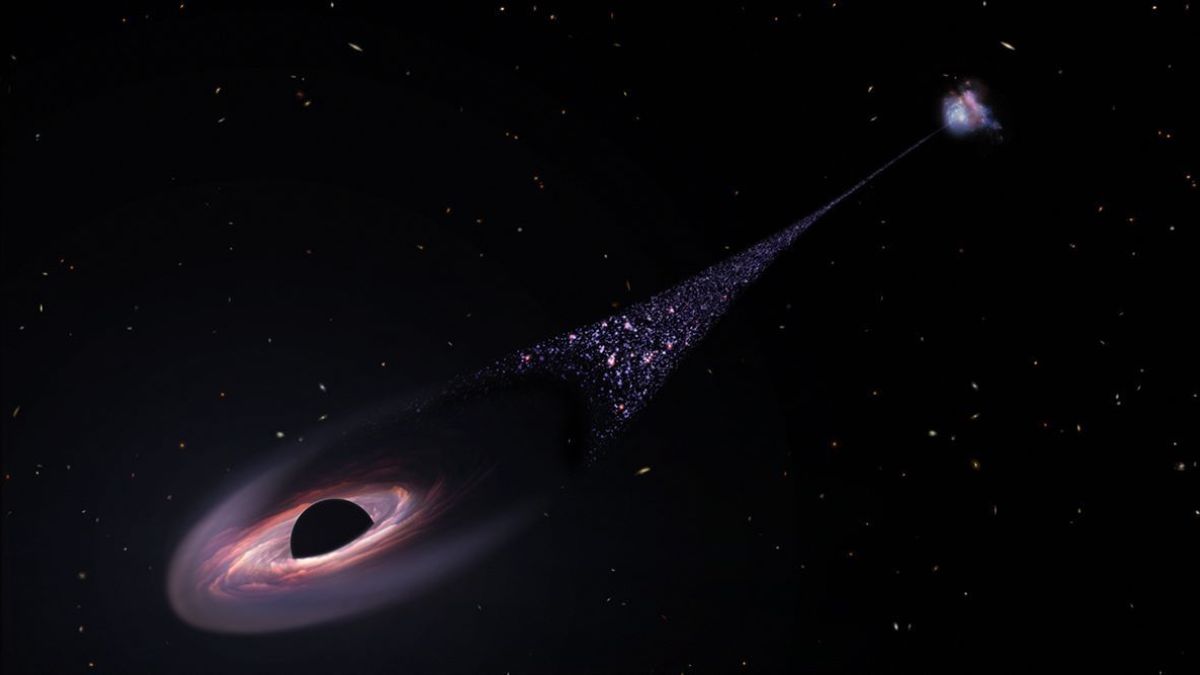

NASA and astronomers around the globe are buzzing about something truly strange and exciting—a space object nicknamed the “cosmic unicorn.” Its official name is CHIME J1634+44, and it’s been emitting radio signals that no one has ever seen before. These bizarre bursts challenge the very physics scientists thought they understood. Ready to look into one of the weirdest discoveries of the decade? Let’s dive in.
Table of Contents
Signals
This story starts with a strange pattern. Astronomers from the National Radio Astronomy Observatory (NRAO) detected something that didn’t match any known object. CHIME J1634+44 sends out strong bursts of radio waves at extremely unusual intervals. Because of this odd behavior, it was classified as a Long-Period Radio Transient, or LPT.
To picture it better, think of a lighthouse on a distant shore. If you’re in the right spot, you’ll see flashes of light at regular intervals, even though the beam is constant. That’s how LPTs work—they emit constant energy, but we receive it in bursts due to the object’s rotation.
Here’s what’s weird: the “cosmic unicorn” sends out one burst every 841 seconds (about 14 minutes), and then another signal every 4206 seconds (about 70 minutes). Even stranger? That longer cycle is exactly five times the shorter one.
Behavior
So, why the nickname “cosmic unicorn”? Because it’s doing things no other space object does.

Most LPTs are neutron stars or white dwarfs—super dense objects that usually slow down over time as they lose energy. But CHIME J1634+44 does the opposite. Instead of spinning slower, it’s speeding up. That’s unheard of for these types of stars.
And there’s more: the signals from this object are 100% circularly polarized. That means the radio waves spin in a perfect spiral through space—something that has never been seen so clearly in other cosmic sources.
Theories
Astronomers are scratching their heads because stars don’t normally behave like this. A single object shouldn’t be able to produce two perfectly synced cycles like that.

So, what could it be? The leading theories suggest CHIME J1634+44 might not be one object at all, but a system:
| Theory | Description |
|---|---|
| Neutron star + unknown body | One dense star interacting with something mysterious. |
| Two close-orbiting stars | Two stars influencing each other’s signals through intense gravity. |
These models push the limits of what we understand about how stars behave. If proven true, they could completely change the way we look at binary systems or even lead to the discovery of a new kind of cosmic object.
Discovery
This mysterious object was found using a network of powerful radio telescopes in the U.S. and Canada, including instruments connected to NASA. The combined data from four observatories helped scientists detect the strange patterns and confirm that the signals were real—not glitches or random noise.
Fengqiu Adam Dong, one of the leading researchers, explained that this “cosmic unicorn” adds a whole new layer to what we know about LPTs. And more importantly, it hints that the universe might be filled with other strange objects just waiting to be found.
Impact
Why does this matter so much? Because CHIME J1634+44 breaks every rule in the book. Just take a look:
| Expected Behavior | Cosmic Unicorn Behavior |
|---|---|
| Slower rotation over time | Faster rotation patterns |
| Random or short signals | Two long, synchronized cycles |
| Regular radio waves | Perfect spiral (circular) waves |
Each feature goes against what we’ve observed in neutron stars and white dwarfs before. This isn’t just a weird find—it could lead to new physics, new star classifications, or even an entirely unknown class of celestial objects.
Mystery
At the end of the day, the “cosmic unicorn” reminds us of one thing: the universe still has secrets. Big ones.
It’s moments like these—when science meets mystery—that push humanity forward. CHIME J1634+44 might be just one star system out of billions, but its strange signals could open new doors in astrophysics, particle theory, and our understanding of how the universe works.
So next time you look up at the night sky, remember—out there in the dark, something is spinning faster, shining stranger, and rewriting the rules of space.
FAQs
What is the cosmic unicorn?
It’s CHIME J1634+44, a space object with strange radio signals.
Why is CHIME J1634+44 unique?
It emits two synchronized cycles and spins faster over time.
What kind of object is it?
Possibly a neutron star system or an unknown stellar pairing.
How was it discovered?
Using data from four radio telescopes in the U.S. and Canada.
What makes its signals special?
They are 100% circularly polarized—perfect spiral waves.