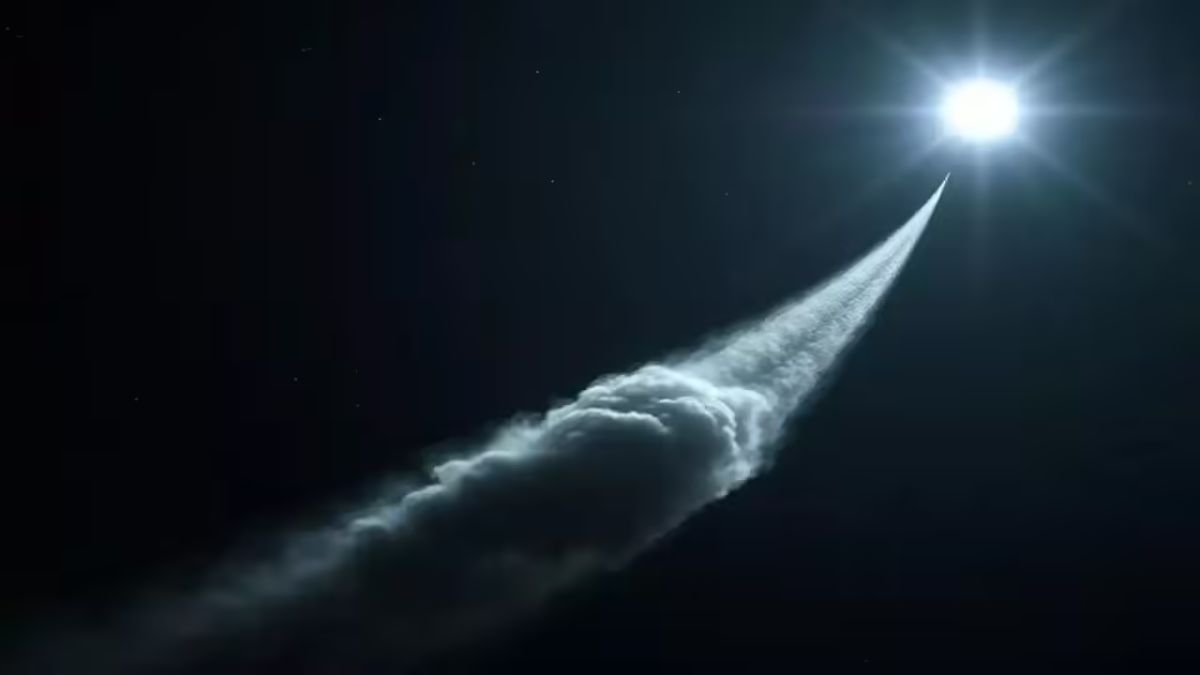
When space gets weird, people start talking. That’s exactly what’s happening right now with 3I/ATLAS, an unexpected visitor from beyond our solar system. It’s only the third interstellar object ever discovered, after ‘Oumuamua and Borisov, and guess what? NASA has pictures of it—high-quality ones from Hubble, James Webb, and even HiRISE on Mars—but they’re keeping them under wraps.
No press releases. No sneak peeks. Just radio silence. The space community is buzzing, the internet is on fire, and the rest of us are left wondering: why the secrecy? Is NASA just being its usual cautious self, or is there something bigger going on here?
Let’s break it down and see how this affects you, even if you’re not an astrophysicist.
Table of Contents
Secrecy
NASA hasn’t confirmed much, but insiders have hinted that images of 3I/ATLAS have indeed been captured. Not just one or two photos either—there’s talk of a whole collection, from multiple observatories, including those on Earth and Mars. Still, the agency has chosen to keep everything “under analysis.”
Why hide images of a comet, you ask? Especially when public interest is through the roof?
Well, it turns out this isn’t your everyday icy rock. 3I/ATLAS is weird—really weird. It’s moving in unexpected ways, reflecting light oddly, and its origin? Nobody knows for sure. Some even suspect it could be artificial, which of course, sends conspiracy theories into overdrive.
Process
Here’s what’s slowing things down: every telescope works differently. Hubble captures visible light with razor-sharp precision. James Webb, on the other hand, uses infrared and picks up heat signatures. HiRISE is snapping from orbit around Mars and relays its data through the Deep Space Network, which is currently handling more urgent missions.
To make these images usable, NASA’s scientists have to:
- Calibrate sensors
- Clean up digital noise
- Align the images
- Match colors across instruments
- Interpret different types of light data
It’s like taking dozens of puzzle pieces from different sets and trying to make one clear picture. That takes time. And a lot of it.
Geometry
You might not think of geometry when you look at a comet, but the way 3I/ATLAS passed behind the Sun created a nightmare for telescopes on Earth. With the Sun’s brightness interfering, getting a clean shot was close to impossible. The timing, angle, and location had to be perfect.
Here’s where it gets tricky—raw space images can be misleading. Bright reflections, pixel glitches, or an odd shape can spark wild theories. That’s why NASA prefers to wait until the full data set is processed. They’ve learned the hard way that rushing leads to confusion—remember the chaos over ‘Oumuamua?
Comet
So what’s so special about 3I/ATLAS?
Let’s compare it to the other two known interstellar visitors:
| Name | Year | Type | Size Estimate | Origin |
|---|---|---|---|---|
| ‘Oumuamua | 2017 | Possibly asteroid | ~100–200m | Unknown (possibly Vega) |
| 2I/Borisov | 2019 | Comet | ~1km | Deep interstellar space |
| 3I/ATLAS | 2025 | Unknown | Estimated 2–3km | Highly uncertain |
What makes 3I/ATLAS different is that it doesn’t behave like a typical comet. It’s faster, darker, and possibly more massive. Some astronomers believe it’s carrying clues about other solar systems—materials we’ve never seen before.
Drama
As usual, secrecy fuels speculation. Some corners of the internet believe 3I/ATLAS is no comet at all but an alien probe. Others think NASA’s holding off because there’s something visually shocking in the images—an unnatural shape, lights, symmetry—something that would ignite wild theories before the scientists could explain it.
Is that likely? Probably not. But when NASA stays quiet for this long, it does make you wonder.
Patience
NASA has a history of playing the long game. Their motto is “science first,” and when dealing with objects from outside our solar system, that means triple-checking every detail. They remember the frenzy over previous interstellar objects, and they don’t want a repeat of the confusion and misinformation.
They plan to release everything in one go—images, data, explanations, maybe even 3D simulations. But they want to make sure it’s accurate and digestible. It’s not about hiding the truth; it’s about avoiding a circus.
In the meantime, amateur astronomers are scanning the skies, forums are exploding with theories, and we all wait.
So how does this affect you?
Well, if 3I/ATLAS is as unusual as early data suggests, the information NASA eventually shares could change how we see the universe. We might learn more about how solar systems form, what materials exist beyond our own, or—who knows—get the first hint of something artificial.
Until then, patience is key. But keep your eyes open, because when NASA finally speaks, it’s going to be big.
FAQs
Why is NASA hiding 3I/ATLAS images?
The images need processing and careful analysis before release.
Did James Webb capture the comet?
Yes, JWST likely captured images but they are still being processed.
Is 3I/ATLAS an alien object?
There’s no proof—it’s still considered a natural interstellar comet.
When will NASA release the images?
There’s no confirmed date, but a full release is expected soon.
Why is 3I/ATLAS important?
It may reveal new info about objects from outside our solar system.