NASA, in collaboration with the James Webb Space Telescope, has once again brought space exploration into the spotlight. This time, astronomers may have uncovered a planet that could change everything we know about planet formation and the possibility of life beyond Earth.
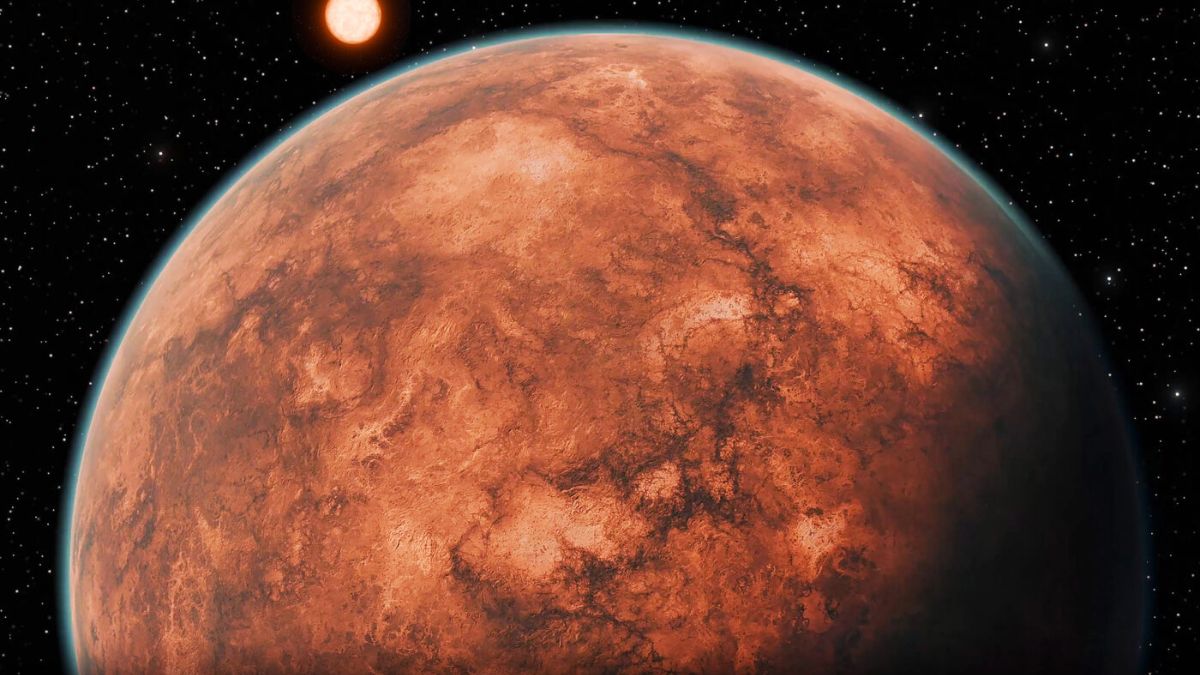
The newly detected object, located 111 light-years away in the Hydra Constellation, may be a planet about 100 times the mass of Earth, with a surface temperature of around 47°C. And yes—it might even be habitable.
Let’s break down why scientists are excited about this and what it means for the future of exoplanet exploration.
Table of Contents
Discovery
The object, orbiting the young star TWA 7, is being called a planetary candidate named TWA 7b. What makes it so unique? It’s located at a distance from its star that’s 50 times greater than Earth’s distance from the Sun. This gives it enough space to possibly hold conditions that aren’t too extreme for life as we know it.
The star itself is only about 6.4 million years old—just a cosmic infant compared to our 4.6-billion-year-old Sun. This makes the whole system a perfect lab for studying how planets are born and evolve.
MIRI
The key to this discovery is an instrument called MIRI (Mid-Infrared Instrument), which is part of the James Webb Telescope. Thanks to MIRI’s powerful coronagraph, astronomers were able to block the blinding light of the star TWA 7 and detect a faint thermal glow nearby. That glow is what’s believed to be TWA 7b.
MIRI worked like a cosmic filter—removing the “noise” and letting astronomers see something they’d never spotted before. Earlier telescopes completely missed it, but James Webb’s advanced tech gave scientists a direct look.
Trojans
There’s also something else possibly in the mix—a Trojan disk.
This is a collection of dust trapped at stable points along a planet’s orbit. Until now, Trojan disks existed only in computer simulations. But this object could be the first real example of such a disk, captured in actual images. It might be surrounding TWA 7b, adding even more mystery to the discovery.
Seeing one for the first time is like spotting an animal thought to be extinct—it opens a new chapter in space science.
Impact
Astronomers like Anne-Marie Lagrange from the Paris Observatory, who led the discovery, believe this is a major step in understanding how planets form, especially around young stars.
Mathilde Malin, co-author of the study and part of Johns Hopkins University, said the finding opens a new door to observing young planetary systems using direct imaging, which is extremely rare in astronomy. Normally, exoplanets are discovered by watching how they affect their stars—making them wobble or dim. But here, scientists are seeing the object itself. That’s like switching from black-and-white radio signals to high-def video.
This is the kind of advancement that could help us answer big questions—like how Earth was formed, and whether other Earth-like planets are out there.
Doubts
Still, there’s a catch. While all the signs point to this being a planet, it hasn’t been confirmed yet. There’s a slim chance that what scientists are seeing could be a distant background object that just happens to line up with TWA 7. Or it might be a temporary phenomenon—something that will disappear in future observations.
That’s why NASA and the James Webb team will continue observing the area in the coming months to confirm the findings.
Future
Even if TWA 7b turns out to be something else, this event is already a game-changer. It’s proof that the technology is working and that direct imaging of far-off worlds is not just possible—it’s happening.
If confirmed, this object would be one of the first large exoplanets directly imaged with such detail. It shows that we’re now at the point where we’re not just theorizing about space—we’re watching it unfold in real-time.
It also sparks the question: if we’re seeing these kinds of planets now, what else is out there waiting to be found? Could we eventually spot a true Earth twin—or something even more advanced?
The universe is huge, and our place in it is small. But discoveries like this make the cosmos feel just a little closer, and a lot more exciting.
FAQs
What is TWA 7b?
TWA 7b is a possible planet 100 times Earth’s mass.
How far is it from Earth?
It’s about 111 light-years away in the Hydra constellation.
What’s special about the temperature?
It’s around 47°C, possibly within a habitable range.
What is a Trojan disk?
It’s a dust cloud trapped in a planet’s orbit.
Is TWA 7b confirmed as a planet?
Not yet—further observations are still underway.