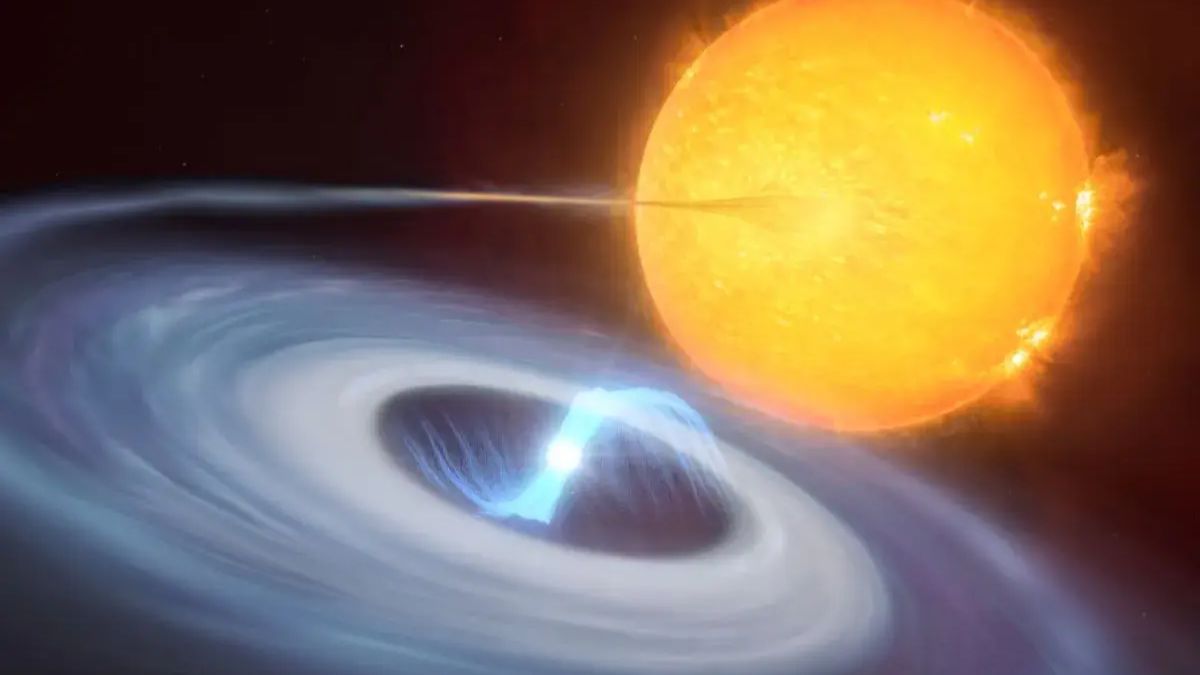
Imagine looking up at the night sky and suddenly seeing a new star appear out of nowhere—so bright, you could spot it without a telescope. That’s exactly what’s expected to happen very soon, as NASA has confirmed the star T Coronae Borealis is about to explode.
But don’t worry, it’s not dangerous. It’s one of the rarest and most exciting space shows you’ll ever see, and it might happen any day now.
Let’s look into what makes this cosmic event so unique.
Table of Contents
Blaze
T Coronae Borealis, also known as T CrB or the Blaze Star, lies in the Coronae Borealis constellation. It’s about 3,000 light years away from Earth, and what we’re about to witness is an extremely rare explosion that happens roughly every 80 years.
When this happens, the star becomes bright enough to be seen with the naked eye, glowing like a cosmic spark for just a short time before fading away again.
Behavior

This star isn’t like most stars. It’s actually a pair of stars—a red giant and a white dwarf—orbiting each other closely. Over time, the white dwarf pulls gas from its red giant companion, storing it like pressure in a kettle. Eventually, the gas buildup causes a sudden thermonuclear explosion on the white dwarf’s surface.
This explosion doesn’t destroy the star. Instead, it releases a burst of energy and light, making it briefly visible from Earth as a bright flash in the night sky.
This type of event is called a “recurrent nova” — and there are fewer than a dozen known in our entire galaxy.
Brightness
Under normal conditions, T CrB is completely invisible to the human eye. It has a brightness level, or magnitude, of +10, which requires a telescope to see. But during the explosion, it jumps to a magnitude of +2, making it about as bright as Polaris, the North Star.
That means you’ll be able to see it with your own eyes—no telescope needed. The only catch? It lasts for less than a day. So, you’ll have to be ready.
Location
Wondering where to look? You’ll find T CrB in the Coronae Borealis constellation, which looks like a semi-circle or a small crown. It sits between the constellations Boötes and Hercules.
An easy way to find it is to draw an imaginary line between the bright stars Arcturus (in Boötes) and Vega (in Lyra). Coronae Borealis sits right in the middle. Better yet, use an astronomy app on your phone—it’ll guide you directly to the right spot in the sky.
Science
This explosion isn’t just a pretty sight—it’s a goldmine for scientists. Watching a recurrent nova in real time helps astronomers understand how binary star systems evolve and interact.
It also gives them clues about the difference between two major types of star explosions:
| Type | Description |
|---|---|
| Nova | Surface explosion on a white dwarf |
| Supernova | Massive star death, outshining entire galaxies |
By studying T CrB, researchers can learn more about how white dwarfs gather material, how they explode, and what it could mean for the life cycles of other stars.
History
The last time T CrB exploded was in 1946, and it was widely observed by astronomers of that time. But this star’s history goes back even further. Ancient records from the year 1217 describe a strange “bright star” that appeared suddenly—likely a past eruption of this same star.
In 2024, scientists started to notice T CrB dimming again, a signal that the explosion was near. Observations using Germany’s Alfred Jensch Telescope confirmed that the white dwarf is accumulating gas faster than usual.
That means the next outburst could happen very soon.
OneNight
When the eruption does happen, you’ll see what looks like a brand-new star lighting up the sky—something that hasn’t happened in nearly 80 years. And unless you plan to live to see the 22nd century, this is your one and only chance to witness it.
It’ll appear for one night, burn bright, and then fade away again into the vastness of space.
So keep your eyes on the stars—or at least on the apps that track them. T Coronae Borealis could light up the night sky at any moment, giving us a rare, dazzling display of the power and mystery of the universe.
FAQs
What is T Coronae Borealis?
It’s a binary star system set to explode in a nova.
Can I see T CrB without a telescope?
Yes, during the explosion it will be visible to the naked eye.
When was the last explosion?
The last eruption was recorded in 1946.
How long will the explosion be visible?
The bright nova will last less than one day.
Where is T CrB located?
In the Coronae Borealis constellation between Boötes and Hercules.