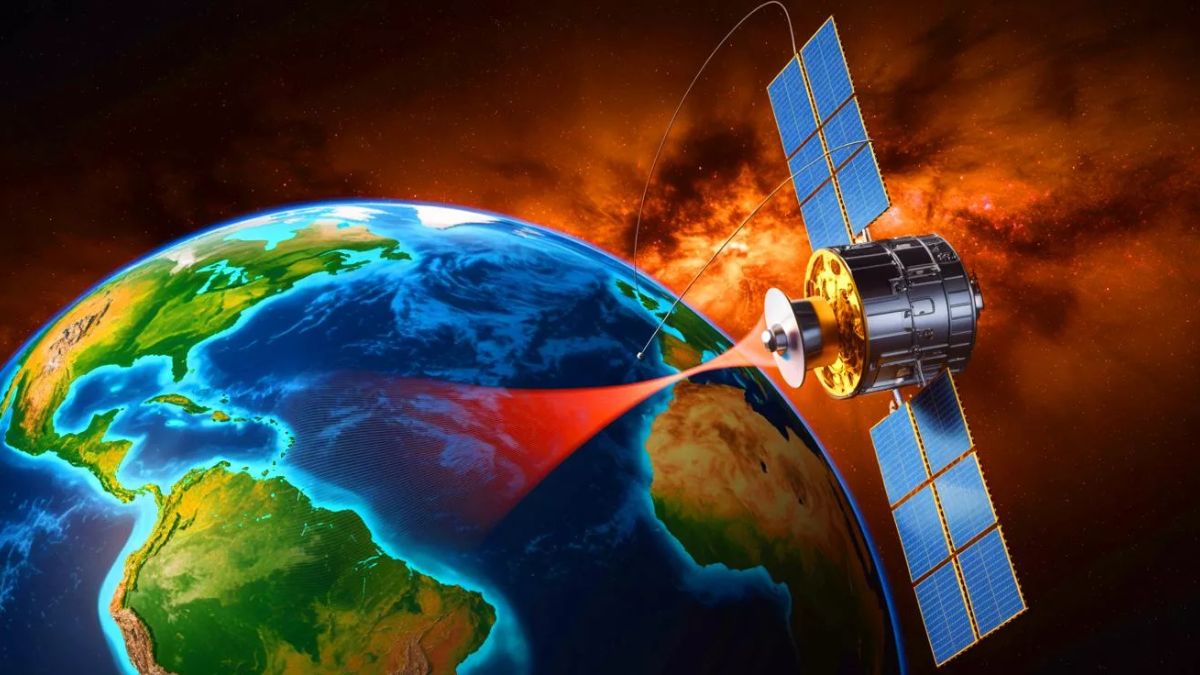
NASA’s been keeping an eye on something strange—really strange. Deep inside Earth’s magnetic field, a mysterious weak spot is expanding. It’s called the South Atlantic Anomaly, and although you don’t need to panic, space agencies are definitely paying attention. Why? Because it puts satellites, spacecraft, and even the International Space Station at risk.
Let’s break it down.
Table of Contents
Anomaly
First off—what even is a magnetic anomaly? Think of it as a dent in Earth’s protective magnetic shield. In this dented region, the magnetic field is significantly weaker. That makes it easier for high-energy particles from the Sun to sneak in and hit satellites or anything orbiting through the area.
Imagine driving through a road full of potholes. The South Atlantic Anomaly is like a pothole in Earth’s magnetic “road.” And satellites that pass through it can take damage—sometimes even permanent. That’s why NASA powers down sensitive systems when spacecraft enter this zone.
Location
This anomaly covers an area stretching between South America and the southwest coast of Africa. It sits over the South Atlantic Ocean, and it’s been gradually growing. But recently, scientists noticed something new: it’s starting to split. Yep, there are now signs of two separate low-intensity zones forming, which could complicate things even more.
Cause
So, what’s causing this bizarre magnetic distortion?
It all starts deep beneath your feet—roughly 2,900 kilometers below the surface. Earth’s magnetic field is powered by molten iron moving around in the outer core. But in the region under Africa, there’s something called the African Large Low Shear Velocity Province—a huge, dense rocky mass that interferes with the usual flow of molten material.
That disruption affects how the magnetic field is generated in that region, leading to a much weaker field above the South Atlantic. And that’s how this anomaly forms.
Impact
Satellites and spacecraft are vulnerable. When they pass through this weak spot, they face increased exposure to solar radiation, which can lead to glitches, short circuits, or even complete failures of onboard systems.
Here’s a simple comparison:
| Area of Impact | Normal Magnetic Field | South Atlantic Anomaly |
|---|---|---|
| Shield strength | Strong | Weak |
| Solar particle access | Blocked or deflected | Easier entry |
| Satellite safety | Stable | At higher risk |
Even the International Space Station, which orbits close to the anomaly, has had to take precautions when passing through it.
Growth
What’s really got scientists buzzing is how this anomaly is changing. It’s no longer a single zone—it appears to be splitting into two. That’s a sign this isn’t a one-time thing. It’s an evolving, possibly cyclical phenomenon. Satellites like CubeSats and Swarm have picked up on the shift, confirming that this is active and dynamic, not just a weird blip.
Some studies suggest this anomaly isn’t new—it’s been happening periodically for millions of years. That’s a relief because it means it probably isn’t a sign of an upcoming magnetic pole reversal, which many people wrongly assume. So, no, your compass isn’t going to start spinning anytime soon.
Research
Why is NASA taking this so seriously? Because knowing this anomaly helps protect current and future missions. The better we understand how Earth’s magnetic field changes, the more we can prepare spacecraft to survive it.
Also, the anomaly is revealing surprising new things. In 2024, researchers found that it can even affect auroras—the glowing light shows we see in the sky near the poles. That suggests the anomaly might also be playing a bigger role in Earth’s climate and atmospheric behavior than we thought.
Risk
Should you be worried? No. On the ground, life continues as usual. Earth’s atmosphere still protects us from harmful solar particles. But up in orbit, this anomaly is a big deal. That’s why NASA and other space agencies are taking it seriously—because one major satellite failure could cost millions and compromise global communication systems.
What’s happening below the surface of our planet is still largely a mystery. But thanks to NASA’s observations and ongoing research, we’re starting to know how even the invisible forces around us are constantly shifting.
FAQs
What is the South Atlantic Anomaly?
It’s a weak spot in Earth’s magnetic field near South America.
Why is it dangerous to satellites?
It allows more solar particles to reach and damage them.
Is this anomaly growing?
Yes, and it now seems to be splitting into two zones.
Does this affect people on Earth?
No, Earth’s atmosphere still protects surface life.
Is this a sign of a pole reversal?
Not likely—it’s a recurring phenomenon, not a new threat.