Back in 1977, two small spacecraft left Earth with one mission — to go further than anything humans had ever launched. These were Voyager 1 and Voyager 2, sent out by NASA during a time when Walkmans were cutting-edge technology and the internet was still a fantasy.
More than 40 years later, these robotic are still out there, hurtling through space and sending back surprising discoveries — including a strange, mysterious region scientists are now calling the “firewall”. Let’s break down what that even means and why it’s blowing minds at NASA.
Table of Contents
Voyagers
Voyager 1 and Voyager 2 weren’t just built to zip around nearby planets. Their job was to study the outer planets — like Jupiter, Saturn, Uranus, and Neptune — and then keep going. Once they finished their tour of the big gas giants, they kept heading into deep space, past Pluto, toward the very edge of the solar system.
And guess what? They’re still going. These probes are now the farthest human-made objects from Earth, and they’re venturing into the great unknown.
Borderline
Where exactly does our solar system end? That’s a question scientists have been trying to answer for decades.
Some say it ends after Neptune. Others point to the Oort Cloud, a vast area of icy bodies that may stretch a light-year away. But NASA’s working definition marks the end at the heliopause.
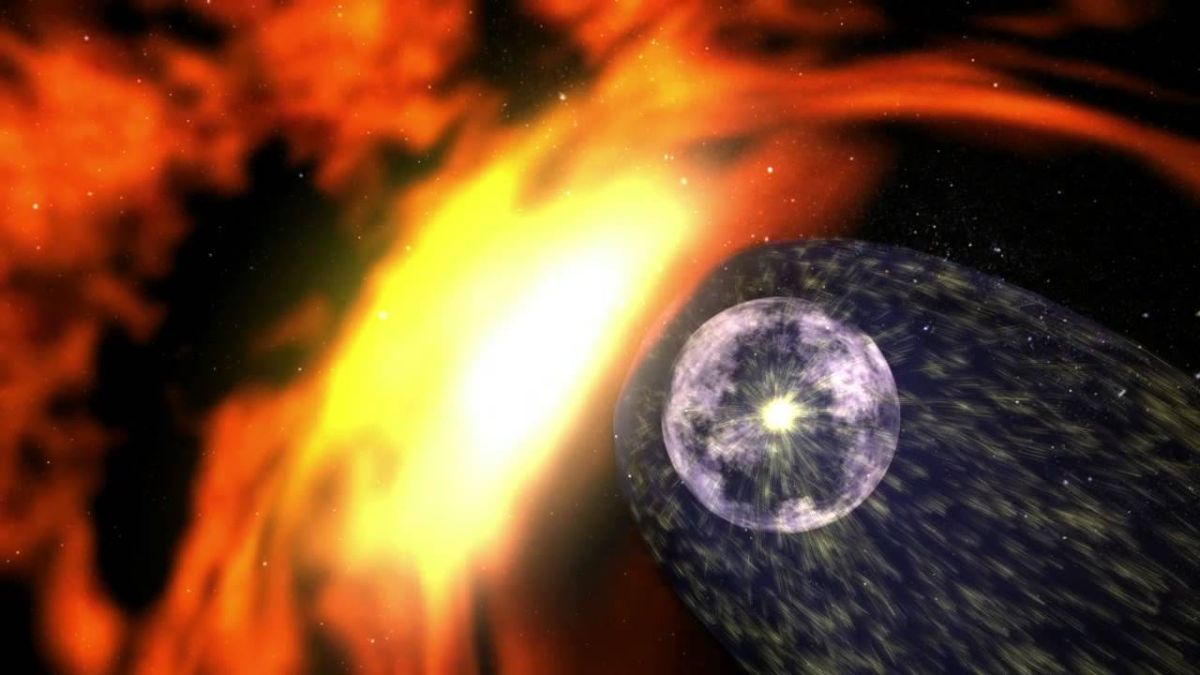
Imagine the Sun blowing up a huge invisible bubble — that’s the heliosphere. The heliopause is the outer edge of that bubble, where the solar wind — streams of charged particles from the Sun — gets stopped by the pressure of interstellar space. It’s like the boundary where the Sun’s influence finally runs out.
Both Voyagers have crossed this border. And what they found there wasn’t what anyone expected.
Firewall
When Voyager 1 crossed the heliopause in 2012 and Voyager 2 followed in 2018, they entered a place that seemed oddly… hot. Scientists noticed a sudden spike in temperature — not just a few degrees, but tens of thousands.
Temperatures in this strange zone were measured at between 54,000°F and 90,000°F (around 30,000°C to 50,000°C). Naturally, the team nicknamed it the firewall.
But here’s the twist: this firewall isn’t made of fire. The Voyager spacecraft didn’t melt. Why? Because in space, heat doesn’t always mean danger.
The “firewall” is full of highly energetic particles, but they’re so spread out in the vacuum of space that they don’t act like flames. It’s more like walking through a hot mist than a firestorm. You’d feel the energy, but it wouldn’t burn you the way touching a hot pan would. That’s the magic (and weirdness) of space physics.
Magnetism
Beyond the firewall, something even stranger happened.
The Voyagers began measuring magnetic fields in interstellar space, and what they found shook up our understanding of space. The magnetic field outside the solar system seemed to align with the one inside. That shouldn’t be happening — at least, not based on current theories.
This connection suggests that maybe the inside and outside of the heliosphere aren’t completely separate. It raises a lot of new questions:
- Could the solar system’s magnetic influence stretch farther than we thought?
- Is interstellar space more connected to our Sun than we imagined?
- Are there hidden rules about how magnetism works in the galaxy?
These are big questions. And the Voyagers are giving us the data to ask them.
Importance
You might be wondering — why does any of this matter?
Well, space isn’t just a faraway science fiction backdrop. The more we learn about it, the more we understand how everything — including Earth — works. Space weather, for example, can affect satellites, power grids, and even climate. And understanding the Sun’s boundary helps us know where its influence stops, and what lies beyond.
The fact that two tiny spacecraft from the ’70s are still running, still exploring, and still finding new things is absolutely incredible. They’re proof that exploration doesn’t always need big explosions or fancy headlines — sometimes, quiet persistence reveals the biggest secrets.
Here’s a quick look at what they’ve achieved:
| Spacecraft | Launch Year | Current Status | Key Milestone |
|---|---|---|---|
| Voyager 1 | 1977 | Active | Entered interstellar space in 2012 |
| Voyager 2 | 1977 | Active | Entered interstellar space in 2018 |
They’ve traveled billions of kilometers and are still teaching us about the universe. That’s dedication.
So next time you look up at the night sky, remember — Voyager 1 and 2 are still out there, somewhere in the dark, still talking to us, and still helping us understand our place in the cosmos.
FAQs
What are Voyager 1 and 2?
They are NASA spacecraft launched in 1977 to explore deep space.
What is the heliopause?
It’s the boundary where the solar wind meets interstellar space.
What is the ‘firewall’?
A hot zone full of energetic particles beyond the heliopause.
Are the Voyagers still active?
Yes, both are still sending data from deep space.
Why are the Voyager missions important?
They reveal unknowns about space and the solar system’s edge.