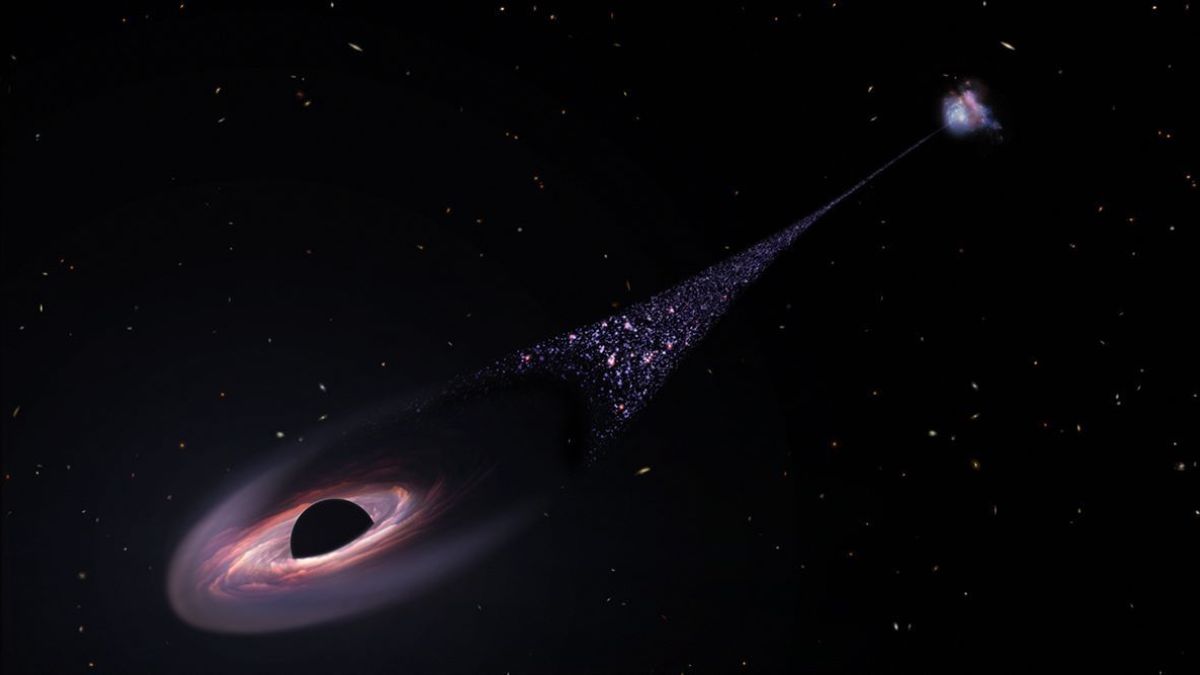
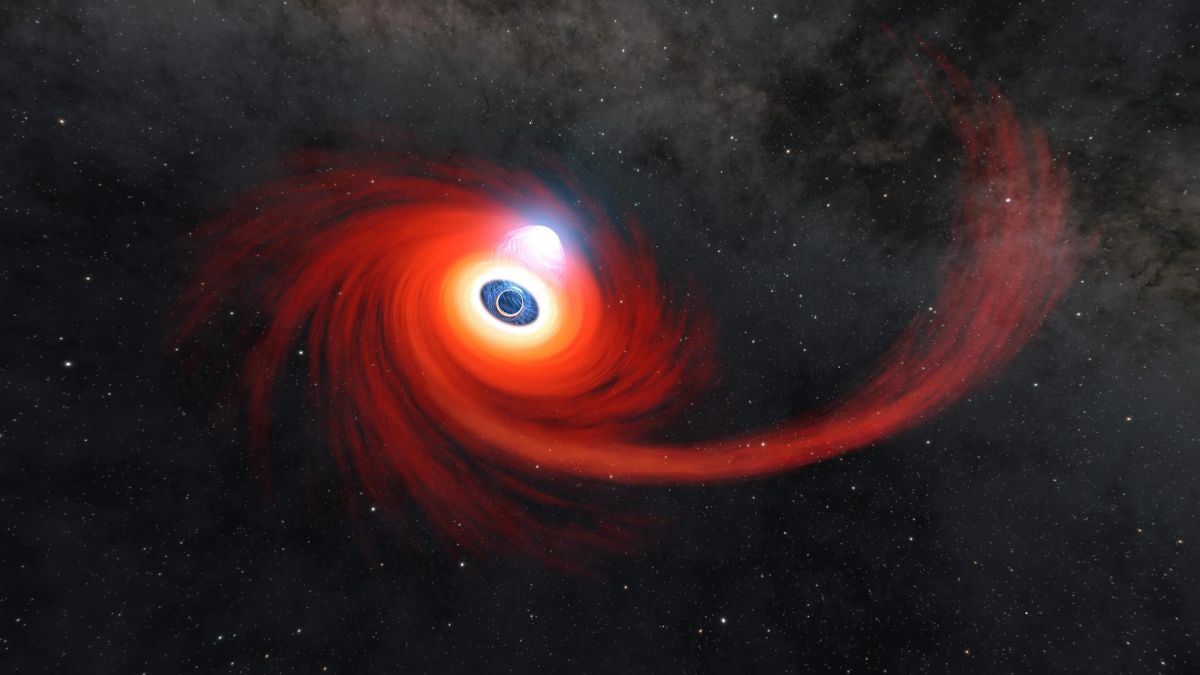
Something incredible just happened about 450 million light-years away from Earth—astronomers spotted a black hole that suddenly “woke up,” producing a powerful burst of light after devouring a nearby star.
Yes, a black hole, one of the most mysterious things in the universe, lit up the sky in a way that scientists never expected. And what makes this even more exciting is that it might not be just any black hole—it could be a long-sought-after type that bridges a major gap in our knowing of space. Let’s break it down.
Table of Contents
Types
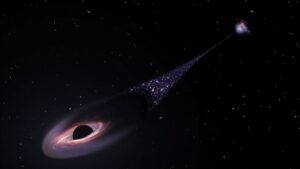
To understand why this matters, let’s talk about the black holes we already know. Scientists are familiar with two main types:
- Stellar-mass black holes – These are formed when massive stars collapse after exploding in a supernova. They usually have up to 100 times the mass of our Sun.
- Supermassive black holes – These monsters live in the centers of galaxies and are millions or even billions of times more massive than the Sun.
But here’s the problem: if small black holes can grow over time, shouldn’t there be something in the middle? A missing link? That’s where intermediate-mass black holes come in—but so far, scientists have struggled to prove they exist.
Discovery
That’s why this latest finding is such a big deal. The black hole in question is called HLX-1 (Hyper-Luminous X-ray source 1). It’s located in a galaxy about 450 million light-years away. HLX-1 isn’t new—it was actually spotted in 2009 when it gave off intense X-rays, a type of light our eyes can’t see, but space telescopes can.

Then, in 2012, something wild happened. HLX-1 got 100 times brighter than it was in 2009. And by 2023, the brightness had faded again. This rise and fall gave researchers just enough data to estimate the black hole’s size—and it’s possibly right in the middle.
Size
Why does the brightness matter? Because the size of a black hole can be guessed based on the intensity of the X-rays it emits while feeding.
- A small black hole wouldn’t produce such powerful X-rays.
- A supermassive black hole would produce even more intense radiation.
HLX-1 was right in between. That led scientists, including lead researcher Yi-Chi Chang, to believe that this could be an intermediate-mass black hole with an estimated mass somewhere between 1,000 and 10,000 times the mass of the Sun.
That’s exactly the kind of black hole scientists have been hunting for.
Mystery
But there’s still a lot of mystery surrounding what exactly happened. HLX-1 flared up, and researchers think it was triggered by a star that got too close. But did the black hole eat the entire star at once? Or did it just nibble on it every time the star passed by in its orbit?
Two main theories are on the table:
| Theory | Explanation |
|---|---|
| Total consumption | The black hole devoured a star in one event, causing a huge flare. |
| Repeated flares | The star orbits the black hole, and small amounts of matter are stripped away over time. |
According to astronomer Roberto Soria, scientists need to keep watching. If HLX-1 lights up again, it might support the idea of multiple flare-ups. But if it continues to fade, then maybe it was a one-time cosmic meal.
Significance
Here’s where things get exciting. If HLX-1 is confirmed to be an intermediate-mass black hole, it could be the missing piece in one of astronomy’s biggest puzzles: how do supermassive black holes form?
Maybe they start small and grow by eating stars and gas clouds over millions of years. Maybe they evolve from mid-sized black holes like HLX-1. But until now, that middle step was purely hypothetical.
So this discovery could finally help explain how the universe builds some of its most powerful objects.
Potential
For space lovers, this is one of those moments that reminds us how little we still know about the universe. Black holes are already fascinating, but if we’re finally finding the ones that fall between the extremes, then we’re one step closer to understanding their life cycle.
The truth is, HLX-1 might be just the beginning. With more telescopes and missions observing the sky, we might discover even more mid-sized black holes hiding in plain sight.
And that? That could rewrite textbooks.
FAQs
What is HLX-1?
A black hole about 450 million light-years from Earth.
Why is HLX-1 important?
It may be a rare intermediate-mass black hole.
How was it discovered?
By observing strong X-rays in 2009 and 2012.
How big is HLX-1?
Between 1,000 and 10,000 times the Sun’s mass.
What are scientists doing now?
Watching HLX-1 for more flares or brightness changes.