
The universe has done it again. Just when we think we’ve got it figured out, a new discovery turns our understanding upside down. Thanks to the incredible sensitivity of the MeerKAT radio telescope in South Africa, astronomers have detected one of the largest galaxies ever seen—so enormous it dwarfs the Milky Way by more than 30 times.
This cosmic giant, named Inkathazo, is not only huge—it’s also strange. Its discovery raises new questions about how galaxies form, how far they can grow, and whether our current theories still hold up. Let’s take a closer look.
Table of Contents
Inkathazo
The name Inkathazo means “trouble” in isiXhosa and isiZulu—fitting for something that’s already causing trouble for existing space models. It’s a giant radio galaxy (GRG), which means its defining feature is not just the stars it contains, but the massive radio-emitting jets that stretch millions of light-years from its core.
How massive are we talking? Inkathazo spans about 3.3 million light-years. For comparison, our own Milky Way measures roughly 100,000 light-years across. That’s a size difference of about 32 times.
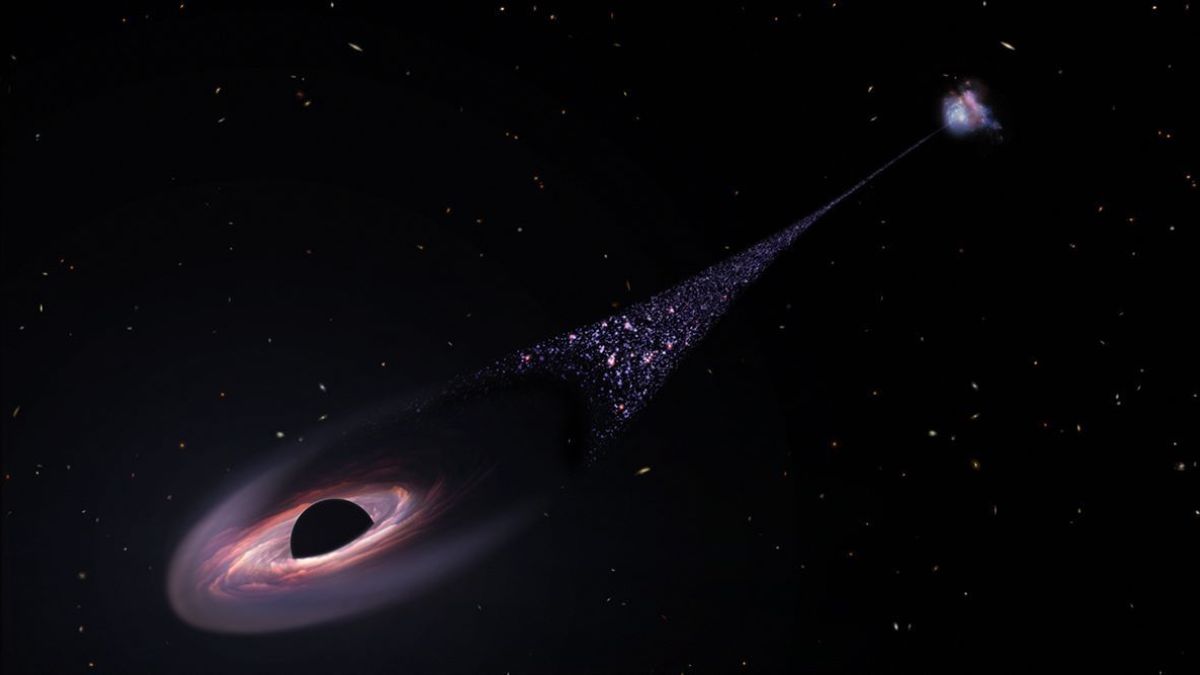
What powers this giant? At the heart of Inkathazo is a supermassive black hole, which shoots out two huge jets of plasma. These jets glow in radio frequencies and travel well beyond the galaxy’s visible edge.
Shape

What makes Inkathazo particularly weird isn’t just its size. Most giant radio galaxies are found in open cosmic environments, where their jets can stretch out unimpeded. But Inkathazo lies in a compact cluster, a denser region full of other galaxies and matter.
Even stranger—one of its jets curves into a rounded shape, unlike the straight, symmetrical jets usually seen in GRGs. This odd jet structure and its environment make Inkathazo stand out in ways astronomers didn’t expect.
MeerKAT
The discovery wouldn’t have been possible without MeerKAT, a world-class radio telescope located in South Africa. This telescope is designed to detect the faint radio signals that optical telescopes can’t see.

When it comes to mapping structures like plasma jets, MeerKAT is a game-changer. It allows researchers to track how far these jets extend and how they behave over time. Since it began operations, MeerKAT has helped astronomers increase the number of known GRGs significantly.
Models
According to standard cosmological models like ΛCDM (Lambda Cold Dark Matter), large galaxies and structures grow slowly over billions of years. Black holes send out jets, but over time, the jets lose power and fade away—unless something unusual is happening.
Here’s the surprise: parts of Inkathazo’s plasma jets appear young and active, even though the galaxy itself is massive. That means some form of ongoing energy is keeping the jets alive—something that current models didn’t really predict.
Theories
Astronomers are still debating how a galaxy like Inkathazo could grow so large and stay so active. A few ideas are on the table:
- Low-density region: The space around Inkathazo might have less gas and dust than usual, letting the jets expand with little resistance.
- Re-energization: Some parts of the jets may have been “turned back on” by new energy sources, giving them a second life.
- Extreme black hole spin: The central black hole may be spinning faster than normal and generating stronger magnetic fields, which launch more powerful jets.
None of these theories alone explains everything, which means our knowing of galactic growth might need a serious update.
Scale
Still trying to picture just how huge Inkathazo is? Let’s break it down visually:
| Galaxy Name | Diameter (light-years) | Relative Size to Milky Way |
|---|---|---|
| Milky Way | 100,000 | 1x |
| Andromeda | 220,000 | 2.2x |
| Inkathazo | 3,300,000 | 33x |
It’s not just larger—it’s in a different league altogether.
Importance
The discovery of Inkathazo is more than just another cosmic record-breaker. It challenges what we know about galaxy evolution, jet physics, and even the limits of how big things in the universe can get. It also shows the value of radio telescopes like MeerKAT, which can reveal cosmic features that stay hidden in visible light.
In short, Inkathazo is a reminder that the universe still has secrets. And if we want to uncover them, we’ll need to keep asking the big questions—and building the right tools to find the answers.
FAQs
What is Inkathazo?
It’s a giant radio galaxy 32 times larger than the Milky Way.
How big is Inkathazo?
It spans about 3.3 million light-years across.
What powers Inkathazo’s size?
Massive plasma jets from a supermassive black hole.
Why is it so unusual?
It’s in a dense cluster and has oddly shaped plasma jets.
What telescope discovered it?
It was discovered using the MeerKAT radio telescope.