If you’ve ever tried to crochet and ended up with a tangled mess instead of a cozy scarf, you’re not alone. For many of us, it’s an exercise in patience and finger gymnastics. But for one Finnish mathematician, crochet wasn’t just a craft—it was the key to cracking a math problem that had puzzled experts for four decades. Sounds wild, right?
Let’s unravel the story (pun intended) of how thread, fabric, and a bit of creativity led to a breakthrough in higher-dimensional geometry.
Table of Contents
Connection

In 1981, mathematician Misha Gromov posed a mind-bending question. It was about the existence of certain types of geometric mappings in high-dimensional spaces—a puzzle that sat unsolved for 40 years. It belonged to the complex world of differential topology, a branch of mathematics that studies shapes and spaces that can be stretched or bent without tearing.
Fast forward to 2025, and Finnish mathematician Susanna Heikkilä, along with professor Pekka Pankka, finally cracked it. Their secret weapon? Crochet.
Breakthrough
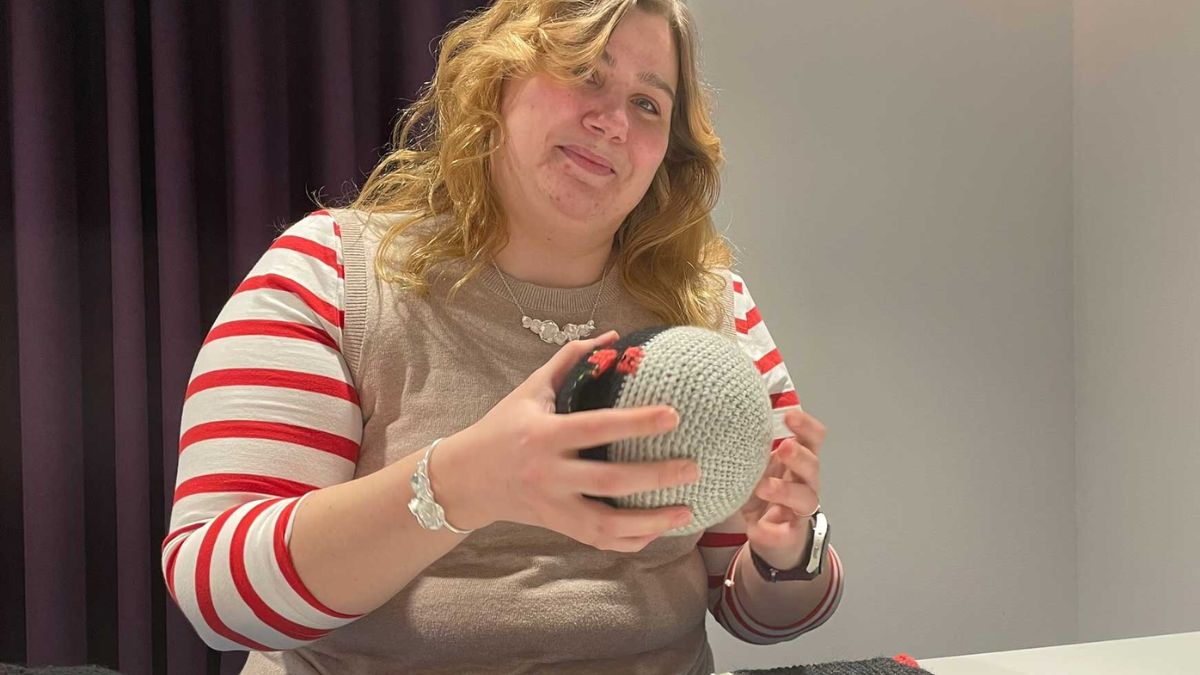
At first glance, you wouldn’t connect yarn and math, but Heikkilä saw things differently. To help explain her ideas, she crocheted a sphere and used a fabric chessboard in her thesis defense. This hands-on approach allowed her to visualize and communicate abstract concepts that had stumped mathematicians for years.

What she solved was the classification of quasiregularly elliptic varieties in four dimensions—a direct answer to Gromov’s question.
Background
Let’s back up a bit. Quasiregularly elliptic varieties are mathematical structures that can be bent or twisted under specific rules without losing their core shape. Think of them like flexible blueprints for higher-dimensional spaces. Understanding which varieties fit these rules helps mathematicians grasp how space behaves beyond our three-dimensional world.
Back in 2019, mathematician Eden Prywes proved that not all varieties were quasiregularly elliptic. But no one knew which ones were—until Heikkilä and Pankka stepped in with a complete classification.
Crochet

So, why crochet?
Crochet allowed Heikkilä to build a physical model of how curved spaces behave. By wrapping a grid-patterned fabric around a crocheted sphere, she could show how certain mappings stretched or compressed space. This visualization highlighted an important concept known as the Alexander mapping, a transformation that wraps a flat surface (like a grid) around a sphere.
By sewing the right parts together, she showed how gaps and deformations appear, helping people understand how these functions work in abstract math.
Topology
The discovery is rooted in something called De Rham cohomology, a mathematical theory that lets researchers analyze space using calculus and algebra. In simpler terms, Heikkilä’s work found that if a space is quasiregularly elliptic, it must meet a specific algebraic condition. That condition made it possible to finally identify which spaces fell into the category.
Pankka explained that for a closed variety to be quasiregularly elliptic, its intersections had to be representable in Euclidean space—our “normal” geometric space. That might sound technical, but it was the missing link that led to solving the decades-old mystery.
Legacy
Heikkilä’s success wasn’t just academic—it was historic. She published her findings in the Annals of Mathematics, one of the most prestigious journals in the field. Few Finnish mathematicians have ever achieved this milestone.
Her thesis is now considered a landmark in Finnish mathematics. But it’s also an example of how combining creativity with logic can change the way we think about science. Who would have guessed that the path to solving a 40-year-old math puzzle would involve a crochet hook and some yarn?
It just goes to show—sometimes, the best tools for solving problems aren’t numbers or computers… they’re the ones hiding in a craft drawer.
FAQs
Who solved the 40-year-old math problem?
Susanna Heikkilä and Pekka Pankka in 2025.
What tool did Heikkilä use?
She used crochet and a chessboard fabric.
What is the Alexander mapping?
A transformation that maps a plane to a sphere.
What are quasiregularly elliptic varieties?
They are deformable shapes that keep core geometry.
Why is this discovery important?
It answered a question posed in 1981 by Misha Gromov.