NASA never stops looking beyond Earth, and Jupiter—our solar system’s gas giant—is always a favourite target. While most of us think of Jupiter’s swirling Great Red Spot, the gigantic storm that’s raged for centuries, this time the spotlight belongs to one of its smallest moons: Amalthea.
Thanks to the Juno spacecraft, scientists have captured stunning new data about this peculiar moon, and it’s raising big questions in the scientific community.
Table of Contents
Amalthea
So, what’s the deal with Amalthea? Well, first off, it doesn’t look like the round moons we’re used to. Discovered in 1892 by Edward Emerson Barnard, Amalthea is small—about 100 kilometres wide—and shaped more like a lumpy potato than a sphere. That’s because its gravity isn’t strong enough to pull it into a smooth, round form.
Amalthea orbits very close to Jupiter, nestled among other tiny moons like Metis, Adrastea, and Thebe. It completes one orbit around Jupiter in just 12 hours. That’s a fast trip, considering Earth’s Moon takes about 27 days to do the same.
Color
Here’s where things get really interesting: Amalthea has an intense red colour. That’s not just for looks—scientists believe it’s because of sulphur particles ejected from Io, another of Jupiter’s moons and the most volcanically active body in the solar system. Io’s eruptions send sulphur gas and dust into space, and some of it finds its way to Amalthea, coating its surface in red.
In space, colour tells a story, and Amalthea’s deep red hue is like a clue in a cosmic mystery. This strange colouration hints at complex interactions between Jupiter’s magnetic field, its moons, and volcanic activity happening millions of kilometres away.
Heat
Another thing that makes Amalthea special? It emits more heat than it gets from the Sun. That’s not normal for an object of its size and distance from the Sun. There are a few theories. One is that Jupiter’s immense magnetic field creates electrical currents inside the moon. Another theory points to gravitational forces causing internal friction and heating the core.
Whatever the cause, this heat could affect the moon’s internal structure and even its surface. It’s another puzzle that scientists are trying to solve—and Juno is helping.
| Feature | Detail |
|---|---|
| Name | Amalthea |
| Size | ~100 km wide |
| Orbit Duration | 12 Earth hours |
| Color | Deep red, due to sulphur from Io |
| Heat Source | Possibly magnetic or gravitational heating |
| Discovery Year | 1892 |
| Shape | Irregular, non-spherical |
Juno
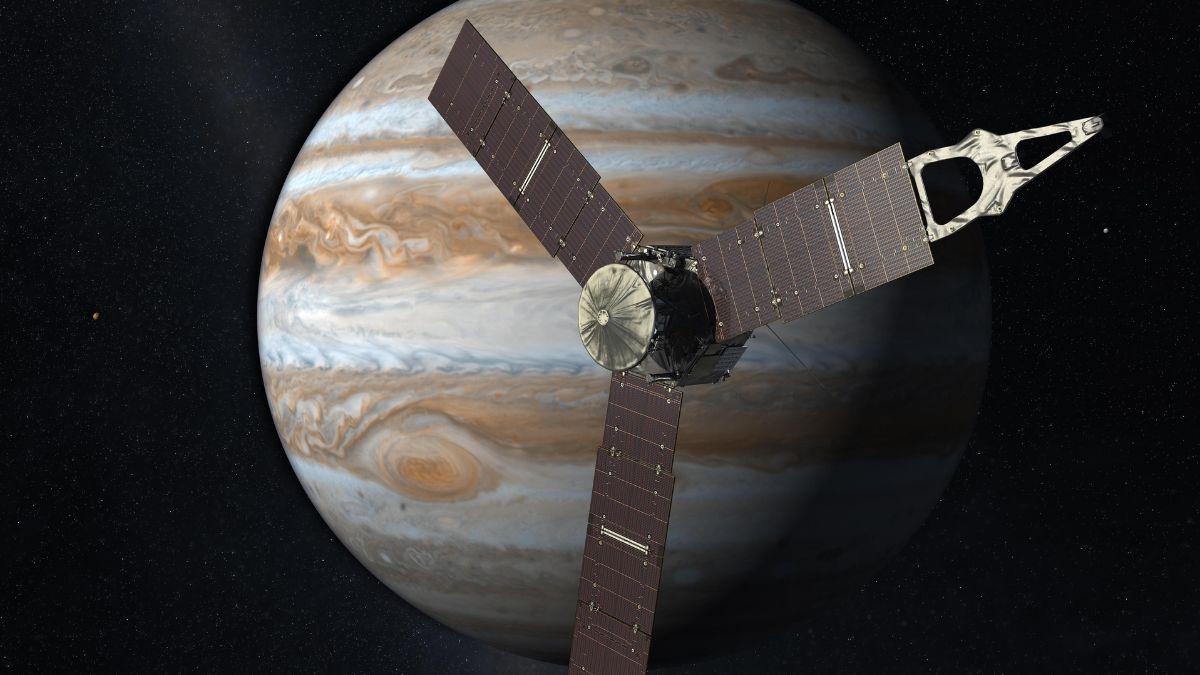
Now let’s talk about the spacecraft making all of this possible: Juno. Launched by NASA in 2011, Juno arrived at Jupiter in 2016 and has been orbiting the gas giant ever since. Its mission is to study Jupiter’s atmosphere, magnetic field, and moons. One of its most useful tools is JunoCam, which captures stunning images and allows scientists around the world to help analyze them.
During Juno’s 59th close pass of Jupiter, it captured detailed images of Amalthea from about 265,000 kilometres above the planet’s cloud tops. The timing was perfect—Amalthea was seen crossing in front of the Great Red Spot, giving us a dramatic view of both the storm and the moon in a single frame.
End
Sadly, Juno won’t last forever. Its original mission ended in 2021, but NASA decided to extend it as long as its systems and batteries hold up. Eventually, when its power runs out, Juno will be sent on a one-way dive into Jupiter’s atmosphere, where it will burn up. This is done to avoid contaminating any of Jupiter’s moons, especially those like Europa or Ganymede, which may have subsurface oceans—and potentially, microscopic life.
Wonder
The image of Amalthea drifting across the face of the Great Red Spot isn’t just a cool space photo. It’s a reminder of how much we still have to learn. This tiny moon is helping scientists rethink everything from heat emission to moon-moon interaction, all while orbiting a planet so massive it could fit 1,300 Earths inside.
Juno may be nearing the end of its mission, but it continues to send back fascinating data that deepens our understanding of Jupiter and its many mysterious moons. So next time you look up at the night sky, think about that little red moon flying past a centuries-old storm, millions of miles away—sending its secrets back to Earth.
FAQs
What is Amalthea?
A small, red-colored moon of Jupiter discovered in 1892.
Why is Amalthea red?
Its red color is due to sulphur from Io’s volcanic activity.
How long does Amalthea take to orbit Jupiter?
Just 12 Earth hours.
What makes Amalthea emit heat?
Likely magnetic or gravitational energy from Jupiter.
What will happen to Juno?
It will eventually burn up in Jupiter’s atmosphere.