You’ve probably heard the name James Webb by now—no, not a sci-fi hero, but a telescope that’s changing everything we thought we knew about the universe. Recently, scientists confirmed something unthinkable: the universe is expanding at two different speeds. That’s right. The James Webb and Hubble Space Telescopes have delivered evidence so puzzling that it’s thrown the world of cosmology into a full-on crisis.
Let’s break down this mind-blowing discovery and why it matters so much.
Table of Contents
Expansion
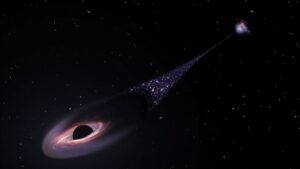
To picture the universe’s expansion, imagine a balloon with dots on it. As you blow air into it, the dots move farther apart—not because they’re moving themselves, but because the balloon (space) is stretching. That’s basically what’s happening to galaxies: they’re being carried apart by the expansion of the universe itself.
This expansion speed is known as the Hubble Constant, and it’s not just a fancy term—it helps scientists figure out how old the universe is, how fast it’s growing, and what its future might look like.
Measuring
Astronomers use two main ways to measure how fast the universe is expanding:
- Cosmic Microwave Background (CMB):
This is like a baby photo of the universe—light leftover from just 380,000 years after the Big Bang. The European Space Agency’s Planck satellite measured this glow and estimated the universe is expanding at 67 kilometers per second per megaparsec. - Cepheid Variable Stars (Cosmic Distance Ladder):
These are special stars that pulse regularly. The brighter they are, the longer their pulse. By measuring their brightness and how stretched their light is (a thing called redshift), scientists calculate a faster expansion rate—74 kilometers per second per megaparsec.
Now here’s the kicker: the two measurements don’t match. And they should.
Tension
At first, researchers thought maybe it was a mistake. Maybe the Hubble Space Telescope was being tricked by nearby stars that made Cepheids harder to see. But then came James Webb, with its sharper infrared vision—and it changed the game.
In 2023, James Webb confirmed Hubble’s findings. And by 2025, using both telescopes, scientists observed over 1,000 Cepheid stars in various galaxies. The data was crystal clear: the Hubble tension—the difference between the two methods—was real. It wasn’t a measuring error.
Mystery
So, if both methods are right, but give different results, what does that mean?
It could mean:
- Dark energy might not work the way we thought.
- Einstein’s relativity could be incomplete when applied to the whole universe.
- Or maybe, just maybe, there’s new physics waiting to be discovered—new particles, forces, or cosmic ingredients we haven’t even imagined yet.
It’s like finding two clocks telling different times in a room without windows. They’re both working perfectly—but something strange is going on outside.
Role
James Webb isn’t just snapping pretty photos of galaxies and exoplanets. It’s doing hardcore detective work in deep space. Its ability to peer through cosmic dust and see distant stars with sharp precision makes it the perfect partner to Hubble.
Thanks to James Webb, scientists now know the Hubble tension isn’t a fluke. It’s a real puzzle—and solving it might lead us to the next big scientific revolution, much like how quantum physics and relativity turned science upside down 100 years ago.
Future
This discovery doesn’t mean the universe is broken—it means science is about to level up. Whenever there’s a contradiction in science, it’s not a problem—it’s a clue. And scientists love clues.
We don’t know yet what’s behind this expansion mystery. But one thing’s certain: James Webb will be part of the answer. As more data comes in, we’ll learn more about dark energy, gravity, and perhaps rewrite some of our most fundamental theories about the universe.
So the next time someone asks, “What’s the universe up to these days?”—you can say, “It’s confusing everyone. And that’s a very good thing.”
FAQs
What is the Hubble tension?
It’s the mismatch between two ways of measuring the universe’s expansion.
What did James Webb confirm?
It confirmed Hubble’s expansion rate using over 1,000 Cepheid stars.
How fast is the universe expanding?
It’s either 67 or 74 km/s/Mpc, depending on the method used.
Why is this important?
It could reveal new physics beyond current scientific theories.
What comes next?
Scientists will gather more data to solve the expansion mystery.