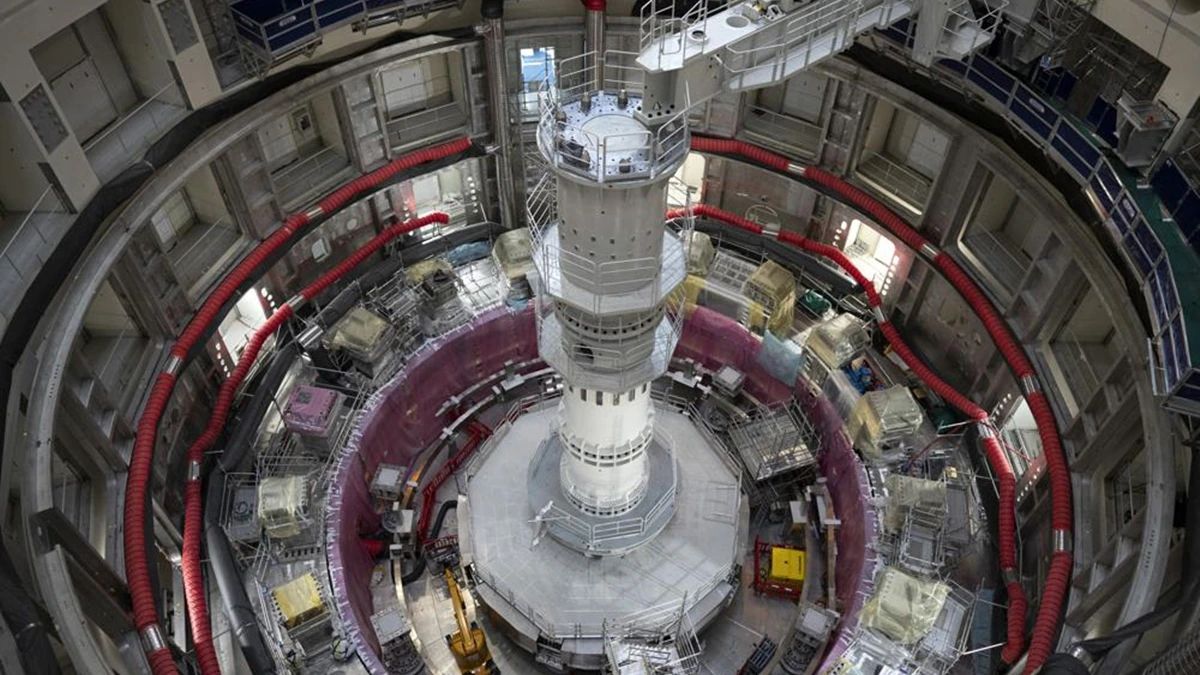
The race to harness the power of the stars just hit a major milestone. In southern France, engineers have begun the final assembly of the world’s largest fusion energy experiment—ITER. And all eyes are on what could become the defining energy breakthrough of our time.
This next phase marks the most complex and crucial step yet in the decades-long journey to make fusion power a reality.
Table of Contents
Assembly

In August 2025, the international ITER project reached its biggest test to date: welding together the reactor’s core. This isn’t your average science project. Westinghouse Electric Company, a U.S. nuclear giant, was awarded a €168 million contract to handle this critical work.
What makes it so complicated? Engineers are assembling nine enormous steel sectors, each weighing nearly 400 tons, into a perfect donut shape known as the tokamak vacuum vessel. This chamber is designed to contain hydrogen plasma heated to a staggering 150 million degrees Celsius—hotter than the sun’s core.
The process demands absolute precision. A tiny misalignment could compromise the entire system. One ITER leader described the job as “solving a three-dimensional puzzle on an industrial scale.” The stakes couldn’t be higher.
Expertise

Westinghouse isn’t working alone. Alongside Italian companies Ansaldo Nucleare and Walter Tosto, it forms the AMW consortium. Together, they bring years of experience with ITER’s complex components and technical standards.
With over a decade of involvement in ITER, Westinghouse is familiar with the project’s high expectations. Precision welding, engineering alignment, and ultra-clean procedures are essential. This phase will decide if the machine can safely handle the extreme forces and temperatures it’s built for.
Collaboration
ITER is not just a reactor—it’s a global team effort. Funded and supported by 35 nations, it brings together more than half of the world’s population and most of its economy. Countries are contributing critical components built around the globe.

From Japan’s superconducting magnets to Russia’s poloidal coils and China’s power supplies, every nation has a part to play. The components arrive in France and must fit together flawlessly. It’s a logistical puzzle as well as a scientific one.
Unlike other mega science projects like the Large Hadron Collider, ITER is focused on a real-world goal: clean, abundant energy. It stands as a symbol of what global cooperation can achieve when united behind a common purpose.
Goal
The dream is big: generate 500 megawatts of fusion power using only 50 megawatts of input. That’s a tenfold energy gain—something never before achieved in any lab.
To put it simply, this is the closest we’ve come to recreating the energy of the stars here on Earth. And if it works, it could transform the way we power everything from cities to entire countries.
Of course, the road has been long. When ITER began construction in 2010, scientists hoped for first plasma by 2018. That goal has since shifted to 2035, underscoring how tough fusion energy really is.
But despite delays, each milestone shows steady progress. The joke that fusion is “always 30 years away” may finally be getting old.
Future
It’s important to remember: ITER won’t generate electricity. It’s a testbed, meant to show that fusion can be controlled and sustained. If successful, the next step is DEMO—a full-scale fusion power plant designed to feed power into the grid.
Fusion offers serious advantages. There’s no long-lived nuclear waste. No meltdown risk. Its fuel—hydrogen isotopes—is almost unlimited, especially in ocean water. Unlike fossil fuels, it produces no greenhouse gases.
If we can crack it, fusion could deliver clean energy for millions of years.
Momentum
And ITER isn’t alone. Private companies and national labs around the world are racing toward fusion, trying different designs: stellarators, laser-driven systems, and compact reactors. Some are even hoping to beat ITER to the finish line.
Still, ITER remains the world’s flagship fusion experiment, showing what’s possible when nations pool their talents and resources.
Humanity
This new phase of assembly is more than a technical achievement—it’s a symbol of global unity. As Westinghouse welds together the heart of the reactor, it’s helping humanity take one more step toward solving one of its toughest problems: sustainable energy.
Sure, there’s a long road ahead. But each coil installed and each steel sector sealed brings us closer to the future we’ve imagined for decades.
And if that future is powered by the same force that lights up the stars? Well, that’s a legacy worth waiting for.
FAQs
What is ITER?
A global project to replicate fusion energy on Earth.
Who is assembling the reactor?
Westinghouse leads, with Italian partners in the AMW group.
When will ITER start fusion tests?
Full fusion experiments are expected by 2035.
Will ITER produce electricity?
No, it’s a test reactor, not designed to generate power.
Why is fusion energy important?
It offers clean, safe, limitless energy with no carbon output.