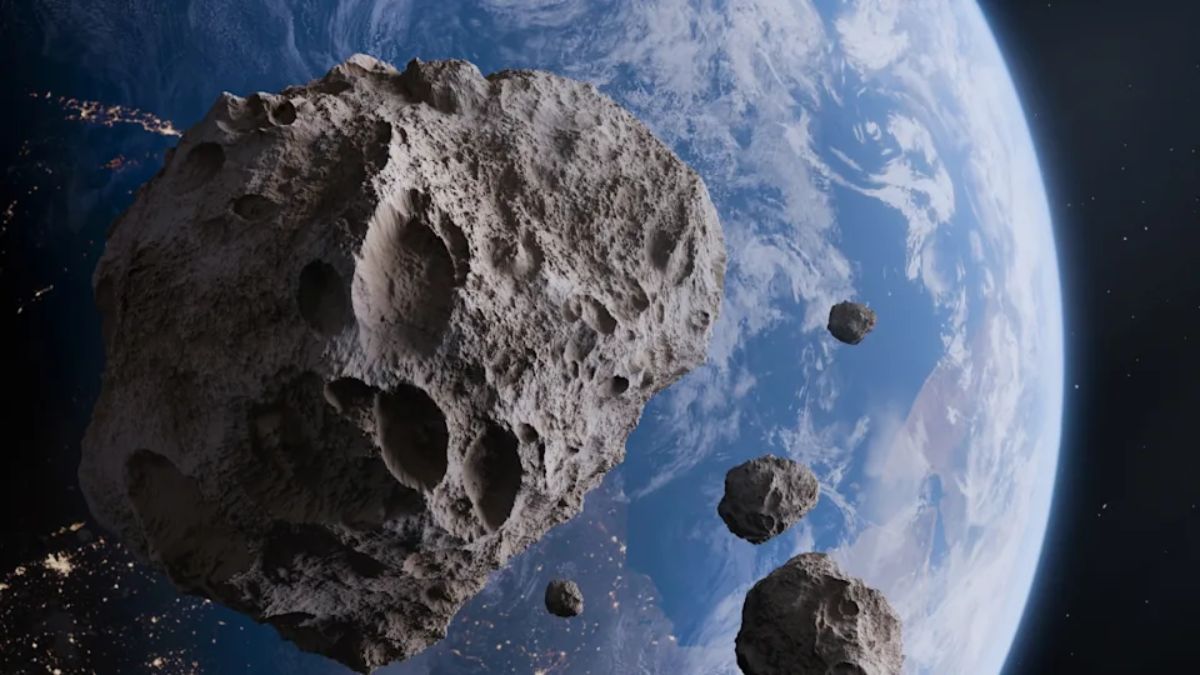
Imagine a group of asteroids quietly orbiting the Sun right alongside Venus. Now imagine that some of these rocks could, one day, veer off course and head toward Earth. Sounds like something out of a sci-fi movie, but it’s very real. Scientists have confirmed that a rare group of co-orbital asteroids near Venus might intersect with Earth’s orbit—just not anytime soon.
Still, the potential future threat is enough to put astronomers on alert. So, what exactly is going on up there?
Table of Contents
Discovery
The new findings were recently published in the scientific journal Icarus and reveal a hidden population of space rocks known as Venus co-orbital asteroids. These objects share a similar path around the Sun as Venus does, moving in stable zones called Lagrange points.
These aren’t your everyday space rocks. Some of them are up to 400 meters in diameter—big enough to cause serious damage if they ever hit Earth. While most are stable and stay in their lanes, computer simulations show that a few could eventually drift toward Earth’s orbit. That’s the long-term concern.
Co-orbitals
So, what are co-orbital asteroids exactly? They’re rare space rocks that orbit the Sun at nearly the same distance as a planet—in this case, Venus. Think of them as distant space companions, trailing behind or moving ahead of Venus in gravitational “sweet spots.”
As of now, astronomers have identified around 20 Venus co-orbitals. While most of them are stable, three stand out. According to simulations, these three may not stay in those safe zones forever. Due to gravitational influences, especially from Earth and Jupiter, their orbits could shift. That’s when things get interesting—and risky.
Timeline
Before you panic, let’s be clear: this isn’t a threat for today or tomorrow. The projected orbital changes could take thousands of years to play out. These rocks aren’t on a collision course yet, but they are in the category of “potentially hazardous” simply because of their size and how unpredictable space dynamics can be over time.
Still, the fact that they exist and could drift into our path someday is enough for astronomers to take them seriously.
Visibility
One major challenge is that these asteroids are incredibly hard to detect. Because they orbit close to the Sun, they’re only visible from Earth during brief periods at dawn or dusk—when the Sun’s glare is weakest. Traditional telescopes struggle to track them, which means scientists have to bring out the big tools.
Here’s what’s helping:
| Telescope | Location | Role |
|---|---|---|
| Vera C. Rubin Observatory | Chile | Ground-based, wide-field sky scans |
| NEO Surveyor | NASA (space-based) | Detects heat signatures from dark or hidden asteroids |
These next-generation observatories will help monitor hard-to-see objects near the Sun, improving our ability to predict and prepare for long-term asteroid risks.
Importance
Why does this discovery matter if the risk is thousands of years away? Because it reminds us that our solar system is more dynamic and unpredictable than we think. Asteroids don’t follow simple paths forever. Over time, small gravitational nudges can have big consequences.
By identifying these co-orbital asteroids now, scientists can begin tracking them more closely. Early detection is key when it comes to planetary defense. Plus, it boosts international cooperation and funding for space monitoring programs.
Perspective
The idea of hidden asteroids slowly inching their way toward Earth is a little unsettling—but it’s also a testament to how far science has come. We now have the tools, data, and people in place to find these threats before they become real problems.
This discovery is just another reason to keep looking up. With space agencies working together and technology advancing quickly, we’re better prepared than ever to face what the universe throws at us—even if it’s moving slowly through the darkness of space for now.
FAQs
What are Venus co-orbital asteroids?
They orbit the Sun at the same distance as Venus.
Can these asteroids hit Earth soon?
No, potential risks are thousands of years away.
How many of these asteroids exist?
About 20 have been identified so far.
Why are they hard to detect?
They orbit close to the Sun, limiting visibility.
What telescopes track these asteroids?
Vera Rubin Observatory and NASA’s NEO Surveyor.