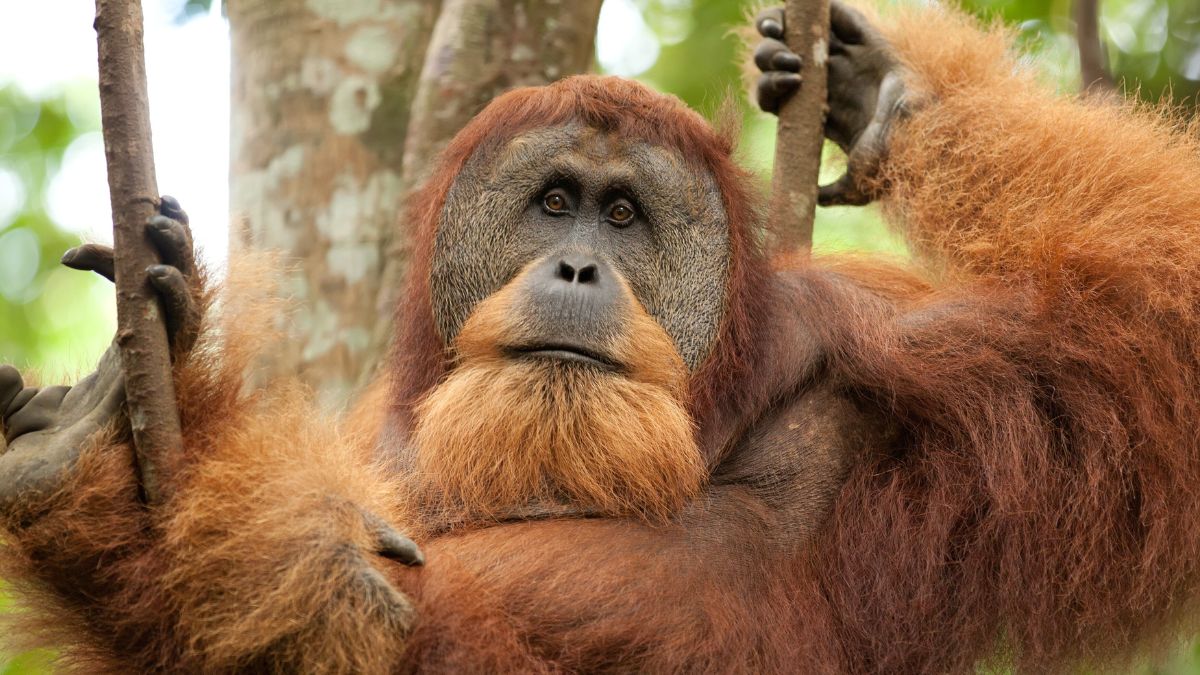
You might not know who Rakus is, but once you read this story, you’ll never forget his name. In 2022, deep in the rainforests of Sumatra, Indonesia, a male orangutan named Rakus did something that left scientists amazed. After getting injured in a fight, he didn’t just rest and heal — he made his own medicine using plants.
This incredible event, published in the Scientific Reports journal, could change how we know the relationship between animals, nature, and the origins of medicine. Let’s take a closer look at Rakus and his remarkable discovery.
Table of Contents
Wounded
Rakus is a 30-year-old male orangutan living in Gunung Leuser National Park in Indonesia. In the summer of 2022, researchers heard the sounds of an intense fight high in the treetops. When they finally spotted Rakus, they noticed he had a deep wound below his right eye and even inside his mouth — a clear sign of a serious battle.
Normally, animals just let their wounds heal naturally. But Rakus did something no one expected.
Remedy
Instead of doing nothing, Rakus began chewing the leaves of a plant called liana. What’s interesting is that this plant is not part of the orangutans’ usual diet. However, humans living in the area know it as a natural painkiller.

Rakus chewed the leaves to create a green paste and then used his fingers to apply it directly to his wound, as if he were using an herbal ointment. He repeated this process several times over the following days.
This was the first time scientists had ever observed an animal clearly using a plant to treat an external wound — a groundbreaking moment in wildlife research.
Healing
Did it work? Amazingly, yes. Rakus’ injury healed within a week, with no signs of infection. His quick recovery stunned researchers, who believe the plant’s chemical compounds reduced inflammation and killed bacteria.

This showed that orangutans might not just recognize edible plants — they may also understand which ones can heal. It’s a fascinating look at how close they are to humans in intelligence and behavior.
Intelligence
Orangutans are among the smartest animals on Earth. Sharing about 97% of their DNA with humans, they use tools, learn from experience, and can identify more than 400 different plant species.
They know which fruits are ripe, how to prepare certain foods, and when to avoid dangerous plants. Rakus’ ability to identify a healing plant on his own shows a deep understanding of his environment — a kind of jungle wisdom that humans once depended on too.
Behavior
This behavior has a scientific name: zoopharmacognosy — when animals use natural substances to treat illness or injury. It’s an amazing concept that suggests early humans might have learned about medicinal plants by watching animals like Rakus.
And Rakus isn’t alone. Over the years, scientists have observed many examples of animals treating themselves:
| Animal | Behavior | Possible Purpose |
|---|---|---|
| Chimpanzees | Eat bitter plants only when sick | Fights parasites |
| Orangutans (Borneo) | Rub their skin with medicinal leaves | Relieves joint pain |
| Insects | Use natural chemicals from plants | Prevents disease |
These examples prove that animals have an instinct for healing — something we humans might have inherited from our shared ancestors.
Meaning
Rakus’ story goes beyond just one clever orangutan. It highlights how intelligent and adaptable wildlife can be, and how much we still have to learn from nature.
His discovery suggests three key lessons:
- Orangutans are problem-solvers capable of self-medication.
- Our ancestors may have learned about natural medicine by observing animals.
- Protecting orangutans means preserving vital knowledge about evolution and survival.
With fewer than 14,000 Sumatran orangutans left in the wild, deforestation and climate change are putting them at great risk. Protecting them isn’t only about saving a species — it’s about safeguarding a piece of our shared history and the secrets nature still holds.
Rakus reminds us that intelligence and healing aren’t just human traits — they’re part of the living world we all share.
FAQs
Who is Rakus?
A 30-year-old male orangutan from Sumatra, Indonesia.
What made Rakus famous?
He used a plant to heal his wound, the first observed case in orangutans.
What plant did Rakus use?
A vine called liana, known for its pain-relieving properties.
Did Rakus’ wound heal?
Yes, it healed completely within a week without infection.
What is zoopharmacognosy?
It’s when animals use natural plants or substances to heal themselves.