NASA scientists are buzzing over a strange new discovery—a mysterious object, code-named A11pl3Z, is hurtling into our solar system at a blistering 245,000 km/h. First detected on June 25 by NASA’s ATLAS survey system, it’s not behaving like anything astronomers have tracked before. It’s big, it’s fast, and it’s not obeying the gravitational rules we’d expect. Some early estimates even suggest it could be among the largest interstellar objects ever observed.
Table of Contents
What We Know So Far
Normally, comets and asteroids we detect are bound to the Sun, looping around in predictable orbits. But A11pl3Z is different. Its path is hyperbolic—which means it’s not from here and isn’t sticking around. It’s simply passing through.

By comparison, the famous interstellar visitor ʻOumuamua in 2017 moved at roughly 138,000 km/h. A11pl3Z is nearly twice that speed. To put it in perspective: at this pace, it could travel from Earth to the Moon in less than two hours.
| Object | Year Detected | Speed (approx.) | Notable Feature |
|---|---|---|---|
| ʻOumuamua | 2017 | 138,000 km/h | Cigar-like shape, no coma |
| 2I/Borisov | 2019 | 175,000 km/h | Classic comet-like coma |
| A11pl3Z | 2025 | 245,000 km/h | No tail, unusually large |
The Timeline Ahead
Current tracking shows A11pl3Z will make a close pass by Mars in October 2025, then swing closest to Earth in December 2025. But don’t start planning disaster movies just yet—Earth will be safely on the opposite side of the Sun when it zips past.

NASA and the European Space Agency (ESA) have both confirmed that while its speed and trajectory are remarkable, there’s zero collision risk with our planet.
What Is It, Really?
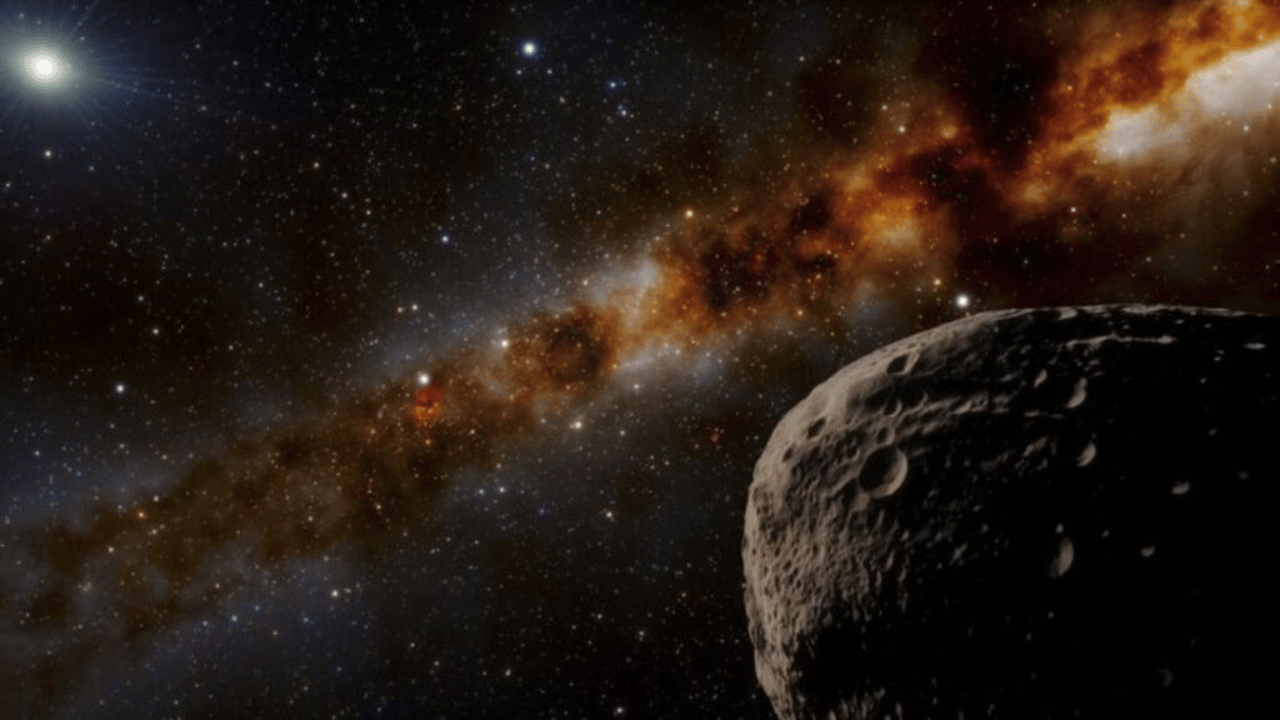
Here’s where it gets murky. A11pl3Z is estimated at 10–20 kilometers wide, placing it in the heavyweight category of space objects. That’s far larger than ʻOumuamua, and even bigger than many comets we regularly see.
But the strangest part? No coma, no tail. Most comets heat up near the Sun, releasing gas and dust. A11pl3Z, so far, looks inert—more like a rocky asteroid. Yet its trajectory and speed scream “interstellar visitor.”

Scientists are weighing a few theories:
- An interstellar comet with little volatile material left to release.
- A rocky fragment from another star system, flung into space long ago.
- Something entirely new, unlike the asteroids or comets we’ve classified before.
Astronomers are now pointing heavyweights like the James Webb Space Telescope and the upcoming Vera C. Rubin Observatory at the object, hoping to decode its composition and exact origin.
Why It Matters
These rare interstellar visitors act like cosmic messengers. They carry clues about the chemistry, conditions, and even the building blocks of life from distant solar systems. ʻOumuamua sparked debates about whether its unusual motion hinted at alien technology (a theory most scientists reject but still fuels speculation).
With A11pl3Z, researchers see a bigger opportunity: if it’s carrying organic compounds or unusual minerals, it might shed light on how planetary systems exchange material—or even how life’s ingredients spread across the galaxy.
The Bigger Picture
Astronomers like Mark Norris estimate that thousands of interstellar objects could be drifting through our solar system at any given time—most too small or faint for us to notice. A11pl3Z, large and unusually bright, just happens to be one we’ve caught in the act.
It’s a reminder of how little we truly know about our cosmic neighborhood. The solar system isn’t a closed bubble; it’s a busy crossroads in a galaxy of constant movement.
While the buzz sounds dramatic, NASA has not issued any impact warnings for Earth. Credible sources, including NASA’s Planetary Defense Coordination Office, stress that A11pl3Z poses no danger. Some viral posts suggesting it’s on a collision course are false. What is true: it’s fast, unusual, and scientifically exciting.
FAQs
What is A11pl3Z?
A newly detected interstellar object, moving faster than known comets or asteroids.
How fast is it traveling?
Roughly 245,000 kilometers per hour.
Will it hit Earth?
No. Its closest pass is in December 2025, but Earth will be on the opposite side of the Sun.
Is it a comet or asteroid?
Not confirmed. It shows traits of both—or possibly something new.
Why is it important?
It may help scientists learn more about interstellar space, planetary systems, and even the origins of life.