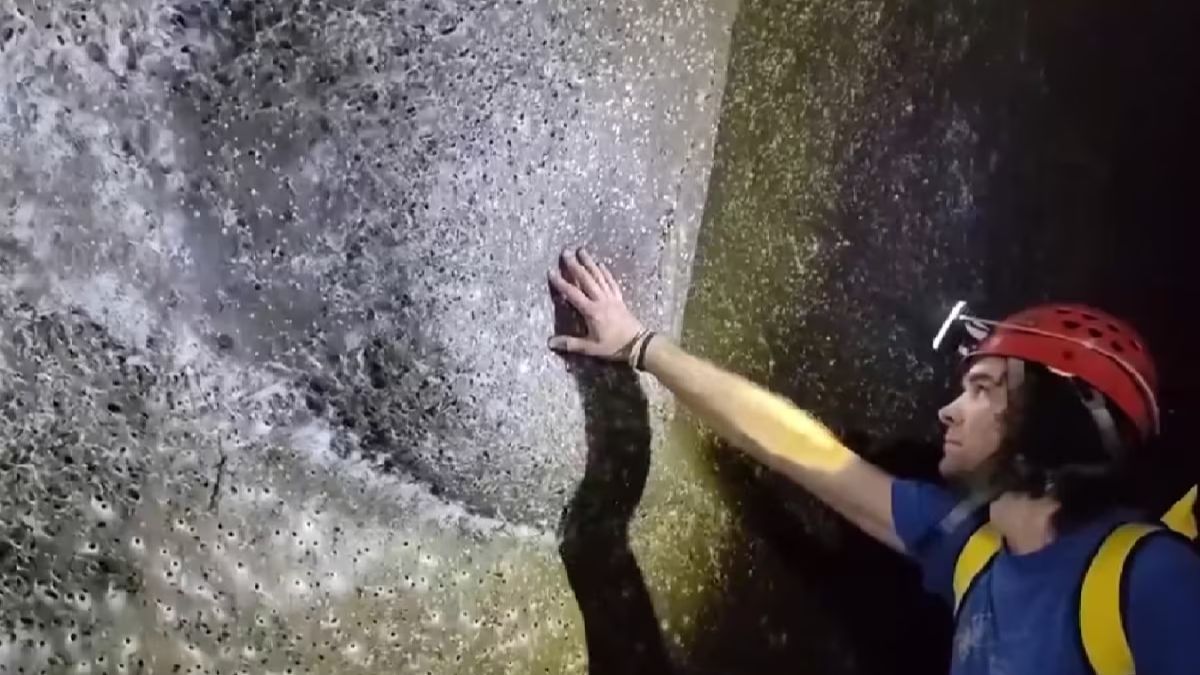
If the thought of a spider in your bathroom already gives you the chills, brace yourself—because scientists have just discovered the largest spider web ever recorded, and it’s straight out of a horror movie. Hidden deep inside a sulfur cave between Albania and Greece, this enormous web spans a jaw-dropping 106 square meters and is home to more than 111,000 spiders. Yes, you read that right.
Before you swear off caves forever, let’s break down what scientists found and why this creepy-crawly discovery is actually pretty amazing for science.
Table of Contents
Discovery
The whole thing started with an expedition by researchers from Sapientia Hungarian University. Back in 2022, a group of speleologists ventured into the little-known caves of the Vromoner Canyon, where they stumbled upon something shocking: a massive white sheet clinging to the cave wall, constantly shifting. At first glance, it looked like fungus or mineral buildup. But nope—it was alive.
By 2024, the team returned, this time with a group of biologists who confirmed what they were looking at: a living, breathing, spider-made mega web. And not just a big one—a record-breaking one.
Species
Here’s where it gets even weirder. The web is home to two different species: Tegenaria domestica and Prinerigone vagans. Normally, spiders are solitary creatures. They fight over space. They eat each other. But here, over 111,000 of them are living side by side, building and sharing the same massive web like peaceful neighbors in a tiny apartment complex.

How is that even possible? Scientists aren’t sure yet, but the fact that two species are coexisting without chaos is a major puzzle—and one that could tell us a lot about cooperation in the animal kingdom.
Habitat
You might wonder: why on Earth would anything live in a sulfur cave?
The cave itself is brutal. It’s dark, humid, full of acidic vapors, and smells terrible thanks to all the sulfur. But oddly enough, that environment created a strange but stable ecosystem. Microorganisms live in the walls and on the cave floor, and they feed the bugs—which, in turn, become food for the spiders.
The spiders here have adapted to complete darkness. They’ve changed the way they hunt, the way they see (or don’t), and most incredibly, the way they live together.
Structure
This mega web is no random tangle. It’s carefully layered—like a woven net of overlapping silk sheets stretched along a massive underground tunnel. Some spiders remain still, ready to attack, while others patrol the web, repairing and reinforcing the lines. It’s like they’ve developed jobs.
The humid cave conditions prevent the silk from decaying, so the web doesn’t fall apart. It just keeps growing and growing.
It’s not just a trap—it’s a whole city made of silk.
Science
Beyond the shock factor, this discovery is a scientific jackpot.
Biologists are now studying how these spiders produce silk that can survive in such extreme environments. Could it be stronger? More durable? Resistant to corrosion? Maybe one day, their silk could inspire materials used in medicine, construction, or even space travel.
And then there’s the mystery of their behavior. How are 111,000 spiders not tearing each other apart? What allows them to work together? Understanding this could help scientists unlock secrets about cooperation, evolution, and survival in hostile conditions.
Reaction
When the first photos hit the internet, the reaction was instant—and intense. Social media lit up with a mix of awe, horror, and fascination. Some users couldn’t believe it was real. Others wished they hadn’t seen it before bedtime.
And let’s be honest, it is kind of terrifying. A wall of spiders is nobody’s dream vacation. But for every person who’s creeped out, there’s another who finds the whole thing mesmerizing.
Yes, 888,000 spider eyes watching you sounds like nightmare fuel, but it also reminds us just how bizarre and brilliant nature can be.
And for anyone worried—don’t panic. These spiders live deep underground in toxic caves. They’re not coming to your garage anytime soon.
FAQs
Where was the spider web found?
In a sulfur cave between Albania and Greece.
How big is the web?
It measures over 106 square meters.
How many spiders live there?
More than 111,000 spiders share the web.
Are the spiders dangerous?
No, they live isolated underground and pose no threat.
Why is this discovery important?
It shows rare spider cooperation and may inspire scientific advances.