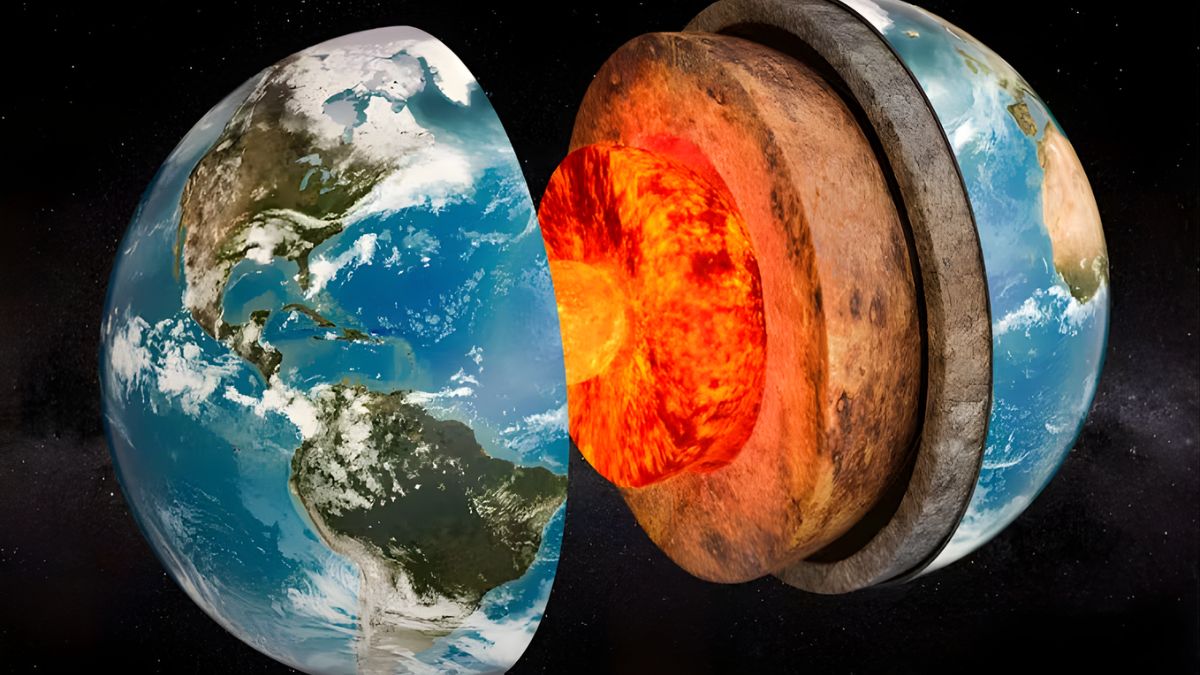
We’ve looked into the oceans, mapped continents, and even sent satellites to space—but the depths beneath our feet still hold mysteries. For a long time, scientists wondered whether the Earth’s mantle—the thick layer between the crust and the core—was completely dry. But recent discoveries have flipped the script. It turns out that deep within the mantle, hundreds of kilometers below the surface, massive amounts of water are hidden inside minerals.
This isn’t liquid water like we find in lakes or oceans. It’s water trapped within the very structure of rocks. Still, this discovery could completely reshape how we understand the planet and its internal processes. So, what exactly is this hidden water, and why is it such a big deal?
Table of Contents
Mystery

Let’s start with the basics. The mantle is a huge, mostly solid layer of hot rock that stretches from just beneath the Earth’s crust down to its core. Despite all we’ve learned about geology, the mantle remains one of the most mysterious parts of our planet.
In fact, science fiction writer Jules Verne once imagined massive oceans inside the Earth in his novel Journey to the Center of the Earth. It sounded wild, right? But today, scientists are finding that maybe Verne wasn’t too far off. While we haven’t found oceans of water sloshing around underground, we’ve discovered something just as mind-blowing: minerals deep in the mantle are holding onto water—lots of it.
Diamond
In 2009, a graduate student stumbled upon what looked like a dull, dirty diamond. It didn’t look like much, but when analyzed by Dr. Graham Pearson and his team at the University of Alberta, it turned out to be a geological jackpot.

Inside the diamond was a rare mineral called ringwoodite. This mineral is special because it can hold water within its crystal structure—up to 1.5% of its weight. That doesn’t sound like much, but considering how vast the mantle is, that tiny percentage adds up to a mind-boggling amount of water.
Depths
Ringwoodite is a mineral that forms only under very specific conditions: extreme pressure and heat, between 410 and 660 kilometers beneath the Earth’s surface. This region is known as the transition zone of the mantle.
Before this discovery, ringwoodite had only ever been found in meteorites, like the famous one from Australia in 1969. That’s why this Earth-born diamond containing ringwoodite was such a big deal—it was the first direct evidence that this water-bearing mineral exists deep inside our own planet.
The diamond itself made a crazy journey. It was carried to the surface by a volcanic rock called kimberlite, which forms deep in the mantle and pushes material upward. This particular diamond ended up in a riverbed in Brazil and was sold for just $20—nobody realizing it held a scientific breakthrough.
Proof
Fast forward to 2022, and the plot thickens. Physicist Tingting Gu, from the Gemological Institute of America, found another diamond—this time from Botswana. But this one was even more revealing.
Not only did it contain ringwoodite, it also had two other high-pressure minerals, both of which only form more than 410 miles (around 660 kilometers) underground. This proved that these water-rich minerals aren’t just in one spot—they exist across a large area of the mantle.
So now, with two diamonds from different parts of the world pointing to the same thing, scientists are much more confident in their theories.
Meaning
So what does all this mean for Earth science? Well, it changes a lot.
Scientists now believe the mantle might hold more water than all the oceans on Earth combined. Yes, more than the Pacific, Atlantic, and every sea on Earth—combined! But remember, this water isn’t in liquid form. It’s part of the rock’s internal structure.
Even so, this “hidden ocean” could have a huge impact on how the Earth works. Here’s how:
| Process | Role of Mantle Water |
|---|---|
| Plate Tectonics | Lubricates plates, influencing how they move. |
| Volcanic Activity | Affects how magma forms and erupts. |
| Heat Regulation | Helps control Earth’s internal energy balance. |
This means everything from earthquakes to volcanic eruptions could be linked to how water behaves deep inside the planet. And it all started with a tiny brown diamond no one thought was special.
Thanks to this discovery, we’re rewriting the textbooks on Earth’s structure and water cycle. The next time you look up at the sky or out at the sea, remember—there may be even more water buried deep below your feet.
FAQs
Is there water in Earth’s mantle?
Yes, water is trapped inside minerals deep within the mantle.
What is ringwoodite?
It’s a deep-Earth mineral that can hold water in its structure.
Where was ringwoodite found?
First inside a diamond from Brazil, later in one from Botswana.
Is the mantle water in liquid form?
No, it’s stored within minerals, not as free-flowing liquid.
Why is this discovery important?
It changes how we understand Earth’s water and geology.