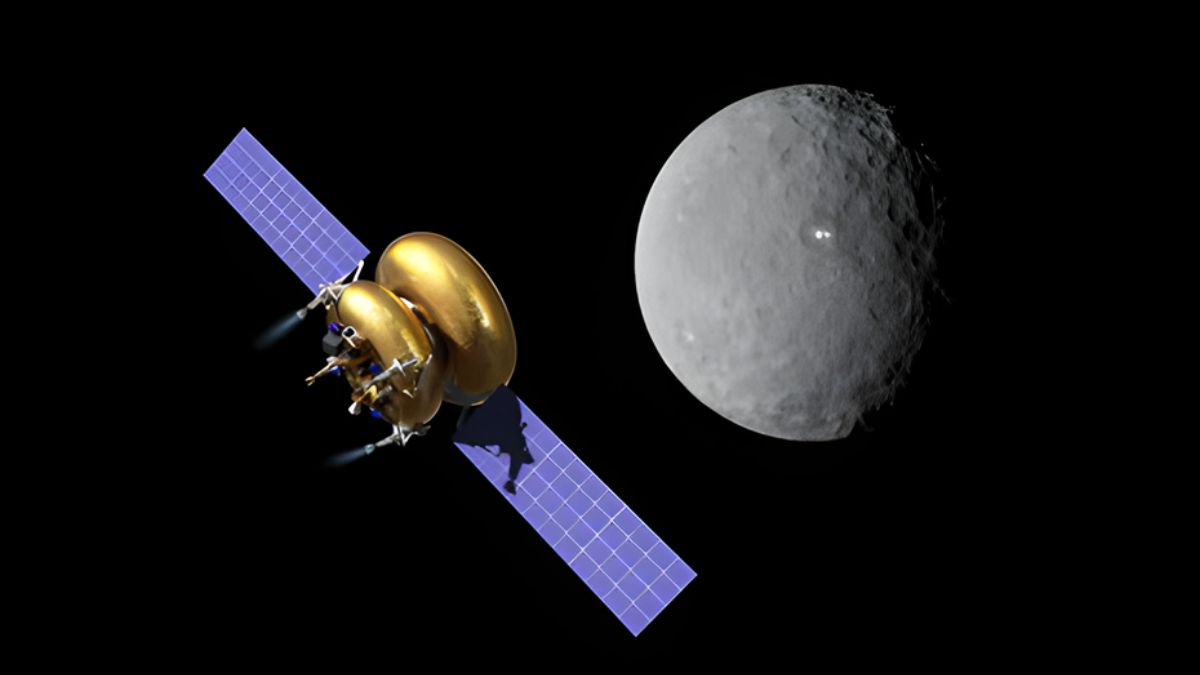
What if we told you there’s an asteroid floating between Mars and Jupiter with more gold than Earth has ever seen? Sounds like a sci-fi movie, right? Well, it’s real. NASA has its eyes on an asteroid named Psyche, and according to early estimates, it could be worth around 700 trillion euros—yes, trillion—with a T. This shiny space rock is packed with precious metals like gold, iron, and nickel, and it’s stirring up dreams of a future where space mining might just make billionaires out of us all.
But before we quit our jobs and invest in space shovels, let’s break down what this discovery actually means.
Table of Contents
Psyche
The Psyche asteroid was first spotted in 1852 by Italian astronomer Annibale de Gasparis. For over a century, it was just one of many lonely rocks orbiting in the asteroid belt between Mars and Jupiter. But recent studies have turned this hunk of space metal into one of the most intriguing objects in our solar system.
Why? Because scientists now believe that Psyche might be the exposed core of an ancient protoplanet, a planetary building block that never fully formed.
Jackpot
So what makes Psyche different from the thousands of other asteroids floating around out there? Its metallic content.

According to studies, somewhere between 30% and 60% of Psyche is made of metal—specifically iron, nickel, and gold—mixed in with silicate rock. Its surface area is over 165,000 square kilometers, which is nearly the size of Cambodia.
Now for the jaw-dropper: some estimates peg the total value of its materials at more than 700 trillion euros. That’s more than the combined GDP of every country on Earth. If we could somehow bring all of that back, well… the phrase “everyone’s a millionaire” might take on a whole new meaning.
Orbit
Psyche is cruising through the asteroid belt, located between Mars and Jupiter. It sits about 370 million kilometers from Earth and is believed to be the leftover core of a planet that began forming billions of years ago but never made it.

It wasn’t until recently that NASA turned its focus to Psyche, likely because of its immense value—not just in cash, but in knowledge.
Mission
NASA officially launched the Psyche Mission in 2023 to study the asteroid up close. But don’t get it twisted—this isn’t a space mining operation (yet). The mission’s goal is scientific: to understand how rocky planets like Earth formed.
Using solar-electric propulsion, the Psyche spacecraft will slingshot past Mars before reaching the asteroid in 2029. Once there, it’ll study the surface using spectrometers, magnetometers, and high-tech cameras to analyze what Psyche is made of and what it can tell us about the early solar system.
So while it may look like a vault in the sky, for now, it’s strictly a science trip.
Mining
Here’s the real question: could we ever bring this treasure home?
The answer, at least for now, is no. Mining Psyche would require space infrastructure we simply don’t have—yet. The technology, the cost, the time—it’s all way beyond what we can currently do. But that hasn’t stopped private companies and space agencies from dreaming big.
Some believe that within a few decades, the first mining missions beyond Earth will begin. And Psyche could be the test case that kickstarts it all.
Impact
Let’s say we could mine Psyche and bring back that mountain of gold. What would happen?
Bringing massive amounts of gold or other precious metals to Earth could crash global markets. It would change the value of resources overnight and shake the foundations of modern economies. There are also major questions about who would own the materials. Is it the country that launched the mission? The company that built the tech? Or should it belong to all of humanity?
Space mining opens up a galaxy of ethical, legal, and environmental questions. And right now, we don’t have many answers.
Gold Rush
Just like the California gold rush in the 1800s, the Psyche discovery has triggered wild excitement. But instead of panning rivers, the next big rush could be across the solar system.
Still, don’t expect gold raining from the sky anytime soon. For now, this is a mission of exploration, not profit. But it’s the beginning of a conversation that’s going to shape the future of space travel, economics, and even international law.
One thing’s for sure—Psyche has already changed the way we think about what’s possible.
Psyche Stats
Here’s a quick snapshot of what we know:
| Feature | Detail |
|---|---|
| Name | 16 Psyche |
| Discovered | 1852 by Annibale de Gasparis |
| Location | Asteroid belt between Mars and Jupiter |
| Estimated Value | €700 trillion (approx.) |
| Surface Area | ~165,000 sq. km |
| Composition | Iron, nickel, gold, and silicates |
| Mission Launch | 2023 |
| Arrival Date | 2029 |
| Main Objective | Study core-like composition |
FAQs
How much is Psyche asteroid worth?
It’s estimated to be worth around €700 trillion.
Can we mine the Psyche asteroid?
Not yet. The technology is still being developed.
When will the Psyche mission arrive?
NASA’s Psyche spacecraft is expected to arrive in 2029.
Is there gold on the Psyche asteroid?
Yes, along with iron and nickel, it’s rich in gold.
Why is NASA studying Psyche?
To understand how rocky planets like Earth were formed.