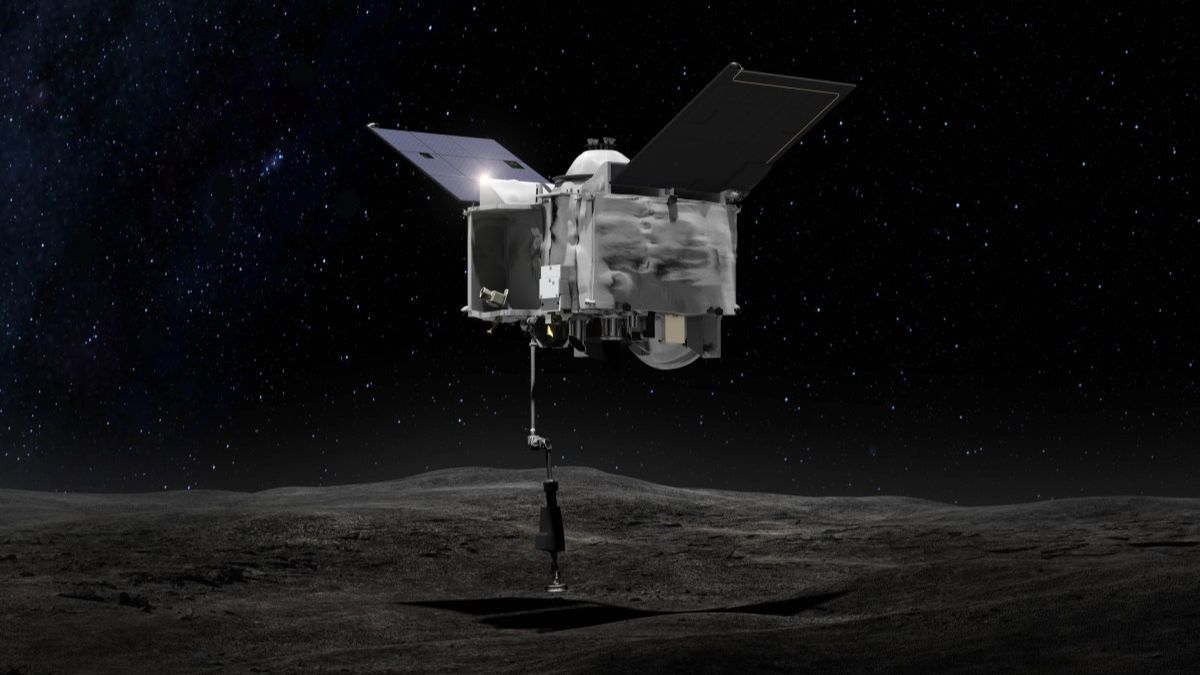
The Hayabusa2 mission was already a game-changer in the world of space exploration, but when it returned to Earth in 2020 carrying tiny grains from the Ryugu asteroid, it brought with it a new chapter in our understanding of the universe.
These space particles weren’t just space dust—they carried chemical signatures older than Earth itself. And among those grains? A mineral never before seen on our planet. Let’s break down what this discovery means and why it’s such a big deal.
Table of Contents
Origins
To really appreciate this discovery, you have to rewind the cosmic clock. Ryugu is a carbonaceous asteroid, meaning it’s rich in carbon and other elements that formed during the early stages of the Solar System—around 4.6 billion years ago. It’s like a time capsule from a period long before Earth was even a concept.
What’s so special? Well, Earth’s geological activity—earthquakes, volcanic eruptions, erosion—has wiped away its earliest chemical records. But Ryugu? It’s been floating peacefully in space, untouched by time, storing raw materials from the dawn of everything.
Scientists analyzed two tiny grains from different parts of Ryugu—one from the surface, one from inside the rock. Each grain told a different story, but together, they revealed the kind of pristine chemistry that simply doesn’t exist on our home planet anymore.
Samples
Here’s the thing—space missions are expensive and complex, and when it comes to material return, every milligram counts. Hayabusa2 brought back just 5.4 grams of asteroid material. From that, only 9.3 milligrams were given to Paul Northrup’s research team at Stony Brook University.
That’s about the size of a grain of sand.
Because of the small sample size, researchers had to be incredibly cautious. Damaging or altering the grains would mean losing critical data forever. Instead of slicing or crushing the samples, the team used advanced, non-destructive X-ray imaging techniques. This allowed them to study the inside and outside of the mineral without so much as scratching it.
Elements
So what exactly did the Ryugu dust contain? A mix of elements, many of which are essential to life on Earth. Here’s a quick breakdown:
| Element | Significance |
|---|---|
| Selenium | Important in DNA repair |
| Manganese | Vital for metabolic functions |
| Iron | Key component of blood |
| Sulfur | Found in amino acids |
| Phosphorus | Essential for DNA and ATP |
| Silicon | Used in biological structures |
| Calcium | Builds bones and teeth |
Among these, phosphorus stood out the most. It was found in two forms—one identical to the mineral that makes up our bones and teeth, and the other? Something completely new.
Mineral
This mysterious new form of phosphorus turned out to be a compound never found on Earth. After further analysis in 2024, scientists identified it as hydrated ammonium magnesium phosphate, or HAMP.
Never heard of it? That’s because it doesn’t exist here.
Interestingly, it shares structural similarities with struvite, a mineral formed in biological settings on Earth (even inside kidney stones). But this version had no known Earthly origin. It formed in space, untouched by Earth’s environmental or biological processes.
Significance
So why does this matter? Astrobiologist Matthew Pasek explained the importance clearly in Nature Astronomy. He pointed out that the discovery of HAMP shows how materials from space could have influenced early life on Earth.
In simpler terms, this space mineral could have helped spark the chemical reactions that led to life as we know it.
Think of it this way: if Earth is a cake, these asteroid minerals might just be part of the original recipe. They’re the missing ingredients that help explain how biology began.
Future
This isn’t just a cool headline—it’s a step toward answering one of humanity’s oldest questions: where do we come from?
The fact that Ryugu’s samples have revealed something completely alien to our planet’s geology means there’s still so much we don’t know. And if we can find a new mineral in just 5 grams of asteroid dust, imagine what else is out there waiting to be discovered.
So the next time you look up at the night sky, just remember—those stars and specks might be carrying the very building blocks of life.
The Ryugu mission is a reminder that space isn’t just about stars and black holes. It’s about chemistry, biology, and history—our history. And every tiny grain from beyond Earth holds clues to the mysteries we’ve been asking for thousands of years.
FAQs
What is Ryugu?
Ryugu is a carbon-rich asteroid studied by the Hayabusa2 mission.
What mineral was found?
The mineral is hydrated ammonium magnesium phosphate (HAMP).
Why is the mineral important?
It could have played a role in life starting on Earth.
How much material did Hayabusa2 return?
Only 5.4 grams of asteroid material were returned.
Is HAMP found on Earth?
No, HAMP is a space-only mineral never seen on Earth.