
Just when you think space can’t surprise us any more, it does. Say hello to 2025 PN7, a newly discovered quasi-moon that’s quietly tagging along with Earth as we orbit the Sun. It’s not quite a moon like the one we see glowing in the night sky, but it’s definitely a fascinating visitor — and it’ll be sticking around for a while.
Let’s look into what this new celestial neighbor is all about and why scientists are so excited about it.
Table of Contents
Companion
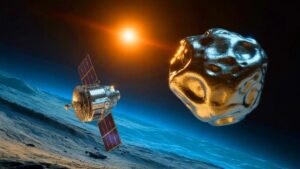
Discovered by a team of astronomers from the University of Hawaii in the summer of 2025, 2025 PN7 is small — only about 18 to 36 meters wide — roughly the size of a school building.
But don’t let its size fool you. Its orbit has caught the attention of researchers worldwide because it’s not just another asteroid. Instead of flying off into deep space, it moves alongside Earth in a curious and graceful pattern.
Unlike our Moon, which is held firmly by Earth’s gravity, 2025 PN7 isn’t actually orbiting Earth at all. It orbits the Sun, just like Earth does — but in a way that keeps it close to us.
Orbit
So, what exactly is a quasi-moon?
Imagine two runners on a track, moving at similar speeds in neighboring lanes. They’re not tied together, but they stay close. That’s the relationship Earth has with a quasi-moon like 2025 PN7.
This space rock loops around in a similar path to Earth, which makes it look like it’s orbiting us, even though it’s really doing its own thing around the Sun.
According to scientists, 2025 PN7 first joined Earth’s side about 60 years ago, and it’ll continue to keep us company until around 2083. At its closest, it comes within 4 million kilometers — that’s about 10 times farther than the Moon. At its farthest, it drifts up to 17 million kilometers away.
This variation happens because of gravitational influences from the Sun and other planets, causing its path to wobble slightly over time.
Discovery
Finding a quasi-moon isn’t easy. These objects are small, dark, and follow complex orbits that make them hard to detect with traditional telescopes.
That’s why the discovery of 2025 PN7 is such a big deal. Astronomers only realized quasi-moons existed in the 1990s, and since then, only eight have been confirmed — including this one.
The team from the University of Hawaii spotted it during a routine sky survey using powerful ground-based telescopes. At first, it appeared as just a faint moving dot. But after carefully tracking its motion for several weeks, they confirmed it wasn’t a satellite, a piece of space junk, or a typical asteroid.
It was something much more unique — a quasi-moon.
Significance
Even though 2025 PN7 doesn’t pose any danger, it holds scientific importance. It’s a rare chance for astronomers to study how Earth’s gravity influences nearby space objects and to learn more about the behavior of small bodies in our solar system.
Here’s why quasi-moons matter:
| Benefit | Why It Matters |
|---|---|
| Study of motion & gravity | Helps know how small objects move near planets |
| Asteroid knowledge | Quasi-moons share traits with asteroids |
| Exploration potential | Could be test sites for future missions |
| Resource mining studies | May help plan future mining of space materials |
Knowing objects like 2025 PN7 could even help in preparing for asteroid mining or defense missions in the future.
Surprise
The most fascinating part? This discovery reminds us how little we still know about our own solar system. Even after centuries of looking at the skies, new objects like 2025 PN7 continue to appear out of the cosmic shadows.
Each new finding helps refine our models, teaches us more about gravitational interactions, and keeps the curiosity of space exploration alive.
So next time you gaze at the Moon, remember — there’s another quiet traveler, 2025 PN7, gliding alongside us in the vast ocean of space. Not quite a moon, but still a loyal companion in our cosmic journey.
FAQs
What is 2025 PN7?
It’s a newly discovered quasi-moon orbiting with Earth.
Is 2025 PN7 a real moon?
No, it orbits the Sun, not Earth, but stays close to us.
How long will 2025 PN7 stay?
It will remain near Earth until around the year 2083.
How far is 2025 PN7 from Earth?
Between 4 and 17 million kilometers depending on its orbit.
Why are quasi-moons important?
They help scientists study space motion and asteroid behavior.