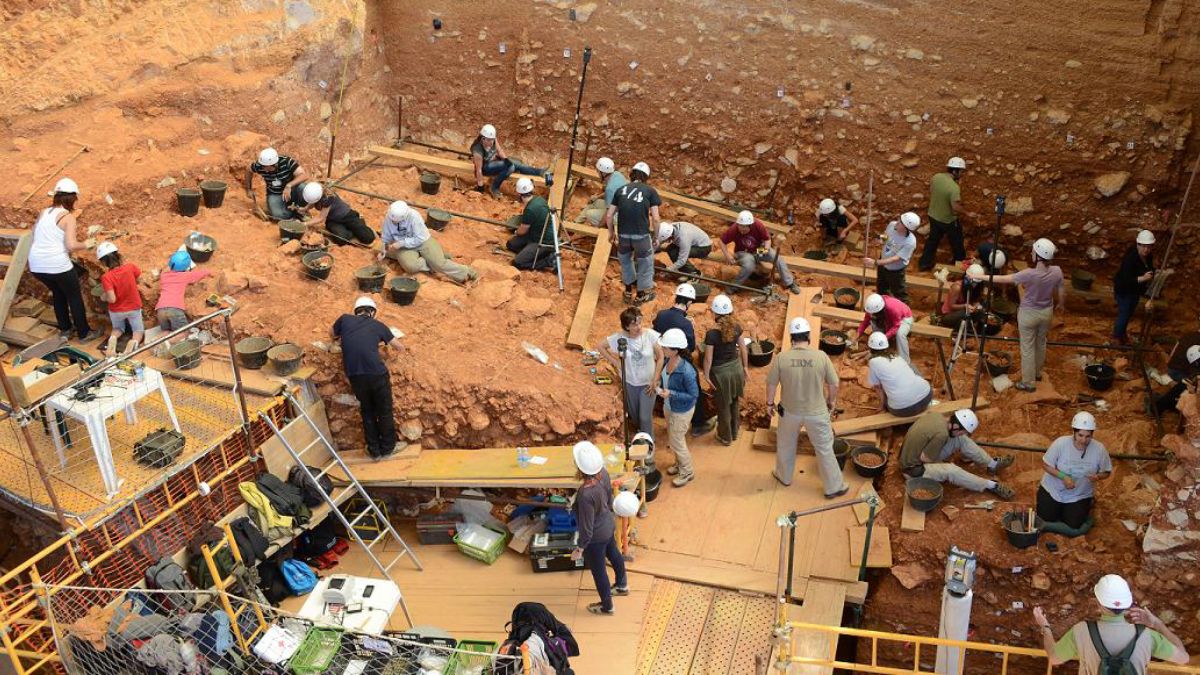
High in the mountains of Atapuerca, in northern Spain, one of the most important archaeological sites in the world is revealing dark secrets about our ancient past. In 2025, paleontologists working in the Gran Dolina cave made a discovery that confirmed something many had feared but could never fully prove: some of the first humans in Europe practiced cannibalism—including on children.
This isn’t a theory or a loose interpretation. The evidence is physical, visible, and scientifically irrefutable. Human bones from over 800,000 years ago bear the same treatment as animal remains, showing that our early ancestors in Europe consumed members of their own kind.
Table of Contents
Evidence

Let’s begin with the discovery that sparked it all. In the TD6 level of Gran Dolina, researchers uncovered a small vertebra belonging to a child estimated to be just 2 to 5 years old. What stood out wasn’t just the age of the bone—but the unmistakable marks left by sharp stone tools.
These weren’t random scratches or erosion from time. These were precise cuts made to separate the head from the body—something that takes skill and intention. And it didn’t end there.
This vertebra was found alongside other human bones from at least 11 individuals, many of them children or teenagers. These remains, first uncovered in 1994, showed the same cut marks, breaks, and signs of being processed for consumption—just like the bones of deer and horses found nearby.
Repetition

The most chilling part? This didn’t just happen once.
The layers of the cave show evidence of at least two separate episodes of cannibalism, separated by hundreds of years. That means this wasn’t just a desperate act during a time of famine—it was likely a repeated, perhaps even culturally accepted, practice.
Researchers believe this indicates a form of nutritional cannibalism—where human meat was consumed for survival, not ritual. Bones were cleaned of flesh, broken open to get to the marrow, and even show bite marks made by human teeth.
The remains were left mixed with animal bones, with no special burial or treatment—further suggesting they were seen as just another food source.
Victims
Most of the remains belong to children and adolescents. Why?
That question remains open, but the data points to a pattern of catastrophic mortality—meaning many children likely died in a short span of time, not gradually over years. This could suggest an event, conflict, or a specific reason why the young were targeted or most vulnerable.
Were they victims of internal violence? Outsiders captured during clashes between groups? Or simply those least able to defend themselves in a world where survival was the only rule?
So far, the evidence doesn’t support a ritual or ceremonial explanation. Everything points to practicality: meat was meat.
Pattern
As shocking as the Atapuerca discovery is, it’s not unique.
Other prehistoric sites across Europe show signs of ancient cannibalism. At Moula-Guercy in France, archaeologists found six Neanderthals—including children—whose bones showed identical processing marks. In El Sidrón, in Asturias, Spain, Neanderthal remains suggest cannibalism driven by famine or hardship.
But Gran Dolina stands out for two reasons:
- Age – Over 800,000 years old, making it the oldest confirmed case of child cannibalism.
- Repetition – It happened more than once, showing it may have been part of cultural survival.
Importance
It’s easy to look at cannibalism through today’s moral lens, but in the Paleolithic world, survival often overruled ethics. For paleontologists, the significance lies not in the horror—but in what the discovery tells us.
These ancient people weren’t monsters. They were doing what they had to do to stay alive in a brutal environment. And in that sense, the discovery opens a raw and honest window into our own evolution.
By comparing treatment of human and animal bones, researchers now have proof that early humans saw little difference when it came to survival.
Here’s a quick comparison:
| Bone Treatment | Human Remains | Animal Remains |
|---|---|---|
| Cut Marks | Yes | Yes |
| Bone Breaks | Yes | Yes |
| Bite Marks | Yes | Yes |
| Burial or Ritual | No | No |
This data leaves little room for doubt—humans were processed just like animals.
Insight
This discovery also led to something else remarkable. The earlier remains found in 1994 helped scientists define a new human species: Homo antecessor, believed to be an ancestor of both Neanderthals and modern humans.
So in a way, the bones of these cannibalized children and teens are helping us learn not just about survival—but about who we are and where we came from.
Each bone, each mark, each bite is part of a bigger picture—a time when life was uncertain, food was scarce, and survival demanded hard choices.
FAQs
Where was the child skeleton found?
In the TD6 level of Gran Dolina, Atapuerca, Spain.
How old is the cannibalism evidence?
The bones are over 800,000 years old.
Was this a one-time event?
No, there were at least two separate episodes.
Were children the main victims?
Yes, most remains belong to children and teens.
Was the cannibalism ritualistic?
No, evidence shows it was for nutritional purposes.