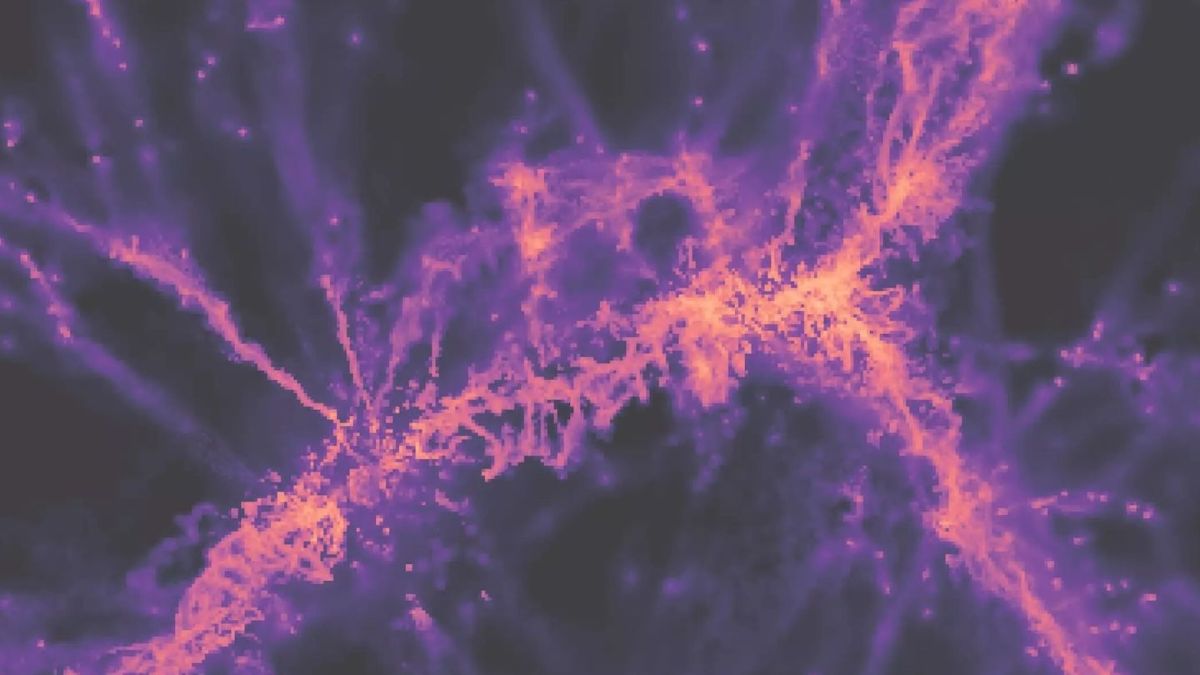
For years, scientists have theorized about invisible threads stretching across the universe—connecting galaxies, guiding matter, and shaping the very structure of space itself.
Now, thanks to a powerful telescope in Chile and hundreds of hours of patient observation, astronomers have finally captured a direct image of a filament of the cosmic web. It’s real, it’s huge—over three million light-years long—and it’s been out there for 12 billion years.
This isn’t just another pretty space picture. It’s a turning point in how we know the universe.
Table of Contents
Web
So, what exactly is the cosmic web? Imagine the universe as a gigantic spider web stretched across space. Galaxies don’t just float around randomly. They’re strung along this vast, delicate structure made mostly of gas and dark matter—two of the most mysterious substances in the cosmos.
The densest knots in the web are where galaxies form and cluster. These are the intersections—the nodes. Gas flows through the strands, and dark matter acts like an invisible magnet, pulling and shaping everything around it. Scientists have believed in the existence of this web for decades, but until now, it was just theory. We could only “see” it by how light from distant galaxies bent as it passed through. But finally, we’ve captured it on camera.
Capture

The breakthrough came from a team at the University of Milano-Bicocca in partnership with the Max Planck Institute for Astrophysics. They used the MUSE spectrograph on the Very Large Telescope (VLT) in Chile—a piece of tech that doesn’t just take pictures but breaks down light into detailed data.
After observing the same patch of sky for days, the team finally saw it: a filament of gas stretching between two galaxies, both containing supermassive black holes. The gas within the galaxies was clearly separate from the intergalactic gas in the filament, and that distinction is huge. It proves that this web is a real, physical structure, not just a figment of our simulations.
Telescope
Capturing something this distant and faint is not like snapping a sunset. It’s more like trying to photograph a candle flame on the Moon. The VLT’s MUSE spectrograph was key because it can slice light into all its wavelengths, revealing details the human eye can’t detect.
They had to stare at the same tiny piece of the sky for hundreds of hours, collecting every photon possible. Eventually, the faint signal of the cosmic web filament appeared—like finding a hairline crack on a windshield from a mile away.
Structure
So, what did they see? A thin thread of gas, extending millions of light-years, connecting two galaxies across the emptiness of space. This is the first time scientists have clearly observed a section of the cosmic web in real detail, and the structure fits exactly with what simulations have predicted.
In short, this is like going from an old pirate treasure map to a satellite image. For scientists, it’s a major win.
Here’s how it compares:
| Feature | Before (Theory) | Now (Observation) |
|---|---|---|
| Cosmic Web Detection | Simulations only | Real image captured |
| Gas in Intergalactic Space | Assumed | Clearly distinguished |
| Galaxy Formation Theories | Mostly hypothetical | Confirmed by observation |
| Filament Structure | Model-based | Matches observed filament |
Meaning
Why does this matter? Because the cosmic web is the universe’s backbone. Understanding how it works means understanding how galaxies are born, how they grow, and what they consume. These filaments act as highways, delivering gas to galaxies, fueling star formation, and shaping the universe’s evolution.
Each filament we find adds a piece to the puzzle. And this first confirmed image? It’s just the beginning.
Future
This discovery opens the door to much more. Scientists plan to search for many more filaments using the VLT and eventually the Extremely Large Telescope (ELT), which will have even greater power and precision.
Think of it as building the Google Maps of the universe. With each filament observed, the cosmic structure becomes clearer. Someday, we might have a detailed map showing exactly how matter flows across the cosmos—from one galaxy to another, through the invisible threads of space.
Perspective
Fabrizio Arrigoni Battaia from the Max Planck Institute summed it up best: “We are delighted with this direct and high-definition observation of a cosmic filament. But, as they say in Bavaria: ‘Eine ist keine’ (one does not count).”
One filament down, countless more to go.
The universe has just given us a glimpse behind the curtain—and it’s more interconnected than we ever imagined.
FAQs
What is the cosmic web?
It’s a structure of gas and dark matter connecting galaxies.
How big is the filament observed?
Over three million light-years long.
How was it captured?
Using the MUSE spectrograph on the VLT in Chile.
Why is this discovery important?
It confirms theories about how the universe is structured.
Will more filaments be found?
Yes, with future telescopes like the ELT.