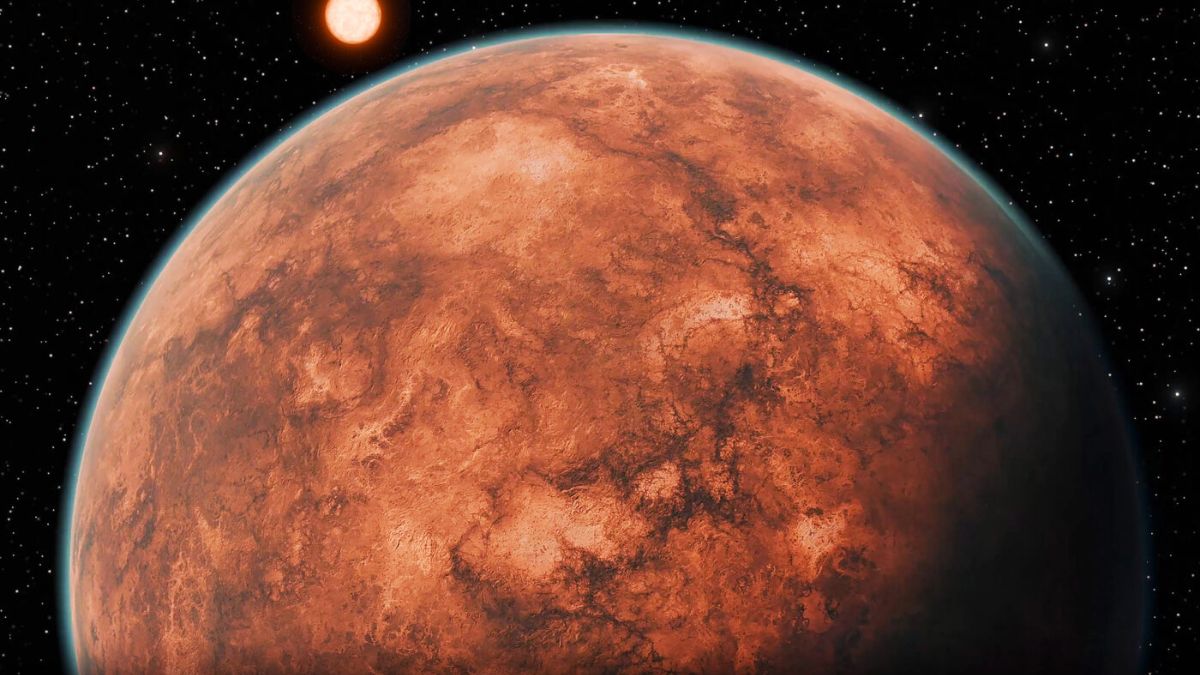
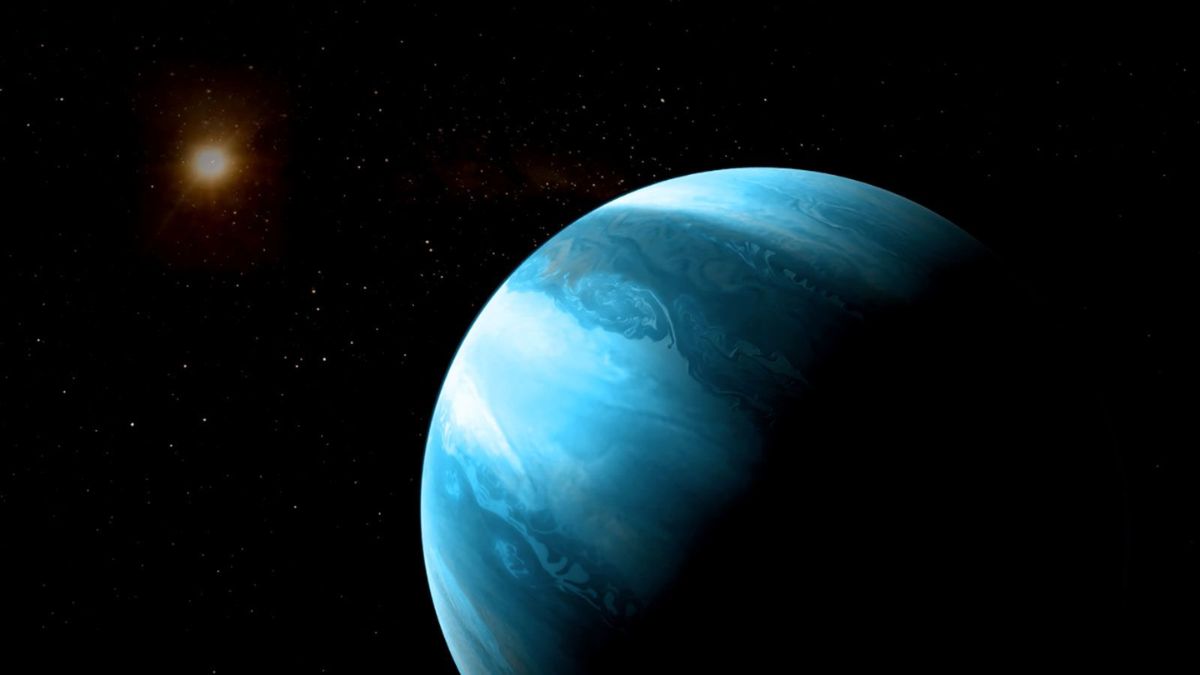
Astronomers just found something that completely flips our understanding of planet formation. Meet TOI-6894b—a giant gas planet orbiting a star so small it’s only one-fifth the mass of our Sun. Even more shocking? The planet is larger than Saturn but has only about half its mass.
This unusual pairing challenges long-standing theories and could mean that huge planets around tiny stars are far more common than we ever imagined. Let’s look into what makes this discovery such a game-changer.
Table of Contents
Discovery
The planet was uncovered during a deep scan of over 91,000 red dwarf stars using NASA’s Transiting Exoplanet Survey Satellite (TESS). Edward Bryant, an astronomer at University College London, was digging into the data, specifically looking for gas giants around low-mass stars.
He struck gold. Follow-up observations from one of the world’s most powerful telescopes—the European Southern Observatory’s Very Large Telescope (VLT)—confirmed it: TOI-6894b is a giant planet orbiting a faint red dwarf star named TOI-6894.
This star is incredibly dim and cool compared to our Sun. Yet, its companion planet is puffed up, even larger in radius than Saturn, but weighs only about half as much.
Surprise

Why is this a big deal? Because planets like TOI-6894b weren’t supposed to exist around stars like this.
Conventional thinking says small stars like TOI-6894 have thin disks of gas and dust—not enough raw material to build a massive planet. In fact, TOI-6894 is 60% smaller than any other known star that hosts a gas giant. It’s like discovering a cruise ship docked at a tiny fishing village—it just doesn’t fit the model.
Most giant planets are thought to form through core-accretion, where a solid core forms and then pulls in surrounding gas. But for stars this small, their disks shouldn’t be able to form such large cores before the gas disappears.
Mystery
So how did TOI-6894b form? That’s still a mystery.
One idea is that it followed an “intermediate” form of core-accretion—somewhere between the standard method and a more chaotic one. That chaotic method is gravitational instability, where parts of the disk collapse on themselves to form a planet.
But neither theory explains everything we’re seeing. For now, TOI-6894b’s origin is wide open, and it’s keeping scientists guessing.
Atmosphere
Not only is TOI-6894b strange in how it formed, it’s also a rare treat for atmospheric scientists.
Despite being a gas giant, it’s not scorching hot. Its distance from its faint star keeps it at a relatively cool 420 Kelvin (about 147°C or 296°F). That cooler temperature means the atmosphere might be dominated by methane—a rare find in exoplanet research.
In fact, TOI-6894b could be the best shot yet at detecting ammonia in an exoplanet’s atmosphere—something never done before. Scientists think this planet could become the “laboratory” for studying exoplanet atmospheres with methane, carbon, nitrogen, and oxygen.
It’s already earned a spot on the James Webb Space Telescope’s observation list. Upcoming studies could reveal even more about its atmospheric chemistry, clouds, and possibly even how it was formed.
Implications
This planet’s existence changes everything. Red dwarfs like TOI-6894 are the most common stars in our galaxy. If even one can host a gas giant, it means many others might too.
The fact that TOI-6894 is so small yet hosts such a large planet forces astronomers to rethink just how frequent these kinds of planets might be.
This one discovery could boost the estimated number of gas giants across the galaxy—and it’s a reminder that planet formation doesn’t always follow the rules.
Future
TOI-6894b is just the beginning. Every new data point helps sharpen the models of how planets form, especially around stars we once thought couldn’t support them.
Upcoming observations, especially with JWST, will likely provide new insights into its atmosphere, formation, and structure. Until then, TOI-6894b stands as a reminder that the universe loves to surprise us—and that we still have a lot to learn about how planets form, grow, and evolve.
Sometimes the cosmos bends the rules. TOI-6894b didn’t just bend them—it rewrote the playbook.
FAQs
How big is TOI-6894b?
TOI-6894b is larger than Saturn but only half as massive.
What type of star is TOI-6894?
TOI-6894 is a cool, low-mass red dwarf star.
How was TOI-6894b discovered?
It was found using TESS data and confirmed by ESO’s VLT.
What makes TOI-6894b unique?
Its massive size around a tiny star defies current models.
Is TOI-6894b’s atmosphere being studied?
Yes, it’s on JWST’s list to study its methane-rich atmosphere.