Sometimes the most powerful discoveries come in the simplest forms — like a clay vase. What looked like an ordinary piece of pottery during an excavation in the Sharjah desert, UAE, turned out to be a window into ancient Arabia’s connection with the wider world.
Inside this vase? A treasure of 409 silver coins dating back over 2,300 years. This find isn’t just about the coins — it’s about rewriting the story of Arabia’s place in global trade and cultural exchange. Let’s cut in.
Table of Contents
Treasure

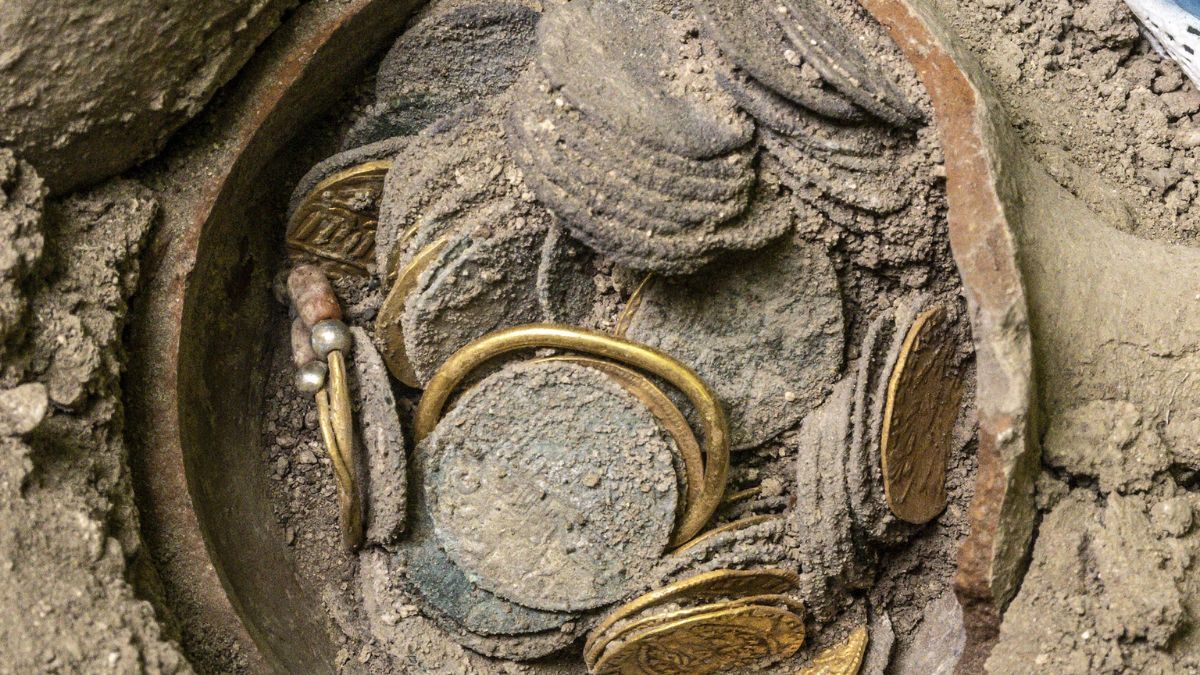
In 2021, archaeologists stumbled upon a clay vase in Mleiha, a historic city in the heart of the UAE desert. But this wasn’t just any vase. When they tried to lift it, it weighed over 9 kilograms — far more than expected for a typical clay container.
Curious, they opened it. And there it was: a perfectly preserved hoard of silver coins. No grains, no water, just pure, ancient currency tucked away in the sand for over two millennia.
Coins
The coins inside the vase weren’t just random bits of metal. Most of them were tetradrachmas — silver coins commonly used during the Hellenistic period. Each coin weighed about 16 to 17 grams and carried symbols that told stories of empires and power.

Many featured Alexander the Great as Hercules, while others showed Zeus seated on a throne. Over time, the designs evolved. Later coins had Aramaic scripts and regional symbols, showing a shift toward local identity and influence.
This shift in imagery is key. It reveals how local cultures in Arabia didn’t just passively adopt Greek culture — they blended and adapted it, creating something entirely their own.
Mleiha
So why was this treasure hidden in Mleiha? Because this city wasn’t some forgotten settlement. Mleiha was a thriving hub that linked trade routes between India and the Mediterranean. Located between the Persian Gulf and the Gulf of Oman, its strategic location made it a key player in the ancient world.

Merchants passed through with spices, incense, textiles, and precious metals. And to trade effectively, they needed coins that were widely accepted. That’s why Mleiha began producing its own currency — Greek in style but tailored for Arabian commerce.
Network
This vase isn’t a one-off discovery. Similar coins have been found in places like Kuwait and Bahréin, showing a broader economic and cultural network across the Gulf.
The presence of these coins across the region proves that ancient Arabia was already part of a sophisticated trade system, not isolated or behind the times. In fact, it was right at the center of the action, adapting global systems to suit its own needs.
Roots
Though the coins date to the 3rd century BC, Mleiha’s roots stretch much further back — as far as 130,000 years ago. Archaeological finds reveal signs of early human habitation and development.
The city flourished thanks to agriculture and an ingenious underground irrigation system called falaj. This allowed farming in the harsh desert environment. Over time, Mleiha evolved into a fortified urban center with temples, palaces, and workshops — the kind of place where someone might hide a valuable treasure for safekeeping.
Meaning
What does this vase full of coins really tell us? That Arabia wasn’t just a trade stop or cultural follower. It was a dynamic player in shaping regional and global systems.
The vase offers a powerful message: Arabia took foreign ideas, reworked them, and made them its own. The gradual shift from Greek symbols to local inscriptions on the coins is proof that the region was confident, creative, and politically aware.
So yes, a single vase discovery can be very important. It shows how archaeology isn’t just about digging up old things — it’s about piecing together stories we never knew existed. And in this case, that story is one of power, trade, and cultural pride in ancient Arabia.
FAQs
What was inside the vase?
409 silver coins dating back over 2,300 years.
Where was the vase found?
In the Sharjah desert, UAE, near Mleiha.
What do the coins show?
Greek and local designs blending cultures.
Why is Mleiha important?
It was a trade hub connecting India and the Mediterranean.
Why is the vase discovery significant?
It proves Arabia’s role in ancient global trade.