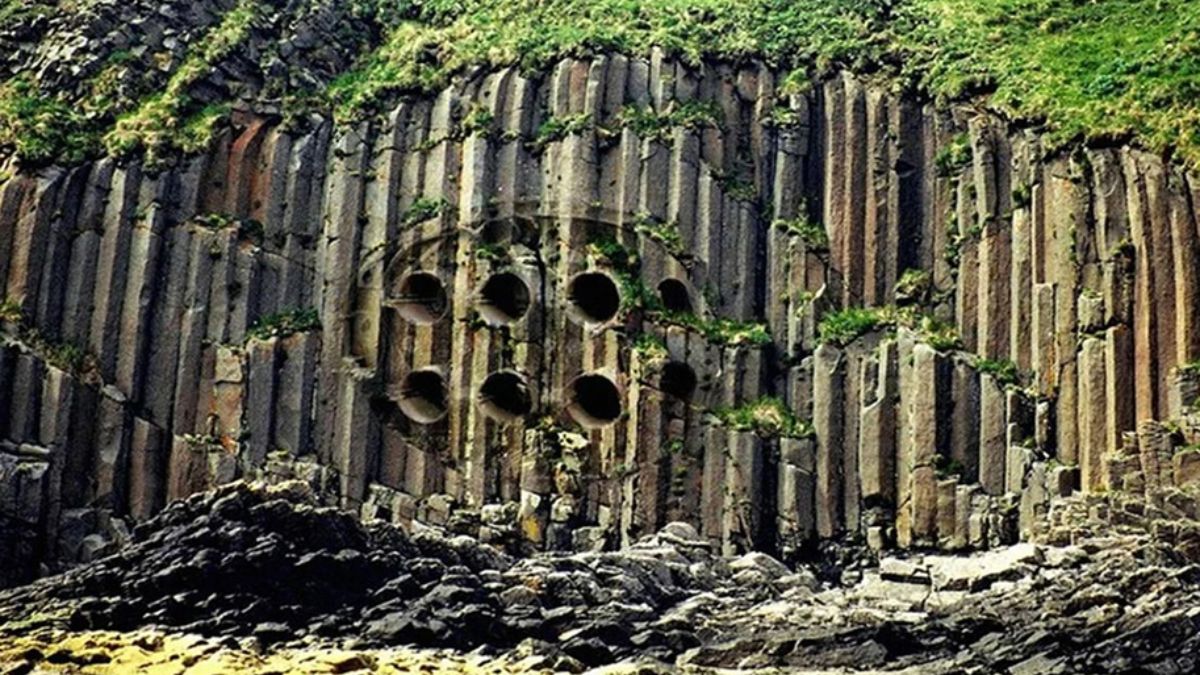
Hidden in the remote lands of Qinghai province, China, lies a mystery that has been puzzling researchers and fueling speculation for decades — the Baigong pipes. Found embedded in the ground around Mount Baigong and even extending into nearby Lake Toson, these pipe-like structures have baffled scientists since they were first reported in the 1990s.
Some believe they could be natural, others claim they’re manmade… and a few even suggest extraterrestrial involvement. So, what are these strange pipes really about? Let’s cut into the mystery.
Table of Contents
Discovery

Although local stories had long circulated, the Baigong pipes caught official attention in the early 2000s. In 2002, researchers began looking closer at these strange tubes that stick out from cave walls and extend down into the lake. They vary widely in size — some just a few centimeters wide, others over 40 centimeters in diameter.
What makes them so intriguing? They appear organized, purposeful, and are found in areas with no signs of ancient civilizations. That’s enough to make anyone curious.
Composition
Chemical tests on the pipes revealed a surprising mix. Around 30 to 40% of the material was iron oxide — expected in rusted metal. But alongside that were silica and calcium oxide. And then comes the twist: about 8 to 10% of the material couldn’t even be identified.

Even more unusual? Organic remains and what looked like plant matter were embedded in the fragments. Could these structures have once been alive in some form?
Roots?
The most widely accepted theory today is that these so-called pipes are actually fossilized tree roots. Over time, as the original wood decayed, iron-rich water may have seeped in and filled the empty spaces, slowly forming mineral cylinders. The process is called diagenesis, and it’s something geologists have seen in other places around the world.
That would explain the pipe-like shapes, the organic material, and the chemical composition. Nature, after all, has a way of surprising us.
Sediments?
Another possible explanation is sedimentation. During ancient floods or water flow, minerals like iron and calcium could have been deposited in cracks and holes in the rock, eventually hardening into cylindrical shapes.
It’s a theory that fits the chemistry. But like the root theory, it’s not a complete answer. The shapes are unusually organized, and not all formations match what we’d expect from flooding alone.
Theories
Of course, no mystery would be complete without the wild theories. Some suggest the pipes were part of an ancient hydraulic system. Others go further — proposing that an unknown civilization or even aliens created them.
Why aliens? Well, local legends claim that Mount Baigong once housed an alien laboratory. That’s right — tubes and tunnels built by extraterrestrial visitors to perform unknown experiments.
As fun as it sounds, there’s zero solid evidence to support it. No artifacts, no human remains, and no clear signs of ancient construction. Just the pipes and the mystery that surrounds them.
Facts?
Here’s what we know for sure: the pipes are real, their composition is partly unknown, and their exact age remains uncertain. While some researchers believe they are at least several thousand years old, there’s no consensus.
No archaeological proof ties them to any known ancient society. And no scientific data confirms they were artificially made. Which leaves the mystery wide open.
Enigma
What keeps this mystery alive is the blend of real science and unanswered questions. There haven’t been many updated studies or peer-reviewed reports in recent years, which adds to the suspense.
The Baigong pipes sit at the crossroads between natural geology, ancient speculation, and science fiction. Whether formed by roots, minerals, or something we can’t yet explain, they serve as a reminder that Earth still has secrets — some buried deep in its mountains, waiting for us to understand them.
Maybe that’s what makes places like this so magical. In an age where we think we’ve mapped it all, there are still corners of the world whispering stories we haven’t finished hearing.
FAQs
What are the Baigong pipes?
Mysterious pipe-like structures found in Mount Baigong, China.
How old are the pipes?
Their exact age is unknown, but some suggest thousands of years.
Are the Baigong pipes manmade?
There’s no evidence proving human construction.
Could they be fossilized roots?
Yes, it’s the most accepted scientific theory so far.
Do the pipes prove alien activity?
No, there’s no evidence to support alien involvement.