Scientists are buzzing with excitement over a discovery that sounds like it came from a science fiction movie. An alien mineral, never seen on Earth, has been confirmed by the scientific community — and it’s flipping the laws of physics on their head.
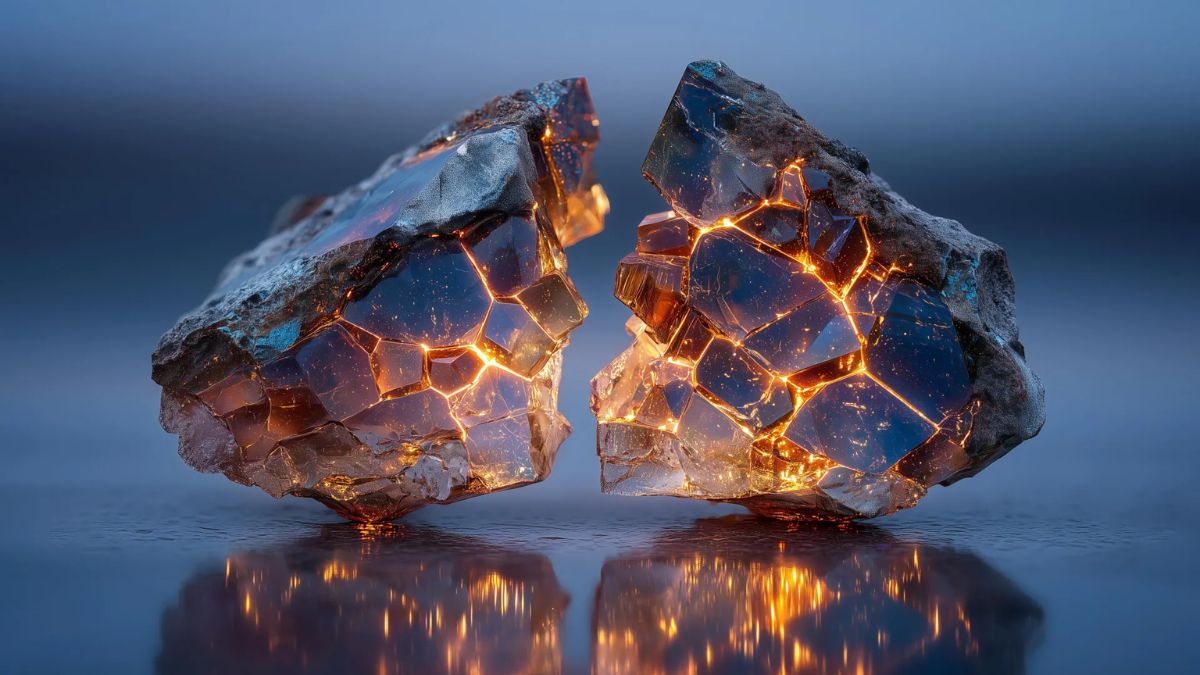
The mineral, found in a meteorite that crashed in Germany back in 1724, is called silica tridymite, and what makes it so mind-blowing is that it behaves unlike anything known on our planet. It maintains constant thermal conductivity even when heated — something completely unheard of.

Let’s look into why this mineral is so special, and how it could help reshape the way we manage extreme temperatures here on Earth.
Table of Contents
Tridymite
Silica tridymite is a rare form of silicon dioxide (SiO₂), and although there are other forms of silica on Earth — like quartz and glass — this one stands out. It doesn’t behave like a crystal, and it doesn’t behave like glass either.
It has characteristics of both — a bit of the structure and order of a crystal, and the disordered, loose nature of glass. That balance gives it unique thermal abilities, and scientists are still scratching their heads trying to classify it.

To make it even more intriguing, tridymite has also been spotted on Mars. Coincidence? Maybe not. More and more discoveries seem to point to the Red Planet as a place full of surprises — and possibly connections to Earth’s early cosmic history.
Alien
What makes this mineral truly alien is its behavior under heat. Normally, as temperature increases, crystals lose their ability to conduct heat and glasses increase it. But this extraterrestrial material? It stays the same. Whether it’s hot or cold, it keeps its thermal conductivity level unchanged.
That’s not just strange — it’s revolutionary.

Imagine materials in industrial use that can handle extreme heat without losing their efficiency. That’s where tridymite comes in.
Applications
The steel and metal industries, which rely on extremely high temperatures, could be completely transformed by materials like this. And here’s the big point: those sectors are massive polluters.
In the U.S. alone, heavy industry is responsible for about 7% of all CO₂ emissions, largely due to energy use for heating. If we could reduce the amount of energy needed to maintain high temperatures — thanks to thermally stable materials — we could significantly cut emissions.
Here’s a quick comparison:
| Material Type | Thermal Conductivity When Heated | Example Behavior |
|---|---|---|
| Crystal | Decreases | Less efficient |
| Glass | Increases | Becomes more conductive |
| Tridymite | Stays the same | Constant performance |
This unusual behavior could become a game-changer in building heat-resistant, energy-efficient tools and machines.
Climate
What’s truly exciting is the sustainability potential. If researchers can replicate or develop new materials based on tridymite’s structure, we might be on the edge of a new era in green industry.
This isn’t just about a weird rock from space. It’s about how science and space exploration might directly impact life on Earth — by reducing our reliance on wasteful, outdated materials.
The mineral’s unique properties could lead to the creation of refractory materials — stuff designed to withstand intense heat without degrading — for use in furnaces, reactors, and beyond.
Future
The study that revealed this discovery is titled Temperature-invariant crystal–glass heat conduction: From meteorites to refractories, and it’s just the beginning.
Researchers are now focusing on how to copy this mineral’s structure or engineer synthetic versions. If they succeed, we could be looking at the foundation for next-generation industrial materials — all thanks to a 300-year-old meteorite that crashed on Earth.
It’s almost poetic. A rock from the stars, forgotten for centuries, might just help us fix the damage we’ve done down here. And as we continue looking into Mars and other cosmic frontiers, who knows what else we’ll find — maybe even more keys to saving our planet.
FAQs
What is silica tridymite?
A rare silicon dioxide mineral found in a meteorite.
Why is tridymite special?
It keeps thermal conductivity constant when heated.
Can it help the environment?
Yes, it could reduce emissions in high-heat industries.
Was it found only on Earth?
No, it’s also been detected on Mars.
Is it a crystal or glass?
It shows traits of both, but fits in neither category.