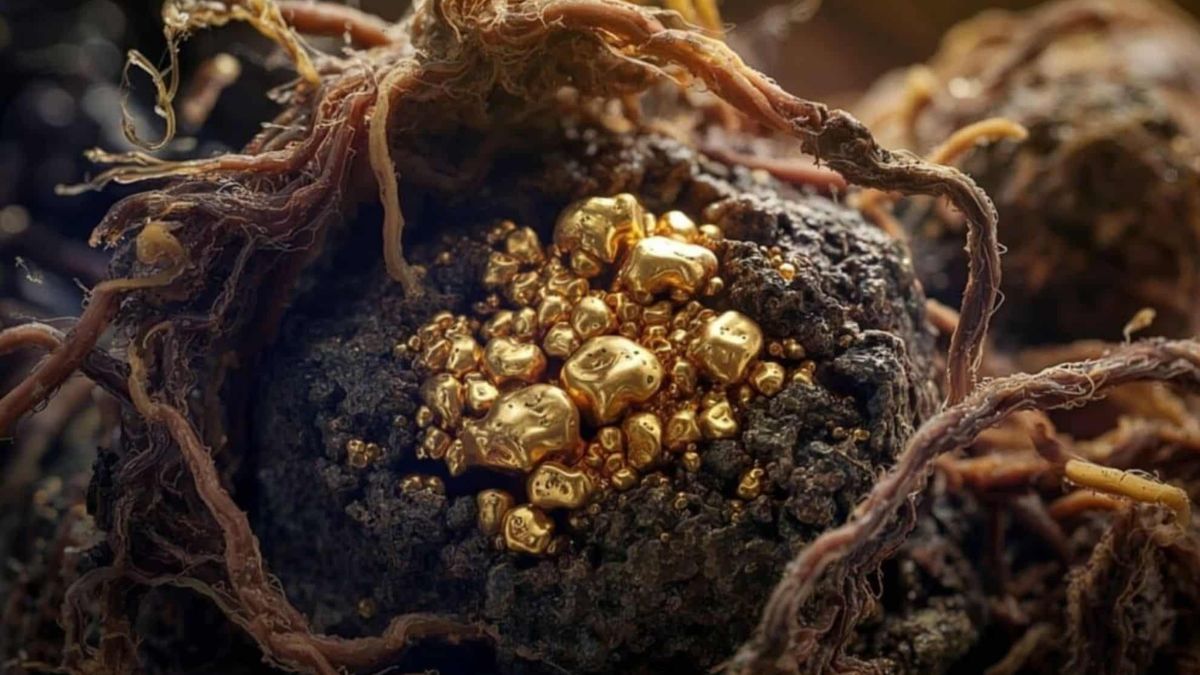
Gold from mushrooms? Sounds like something out of a fantasy novel. But it’s real—and scientists in Australia have found a fungus that not only tolerates gold, but actually grows better around it and even absorbs and coats itself with gold particles. That’s right, this living organism blings itself out like it’s headed to a red carpet.
This wild discovery could completely flip the gold mining industry on its head. No more massive digging or toxic chemicals. Just fungi and a little bit of science.
Table of Contents
Discovery

The research comes out of CSIRO, Australia’s national science agency. While digging into how certain organisms interact with metals, scientists stumbled upon a species similar to Fusarium oxysporum. What shocked them wasn’t just that it could survive near gold—it thrived.
This fungus seems to grow faster when gold is around and even pulls it into its structure, sticking microscopic gold particles on its surface. Think of it as a gold-loving mold that doesn’t just tolerate the metal, it practically wears it.
Surprise
Gold is famously unreactive. Chemically speaking, it doesn’t bond easily with other elements or living organisms. That’s why this finding is such a game-changer. Dr. Tsing Bohu, who led the study, said it challenges everything we thought we knew about gold’s behavior in nature.

It’s not just lying there in rivers or hidden in rocks—nature may have been quietly farming it underground all this time.
Process
What’s even more interesting is that the fungus doesn’t just collect gold—it might be transforming it. Researchers noticed it can create gold nanoparticles when exposed to certain conditions. These tiny particles are valuable not just for mining, but for tech and medical uses too.
And it’s not a one-hit wonder. Another fungus, Candida rugopelliculosa, also showed similar traits when stressed. So we might be looking at a whole underground network of gold-producing fungi.
Potential

This is where things start to sound like science fiction—in a good way. Right now, mining for gold involves blasting through earth, using dangerous chemicals like cyanide, and leaving behind environmental damage that can last for decades. But imagine a process where fungi do the hard work for us.
These organisms could act like natural sensors, pointing us to gold-rich areas without a single shovel being lifted. If we manage to scale the process, it could lead to biological mining—a cleaner, safer, and smarter way to get gold.
Here’s a comparison of traditional mining vs potential fungal mining:
| Method | Traditional Mining | Fungal Mining (Potential) |
|---|---|---|
| Environmental Impact | High (deforestation, pollution) | Low (minimal disturbance) |
| Chemical Use | Cyanide, mercury | None |
| Water Consumption | Very high | Very low |
| Cost | Expensive machinery | Lab cultivation |
| Scalability | Already established | Still under research |
Obstacles
But of course, it’s not that easy. The fungus was discovered under controlled lab conditions. The real challenge is figuring out how to make it work in the real world. What kind of environment does it need? How does it interact with other organisms underground? Can it survive in mining zones?
And perhaps most importantly: can it be grown at scale? That’s the million-dollar (or should we say gold-bar) question.
Outlook
We’re still early in the game. But even the possibility of mining gold without wrecking the environment is revolutionary. This could turn into one of those rare scientific moments where a simple natural discovery leads to a major shift in industry.
If fungi can grow gold, they might also grow us a way out of destructive mining practices. Nature had the solution under our feet all along—we just needed to look down.
FAQs
Can fungi really grow gold?
Yes, some fungi absorb and coat themselves in gold.
Which fungus grows gold?
A species like Fusarium oxysporum was found to do this.
How is fungal mining better?
It avoids chemicals and reduces environmental damage.
Is fungal gold farming scalable?
Not yet—it’s still being researched in labs.
Could fungi replace mines?
Possibly, if lab success translates to real-world use.