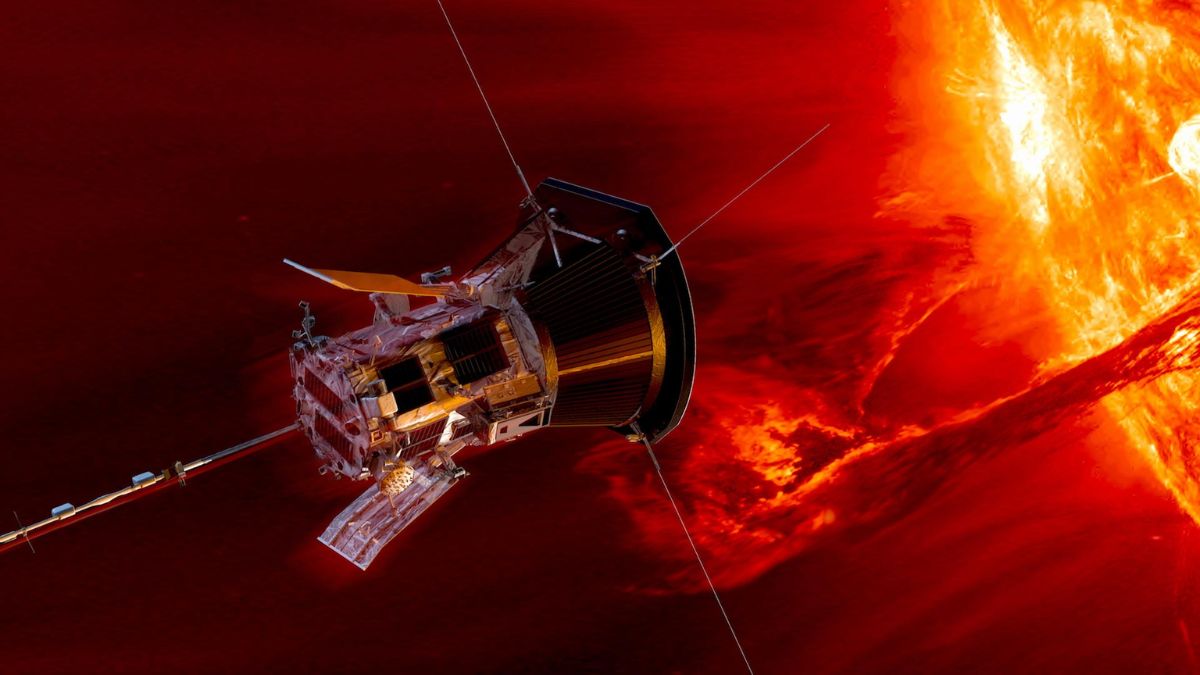
For years, one question left scientists scratching their heads—why is the Sun’s corona, its outermost layer, way hotter than its surface? It didn’t make sense. The surface of the Sun is already scorching, but the corona takes the heat to a whole new level. It was a puzzle with no clear answer. Until now.
NASA’s Parker Solar Probe has just changed that. By flying directly into the solar atmosphere, it uncovered something that was only theoretical before: the helicity barrier. It’s a game-changer for solar science—and possibly for all of astrophysics.
Table of Contents
Breakthrough
Let’s start with what the Parker Probe actually found. For the first time, it confirmed the existence of a helicity barrier. Imagine an invisible wall in the Sun’s outer atmosphere, a zone where plasma behaves differently from anything we’ve seen before. Normally, turbulent energy in plasma moves, mixes, and fades out. But near the Sun, that doesn’t happen. The barrier keeps opposing plasma waves from mixing.
The result? Energy gets trapped and behaves in strange, powerful ways. And that changes everything we thought we knew about solar physics.
Barrier
So, what exactly is this helicity barrier? It forms under specific conditions—when the Sun’s magnetic field is incredibly strong and plasma pressure is low. That balance doesn’t happen just anywhere. But in the Sun’s corona, it’s the perfect storm.
When plasma waves collide and move in opposite directions, instead of blending and fading out, the barrier blocks the interaction. This leads to a build-up of energy, and that energy has to go somewhere. Now we finally understand why it flows to the protons more than the electrons.
Explanation
Here’s where things start making sense. For years, scientists were baffled by the fact that protons in the solar wind were so much hotter than electrons. According to old models, that shouldn’t happen. The heat should be more balanced. But with the helicity barrier in the picture, the math works out.
It’s not that the Sun is breaking the rules. It’s just playing by rules we didn’t know existed.
Unique
The Sun isn’t the only place with hot plasma, but this kind of behavior is rare. To see a helicity barrier, you need extreme heat, low density, and powerful magnetic fields all at once. That combination only happens in a few places in the universe—like the corona of the Sun.
That makes this discovery a tool for studying not just our star, but other extreme environments in space. From black holes to cosmic jets, there are plenty of places where this barrier might exist.
Impact
This isn’t just science for science’s sake. Solar wind affects more than just scientists’ curiosity. It impacts life on Earth. When solar storms get intense, they can mess with satellites, GPS, communications, and even electrical grids.
The better we understand how solar wind behaves, the better we can prepare for space weather. And thanks to Parker, predictions will get more accurate and reliable.
Laboratory
The Sun is now our natural lab. Parker didn’t just get close—it actually touched the solar atmosphere. That allowed it to collect data that simply can’t be gathered from Earth. Until this mission, this kind of solar plasma could only be simulated on computers.
Now we have the real thing. And that opens the door to understanding not just the Sun, but also far-off phenomena like the gas clouds around dying stars or the chaotic disks around black holes.
Mission
Parker Solar Probe isn’t just another spacecraft. It was specifically built to get closer to the Sun than anything before it. Its mission is risky, but the payoff is huge. And the discovery of the helicity barrier is proof that it’s working.
Published in Physical Review X, this finding is just the start. As the probe keeps diving into the Sun’s atmosphere, it will keep gathering more secrets.
Future
So, what’s next? Now scientists will dig into the massive amount of data Parker is sending back. They’ll track how this barrier behaves as you move farther from the Sun. They’ll also look for signs of similar behavior in other parts of the universe.
We’re not just solving old mysteries—we’re rewriting our knowing of how energy works in extreme space environments.
The helicity barrier started as a theory. Now it’s real. And it could change the way we see not only our star but the entire cosmos. The best part? Parker is just getting started.
FAQs
What did the Parker Probe discover?
It confirmed the existence of the helicity barrier near the Sun.
Why is the corona hotter than the Sun’s surface?
Because the helicity barrier traps energy, heating protons more.
What is the helicity barrier?
A zone that blocks plasma waves from mixing near strong magnetic fields.
How does this affect Earth?
It improves solar wind predictions, protecting satellites and systems.
Where else could this barrier exist?
Possibly near black holes, nebulae, or other extreme space zones.