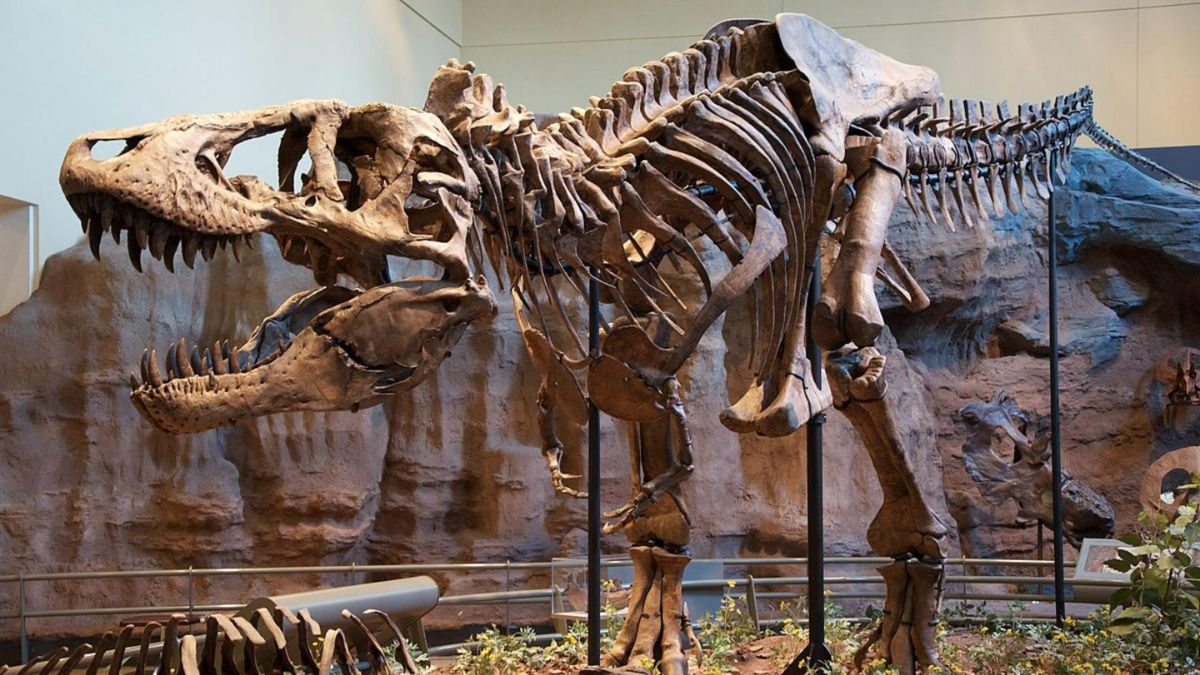
It’s not every day that fossils sitting quietly for 50 years suddenly flip the script on dinosaur history—but that’s exactly what just happened. Paleontologists have re-examined bones found in the Gobi Desert during the 1970s and made a groundbreaking discovery: a brand-new species of dinosaur closely related to the iconic Tyrannosaurus rex.
Say hello to Khankhuuluu mongoliensis. Yes, it’s a mouthful. And yes, it’s a game-changer.
Table of Contents
Fierce
So what makes this dinosaur so special?
For starters, it’s not the towering beast you might expect from the T-Rex family. This creature was about four meters long and weighed roughly 750 kilograms. That’s nowhere near the six-ton weight of its cousin Tarbosaurus, but don’t let its size fool you—it was still a fierce predator.
Its importance isn’t in how big it was, but in what it reveals about where T-Rex actually came from. This dinosaur isn’t just another fossil. It’s the missing link that scientists didn’t know they were looking for.
Roots

The discovery of Khankhuuluu mongoliensis rearranges the entire tyrannosaur family tree.
Based on its features, scientists now believe this species is the closest known relative of T-Rex. It lived around 85 million years ago, long before the famous T-Rex ruled North America. This means the story of how these dinosaurs evolved just took a big turn—and that turn starts in Asia.
Bridge
Researchers believe this dinosaur or its relatives likely crossed a land bridge between Siberia and Alaska during the Late Cretaceous period. That land bridge, now long gone, once connected Asia and North America.
This prehistoric migration could have been the moment that allowed tyrannosaurs to spread and evolve into the giants we all know today.
Kind of like ancient dino backpackers looking for new territory.
Delay
You might be wondering: how did this go unnoticed for so long?
Well, the fossils were originally discovered in 1972 and 1973 but sat largely untouched or misclassified for decades. It wasn’t until recently—thanks to new technology and fresh research—that experts realized they had something completely new in their hands.
It’s a perfect example of how old bones can still tell new stories.
Shift
This discovery also confirms something major: T-Rex likely didn’t originate in North America after all. Its true roots, it turns out, trace back to Asia.
According to paleontologist Cassius Morrison from University College London, this underlines the evolutionary importance of Asia in the success of tyrannosaurs. Basically, if you’re looking for the real Jurassic homeland of these beasts, it might be time to look east.
Clues
Paleontologist Darla Zelenitsky said it best: “This discovery forced us to look at the tyrannosaur family tree with different eyes.”
And it doesn’t end there. This new species opens the door to re-examine other neglected fossils. There may be even more undiscovered relatives waiting in museum drawers and desert digs.
Imagine all the dino secrets still buried under our feet—or stored in boxes, misidentified for decades.
Legacy
So what’s next?
This discovery reignites discussions that many paleontologists thought were closed. It challenges long-standing assumptions and reminds us how much we still have to learn.
The Khankhuuluu mongoliensis may have been smaller and less flashy than T-Rex, but its impact on science is massive. It shows us that the history of dinosaurs isn’t finished—it’s still unfolding.
And sometimes, all it takes is a closer look at the past to change everything we thought we knew.
FAQs
What is Khankhuuluu mongoliensis?
A newly identified dinosaur and close relative of T-Rex.
Where was it discovered?
In the Gobi Desert, Mongolia, during the 1970s.
How big was Khankhuuluu?
About 4 meters long and weighed around 750 kilograms.
Did T-Rex come from Asia?
Yes, this discovery suggests T-Rex evolved from Asian ancestors.
Why is this discovery important?
It reshapes the tyrannosaur family tree and origins.