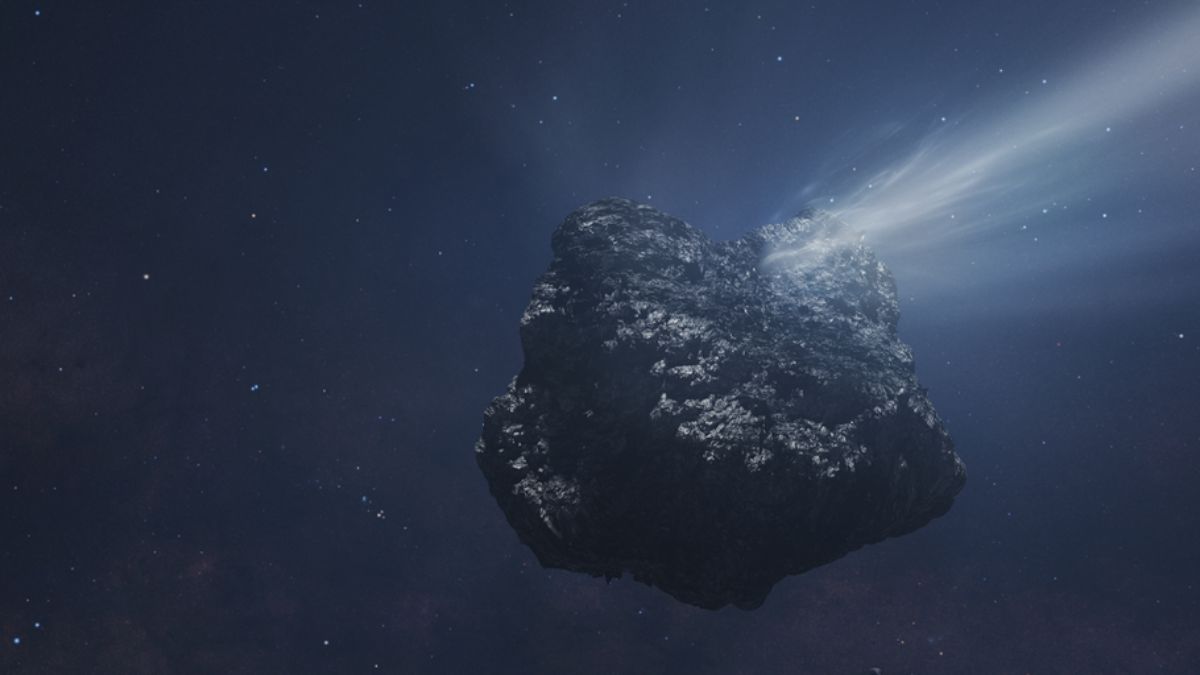
The skies have caught the world’s attention again — and this time, it’s because of a mysterious space traveler known as comet 3I/ATLAS. Unlike most cosmic visitors, this one’s raising eyebrows across the scientific community. Not because it’s headed toward Earth (spoiler: it’s not), but because its chemical makeup is like nothing we’ve ever seen before.
With ingredients like nickel, carbon dioxide, and an unusually high amount of cyanide, 3I/ATLAS is anything but typical. While some are jumping to conclusions — aliens, toxic fallout, or world-ending predictions — let’s break down what scientists actually know about it.
Table of Contents
Composition
Here’s the wild part — the composition of 3I/ATLAS has scientists completely stumped. It’s not that cyanide is new in comets. In fact, it’s pretty common. What’s unusual is the intensity — there’s way more than usual. Pair that with a significant amount of nickel, and it starts to look like this comet doesn’t follow the chemical rules of other known celestial bodies.
And let’s not forget the CO2. It’s there too, but not in a way that makes sense based on past comet studies. This trio of chemicals — nickel, cyanide, and carbon dioxide — is throwing off the usual cosmic formula.
Doubts
Even seasoned astronomers are scratching their heads. The 3I/ATLAS comet behaves differently than others. It’s trailing a bizarre cloud of compounds that’s way larger than average, making its movement harder to predict.
Then there’s the anti-tail — a rare visual effect that only happens under certain cosmic alignments. But this anti-tail is so pronounced, scientists want to study why it’s dragging so much debris.
Anti-tail
Most comets have two tails: one made of dust and the other of ionized gas. But the anti-tail is a visual illusion that, from Earth, appears to point in the wrong direction — toward the Sun.
That’s exactly what’s happening with 3I/ATLAS. Its anti-tail looks massive, and the volume of dust it’s trailing behind is off the charts. It’s not a new kind of comet, just a weird-looking one — and the illusion is all about perspective.
Here’s a quick breakdown:
| Tail Type | Direction | Cause |
|---|---|---|
| Dust Tail | Along orbit (behind comet) | Sunlight pressure on dust |
| Ion Tail | Opposite the Sun | Solar wind on ionized gas |
| Anti-Tail | Appears toward the Sun | Earth’s viewpoint illusion |
Toxic?
Let’s get to the question that’s keeping conspiracy theorists up at night: Can 3I/ATLAS poison Earth?
Absolutely not. The comet won’t even come close to Earth — not by a long shot. It won’t enter our orbit, and even if it did eject material in our direction (which it won’t), that debris would burn up or disperse in the vacuum of space long before getting anywhere near our atmosphere.
Even the cyanide part isn’t alarming to experts. They’ve seen cyanide in comets before. It’s the amount that’s interesting — not dangerous.
Origin
Where did this strange rock come from? Most likely, from somewhere outside our solar system. 3I/ATLAS is an interstellar object, meaning it probably formed billions of years ago — long before our Sun or planets existed.
It’s been drifting alone through space, unclaimed by any star, and just happened to swing through our solar system for a quick pass. After this flyby, it’ll continue on its lonely journey for millions of years more, maybe into another system.
Panic?
So, should you be worried? Not at all. 3I/ATLAS is interesting, mysterious, and exciting for astronomers — but it’s not a threat. No impact, no contamination, no surprise invasion.
Instead of fear, this is a time to marvel. A comet like this gives scientists a rare chance to study what the early universe might have looked like — kind of like finding an ancient message in a bottle, floating through cosmic oceans.
The buzz is real, and rightly so. But take a breath — Earth is safe, and this visitor will be gone soon enough, leaving only data and wonder behind.
FAQs
What is comet 3I/ATLAS?
It’s an interstellar comet with a rare chemical mix.
Can it hit Earth?
No, it’s not on a collision path with Earth.
Is the cyanide dangerous?
No, it’s common in comets and poses no threat to us.
Why is the anti-tail unique?
It’s unusually large and visually striking from Earth.
Is 3I/ATLAS a UFO?
No, it’s a natural space object, not an alien craft.