Hidden deep in the coral jungles of the Pacific, there lives a creature that’s almost impossible to spot unless you know exactly where to look. Meet the pygmy seahorse—a master of disguise that didn’t evolve through addition, but subtraction.
That’s right. Instead of gaining genes like most animals, this tiny sea creature lost hundreds of them and became better at surviving because of it. Ready to cut in and uncover the secrets of nature’s most efficient minimalist? Let’s go.
Table of Contents
Pygmy

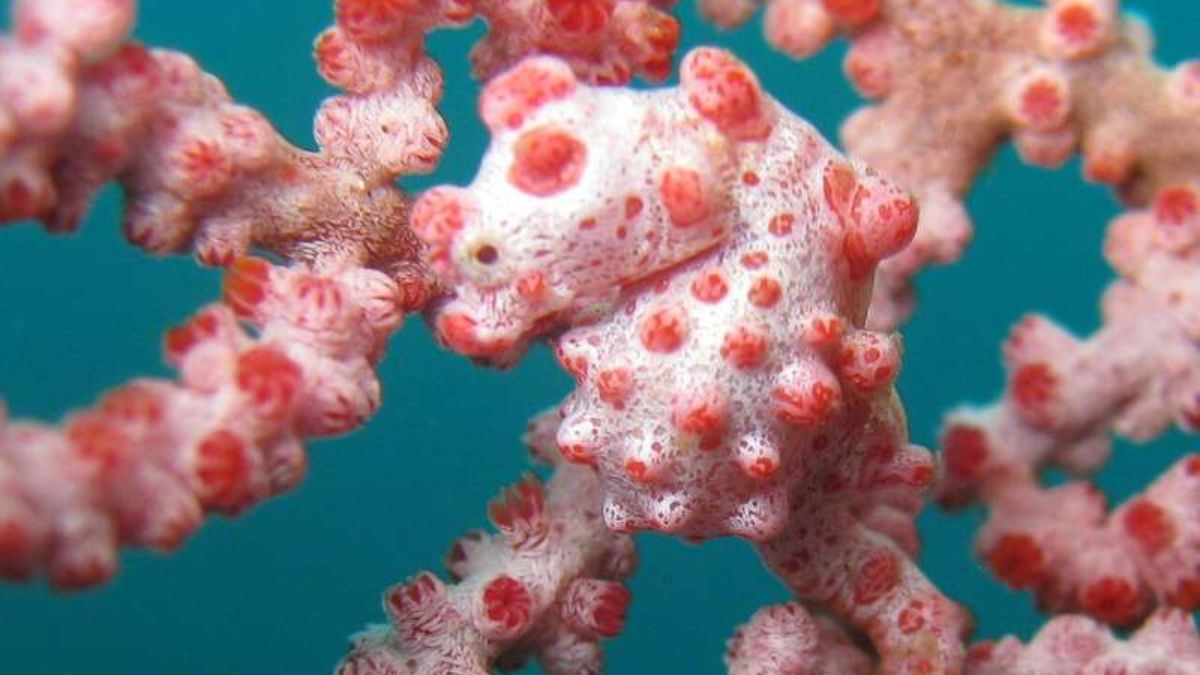
The pygmy seahorse, or Hippocampus bargibanti, is barely the size of a fingernail—about two centimeters long. It lives among coral reefs in the western Pacific Ocean, where it blends in so well that divers didn’t even know it existed for years. It wasn’t until researchers closely examined certain coral species that they spotted something… odd. A bump that moved. And just like that, this nearly invisible marine creature was discovered.
Its entire look—color, bumps, and even its body texture—mimics the coral it clings to. That’s camouflage on a whole new level. But here’s what really surprised scientists: this disguise didn’t come from more complex evolution. Instead, it came from something that rarely makes headlines in biology—gene loss.
Genome
When scientists studied the pygmy seahorse’s DNA, they were stunned. Compared to other seahorses, it had lost at least 438 genes entirely, and another 635 were either broken or no longer functioning. In most species, evolution adds complexity. New features. Extra tools. But the pygmy seahorse evolved in reverse.

This isn’t just a fluke—it’s a concept called “evolution by subtraction.” In the case of the pygmy seahorse, less turned out to be much, much more.
Nose
One obvious physical difference? Its nose. While most seahorses have long, tube-like snouts, the pygmy has a short, rounded one. The reason? It lost a gene called hoxa2b, which helps shape the head. Without this genetic instruction, its face stayed small and stubby.
And that turned out to be perfect. Its coral home is covered in tiny bumps and branches, and this rounded nose fits in like just another piece of the coral puzzle. The missing gene didn’t harm the pygmy—it helped it disappear.
Skin

The camouflage doesn’t stop at the nose. The pygmy seahorse’s skin is textured with little bumpy nodules that match the coral polyps it hides among. Again, this feature didn’t come from gaining a fancy gene—it came from losing control over how the skin should grow.
Normally, genes tell skin cells what texture to form. But in the pygmy, many of those genes and genetic switches have vanished or stopped working. What’s left? A skin that naturally grows uneven, coral-like bumps. And since it retains many baby-like traits for life—such as a small head and textured skin—it stays hidden from predators.
Immunity
Now here’s the real curveball: the pygmy seahorse has the weakest immune system of any known vertebrate. In the wild, that should be a disaster, right? A weak immune system usually means higher risk of infection and disease.
But this tiny marine ninja doesn’t need a strong immune system—it’s got backup. Its coral home produces natural antimicrobial chemicals that protect both itself and its little tenant. It’s like living in a house that automatically cleans itself from germs.
So while other animals have to fight off bacteria and viruses, the pygmy just sticks to its coral, and lets nature handle the protection.
Pregnancy
Here’s a fun fact you might’ve heard before: male seahorses carry the babies. But in most species, the father’s body would see the embryos as foreign invaders and possibly reject them. The pygmy seahorse avoids that problem thanks to—you guessed it—its weak immune system.
Because it can’t mount much of a rejection response, it becomes a perfect incubator for baby seahorses. No fighting. No stress. Just a cozy pouch for the next generation.
Strategy
So what do we take away from all this? The pygmy seahorse didn’t become a better survivor by adding traits. It succeeded by losing the ones it didn’t need.
By stripping down its DNA, the pygmy seahorse fine-tuned its features to match its environment—small size, bumpy skin, weak immune system, rounded nose. Everything about it screams “I belong here,” and predators don’t even notice.
This is evolution by subtraction. And it shows us that sometimes, the simplest designs are the most effective. In the ocean’s endless game of hide-and-seek, the pygmy seahorse isn’t just playing—it’s winning.
The pygmy seahorse reminds us that evolution isn’t always about building more. Sometimes, it’s about knowing what to let go of. It’s a brilliant example of nature’s efficiency—where losing a few tools leads to mastering survival. If we want future generations to keep learning from these wonders, we need to protect their coral homes. After all, when the ocean speaks, it’s often the smallest voices that carry the biggest wisdom.
FAQs
What is a pygmy seahorse?
A tiny, coral-dwelling seahorse known for extreme camouflage.
How does the pygmy seahorse camouflage?
By mimicking the color and texture of coral polyps.
Why is its immune system weak?
It lost key immune genes but lives safely on protective coral.
Do male pygmy seahorses get pregnant?
Yes, and their weak immune system makes it easier.
What is evolution by subtraction?
Adapting by losing genes instead of gaining new ones.