On August 20, 2025, something unusual happened in space. An asteroid named 1997 QK1 flew near Earth, and it wasn’t just any regular space rock—it looked like a peanut.
Yes, a peanut! After more than 350 years since its last close approach, this strange object gave scientists a rare chance to study it up close. With over 200 meters in length and a curious double-lobed shape, this asteroid left researchers intrigued and eager to learn more. Let’s cut into the cosmic peanut’s story.
Table of Contents
Shape
Asteroids come in all shapes and sizes, but this one was different. Nicknamed the “cosmic peanut,” 1997 QK1 has a shape that resembles two chunks of rock stuck together. This structure is known as a “contact binary.” It’s basically two lobes that merged after colliding gently billions of years ago.
NASA’s planetary radar captured detailed images of the asteroid using the Goldstone Solar System Radar in California. These images, taken on August 21, showed one lobe nearly twice the size of the other, both featuring craters and concave surfaces that stretch as deep as multi-story buildings.
Stats
Thanks to its close approach, scientists gathered useful data about this cosmic visitor. Here’s a quick snapshot of what they found:
| Feature | Detail |
|---|---|
| Name | 1997 QK1 |
| Shape | Contact binary (peanut-like) |
| Length | About 200 meters |
| Distance from Earth | ~2 million km (8x Moon’s distance) |
| Rotation period | 4.8 hours |
| Risk classification | Potentially hazardous, but no threat |
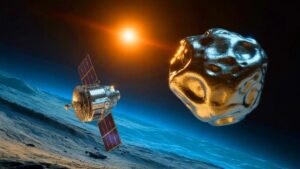
Even though 2 million kilometers might sound far, it’s considered a close shave in space terms. It was the closest this asteroid had come since the 17th century.
Structure
The peanut shape isn’t just for fun—it tells us something about the asteroid’s history. Roughly 15% of near-Earth asteroids of this size are contact binaries, according to NASA. These space rocks are leftovers from the early solar system that never became planets. Over time, they collided with other objects and slowly merged into odd shapes like this one.
Their composition also varies. Some are solid rocks; others are loose rubble piles held together by gravity. Knowing which type we’re dealing with is important if we ever have to deflect one in the future.
Value
You might wonder, why do scientists care so much about a weird-shaped rock flying by? The answer lies in three main areas:
1. Clues to the Past
Asteroids are ancient. They’re like frozen time capsules carrying material from the solar system’s birth. Studying them helps us understand the conditions and ingredients that formed Earth and other planets.
2. Planetary Defense
Don’t let the size fool you. Even a 20-meter object like the one that exploded over Chelyabinsk, Russia, in 2013 caused injuries and damage. A 200-meter asteroid would be much more dangerous. That’s why knowing how these rocks behave, spin, and break apart is key to stopping them if needed.
3. Future Missions
NASA is already planning ways to nudge dangerous asteroids off their path. Just look at the recent DART mission, which successfully altered an asteroid’s orbit with a controlled crash. Data from 1997 QK1 will help improve those methods.
Future
This wasn’t a one-time visit. NASA predicts that 1997 QK1 will return for another close pass in 2039—this time about 2.4 million kilometers from Earth. That might sound farther than its 2025 trip, but it still counts as close in space terms.
And who knows? By then, we might be ready to send a spacecraft to study it up close, maybe even land on it. A mission like that could reveal its exact composition and give us more insight into the evolution of contact binaries.
So, mark your calendars for 2039. The cosmic peanut will be back—and it might bring even more surprises with it.
FAQs
Why is it called the cosmic peanut?
Its double-lobed shape looks like a peanut in space.
How big is asteroid 1997 QK1?
It measures around 200 meters in length.
Is it dangerous to Earth?
It’s classified as hazardous but poses no threat currently.
When will it return?
NASA expects another close pass in the year 2039.
What is a contact binary?
It’s an object made of two lobes joined together like fused rubble.