Time. We think we understand it—always moving forward, measured in seconds and hours. But what if we’ve had it all backward? What if time isn’t just a straight arrow but has depth—three dimensions, just like space? That’s the mind-bending idea proposed by physicist Gunther Kletetschka from the University of Alaska Fairbanks. His theory doesn’t just challenge a few equations—it has the potential to flip modern physics on its head.
Let’s break it down into something you can actually imagine—without needing a PhD.
Table of Contents
Time

Kletetschka’s main claim is wild, yet oddly elegant: time has three dimensions, and what we call “space” is merely a consequence of those temporal dimensions. Not the other way around.
So imagine time as a woven braid—three threads running in different directions, intersecting and looping together. Where they twist and pull, they create something else entirely: the space we live in, and the matter we’re made of. That means everything—from stars and atoms to your morning coffee—could be shaped by the dynamic movement of these time axes.
Pretty intense, right?
Framework

In the world of physics, Einstein showed us that space and time are part of a unified fabric—spacetime. But Kletetschka takes it a step further. He says time creates space, not just flows through it.
According to his paper titled “Three-Dimensional Time: A Mathematical Framework for Fundamental Physics,” every physical event—like light moving or gravity pulling—is actually happening inside this 3D matrix of time. The idea is that each axis of time interacts with the other two, and those interactions create the forces and particles we observe.
In other words, we’re not in space watching time pass—we’re swimming through a sea of time that builds space around us.
Illusion

This is where things get philosophical. If Kletetschka is right, then space is not fundamental—it’s just a visible side-effect of deeper time interactions.
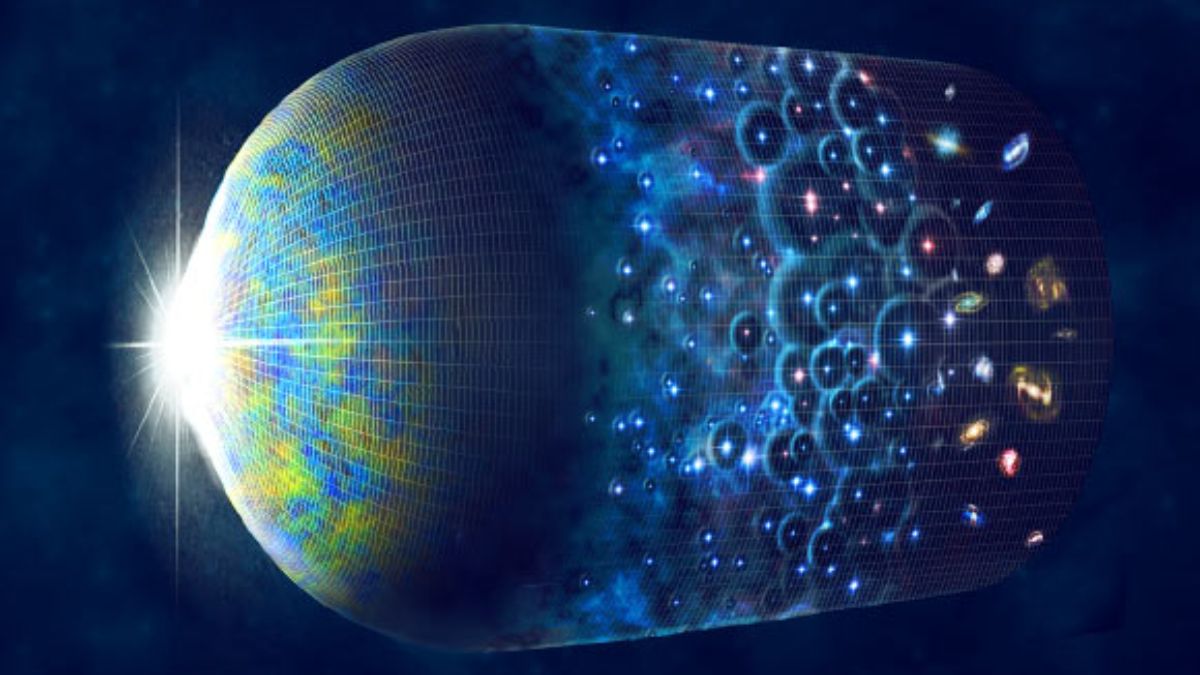
That would explain a lot of puzzling phenomena. Take the Big Bang, for example. Right now, we think the universe came from “nothing,” rapidly expanding into space. But what if it wasn’t space expanding, but time folding in new ways, creating the illusion of expansion?
It’s like being in a 3D movie theater. You see objects popping out at you, but they’re just flat projections—illusions built by angles and depth. Space, in this theory, might be just that—a projection of the true, deeper reality of time.
Unity
Let’s talk big picture. One of modern physics’ greatest unsolved problems is unifying general relativity (which describes gravity) with quantum mechanics (which describes subatomic particles). They don’t play nice.
But if time is actually the foundation of the universe—and it has three dimensions—it could be the missing link that ties it all together. Mass, energy, even gravity, could all be results of how the three time dimensions twist and interact.
Kletetschka’s theory opens the door to that elusive “theory of everything” that physicists have dreamed about for over a century.
Impact
If this theory holds water, the consequences are enormous. Beyond rethinking science textbooks, it could fuel innovations in technology, energy, and even time travel.
Think about it: if time has structure and direction, and we can understand how it flows or folds, we might learn how to navigate it—just like GPS helps us move through space. Communication, transportation, and our understanding of life itself could all change.
Still sound like science fiction? So did Einstein’s ideas—until GPS, black holes, and quantum tunneling became everyday topics.
Debate
Of course, groundbreaking ideas don’t get accepted overnight. The scientific community is skeptical, as it should be. Big claims need big proof.
But Kletetschka’s paper is already causing a buzz. The math is dense, the implications huge, and many experts are starting to wonder: what if he’s right?
Even if the theory turns out to be incomplete, it forces us to think differently—and that’s always been the start of progress in science.
Shift
Let’s bring it back to you, the reader. Why should you care?
Because this theory doesn’t just live in a lab or blackboard. If time is more than we think—if we’re living inside it, rather than watching it go by—it reshapes our understanding of reality. You’re not just a person moving through time. You might be a product of time’s structure, folded into existence by a pattern of temporal dimensions.
And that’s not just deep—it’s revolutionary.
FAQs
What is 3D time theory?
It’s a theory that time has three dimensions instead of one.
Who proposed 3D time?
Physicist Gunther Kletetschka from University of Alaska Fairbanks.
How does 3D time affect space?
Space is seen as a result of the interaction of time’s three axes.
Is space an illusion?
According to this theory, yes—space may just reflect time.
Could this theory replace relativity?
It might unite relativity and quantum mechanics someday.