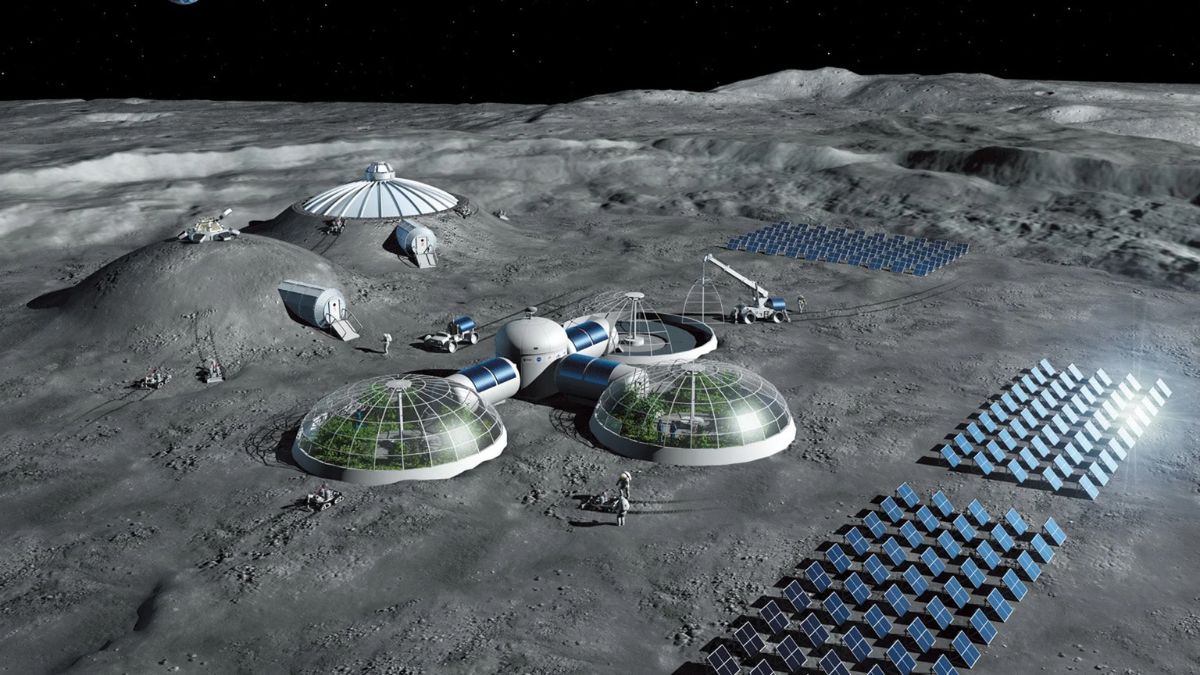
The United States just made a massive declaration that has the space community buzzing. At the International Astronautical Congress (IAC 2025) in Sydney, NASA Administrator Sean Duffy announced that the U.S. plans to build a lunar village within the next 10 years. Not a temporary base, not just astronauts planting flags, but an actual, nuclear-powered village on the Moon—with people living and working there.
While most space agencies are focusing on solving problems here on Earth, NASA is turning its eyes toward the stars. Let’s cut into what this means for the future of space exploration—and why the next decade might redefine what we think is possible.
Table of Contents
Vision

So, what exactly is this lunar village idea? Duffy made it clear—this isn’t some distant dream or sci-fi fantasy. It’s a tangible goal with real steps already in motion.
The lunar village aims to be a permanent human settlement on the Moon. It would support life, research, and even daily human activities. Think of it like a small town, except in space. People would live, work, and possibly even grow food there, using technologies designed for long-term sustainability.
The kicker? It will be powered by nuclear energy. NASA has already reached out to private companies to start designing and building a small, robust nuclear reactor that could power the Moon base. The goal is clear: create a self-sufficient lunar presence that doesn’t rely on constant resupply from Earth.
Energy

Let’s talk about the power source—nuclear energy. Why nuclear on the Moon?
Well, solar power is great on Earth, but not so reliable during the Moon’s two-week-long nights. That’s where nuclear comes in. It’s compact, efficient, and works regardless of sunlight. NASA is exploring compact reactor designs, including systems that can be launched, landed, and activated with minimal crew input.
They’re working with private space companies to fast-track development. It’s not just about powering lights and computers—it’s about life support, oxygen generators, habitat heating, and even water recycling systems.
Mars

Beyond the Moon, Duffy made it clear that Mars is still on the horizon. In fact, the work being done for the lunar village will directly support the long-term goal of sending humans to Mars.
Think of the Moon as the training ground. If we can live there successfully, with sustainable systems and reliable power, we can apply those same systems to Mars. NASA expects to have taken major steps toward Mars missions within this same 10-year timeline.
It’s like preparing for a big hike by setting up a camp halfway. The Moon is that midway point.
Sustainability
This year’s IAC theme was “Sustainable Space, Resilient Earth.” While most agencies were focused on Earth-related sustainability—like climate change and natural resource monitoring—Duffy emphasized sustaining human life beyond Earth.
For NASA, sustainability means learning how to survive off-planet without constant resupply. It’s about mastering closed-loop life systems, renewable energy, and efficient recycling methods.
Duffy pointed out that other U.S. agencies focus on Earth sustainability, while NASA’s job is to push the human frontier. It’s a division of responsibility—Earth’s care stays here, while NASA shoots for the stars.
Agencies
The contrast between space agencies was pretty stark during the IAC discussions. Here’s a quick rundown of what each agency emphasized:
| Country | Space Agency | Main Focus |
|---|---|---|
| United States | NASA | Moon village, Mars mission, nuclear power |
| Europe | ESA | Earth observation data for climate and wellbeing |
| India | ISRO | Food and water security for its population |
| Canada | CSA | Biodiversity research from space |
| Japan | JAXA | LUPEX Moon mission with India, greenhouse gas satellites |
| China | CNSA | Earth observation, space debris management, satellite traffic systems |
The missing voice? Russia. The country was noticeably absent from the session, reflecting its current uncertain role in global space collaboration.
Debris
If there was one issue everyone agreed on—it was space debris. The junk floating in Earth’s orbit is becoming a major threat. Broken satellites, rocket parts, and leftover equipment are creating a dangerous environment for all current and future missions.
China is actively developing removal tech, while Japan is backing companies like Astroscale, which aims to capture and deorbit old satellites. But they warned the issue is massive—and solving it might not happen in time to avoid serious collisions.
Every spacefaring nation acknowledged that managing orbital debris will require deep international cooperation. It’s like cleaning a neighborhood—if everyone doesn’t pitch in, the mess just keeps piling up.
Future
So here’s the big picture: the world’s space agencies are split between two equally valid goals. The United States wants to put people on the Moon and then Mars. Other nations want to use space to improve life on Earth.
One vision reaches for the stars; the other keeps its feet firmly planted in the soil. But maybe both are necessary. Because as we look outward, we also need to keep watching inward.
The real test will come in 10 years—will the U.S. have people living on the Moon? Will a nuclear reactor be humming away while astronauts sip coffee in a lunar lab? Or will Earth-focused missions win the race by solving climate issues with space data?
Time will tell. But one thing’s for sure: space is no longer the final frontier. It’s the next neighborhood.
FAQs
What is NASA’s 10-year lunar goal?
To build a permanent lunar village powered by nuclear energy.
Why use nuclear energy on the Moon?
It works during long lunar nights when solar power fails.
Which agencies focus on Earth issues?
ESA, ISRO, CSA, JAXA, and CNSA prioritize Earth sustainability.
What is the Moon village for?
To test life support, energy, and survival systems for space.
What’s the global concern in space?
Space debris and how to manage or remove it.