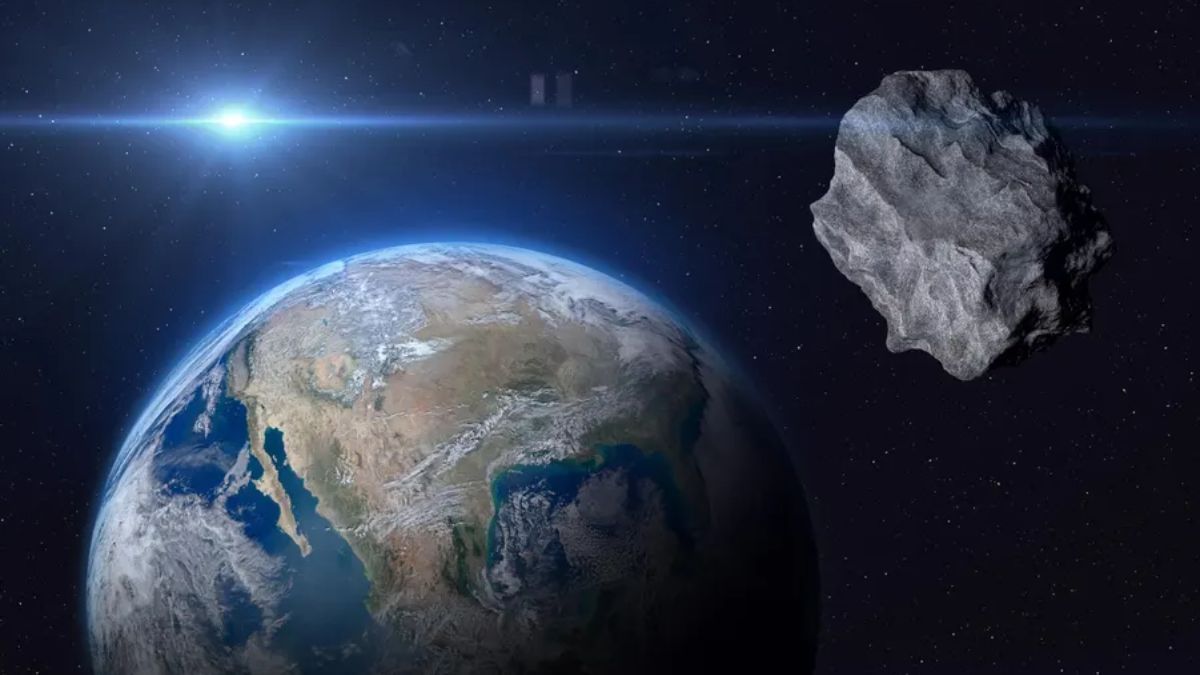
Space just dropped another surprise. Scientists have discovered a new traveling companion for Earth — and no, it’s not a second moon. It’s something a bit weirder: a “quasi-moon.”
Officially named 2025 PN7, this tiny celestial body will be journeying alongside our planet for the next 50+ years. But what is a quasi-moon, and why is NASA — and the rest of the astronomy world — so excited about it?
Let’s break it down.
Table of Contents
Discovery
The discovery was made by a team of astronomers at the University of Hawaii during the summer of 2025. Using powerful telescopes and sky-scanning systems, they spotted an unfamiliar object moving close to Earth’s orbit. After tracking its path, they realized it wasn’t space junk or a regular asteroid — it was a quasi-moon.
2025 PN7 is estimated to be somewhere between 18 and 36 meters wide — about the height of a small building. While that’s not huge by space standards, it’s still a pretty significant find considering how rare and hard to detect these objects are.
Orbit

Here’s the cool part: 2025 PN7 doesn’t actually orbit Earth like the Moon does. Instead, it orbits the Sun just like we do. But because its path is so similar to ours, it looks like it’s traveling with Earth, staying close by in a sort of cosmic slow dance.
Picture two runners going around a track in almost the same lane. They don’t hold hands, but they’re constantly near each other. That’s how a quasi-moon behaves. It’s not pulled in by Earth’s gravity the same way the Moon is, but it still tags along for the ride.
Distance
At its closest point, 2025 PN7 comes within 4 million kilometers of Earth — that’s about 10 times farther than our actual Moon. And at its farthest? Around 17 million kilometers away. The distance keeps changing because its orbit is slightly different and gets tugged around by the gravity of the Sun and other planets.
Despite that, it stays close enough that we’ll be sharing our solar orbit with this little asteroid until around 2083. After that, it’ll slowly drift away and continue its journey through space.
Rarity
Quasi-moons aren’t something you hear about every day — and for good reason. They’re incredibly tough to find. They’re small, dark, and move in complex patterns that make them blend into the background. In fact, scientists didn’t even know quasi-moons were a thing until the 1990s.
To date, astronomers have only confirmed eight quasi-moons, including 2025 PN7. Each discovery adds a piece to the puzzle of how objects move through space and how Earth’s gravity interacts with small celestial bodies nearby.
Tools
The University of Hawaii team used some of the most advanced telescopes in the world to spot the tiny asteroid. During a routine sky survey, they noticed a strange blip moving in sync with Earth. After weeks of tracking and analysis, they ruled out satellites and space debris, confirming it was a natural object — a quasi-moon.
These discoveries require precision, patience, and a bit of luck. Imagine staring into a dark ocean and spotting a pebble drifting along the tide — that’s how hard it is to detect something like 2025 PN7.
Value
So why does this matter? Quasi-moons like 2025 PN7 may be small, but they offer big scientific value. Studying them can help astronomers better understand gravity, orbital mechanics, and how small objects behave in space.
They could also provide insight into asteroids in general — which could be important for both safety and future space mining missions. Since quasi-moons are close to Earth but still out in space, they make ideal testing grounds for spacecraft and technology.
Some scientists even believe quasi-moons could become stepping stones for deeper space exploration. Think of them as practice zones that float just within reach.
Timeline
Here’s a quick look at 2025 PN7’s timeline and key details:
| Feature | Detail |
|---|---|
| Name | 2025 PN7 |
| Discovered by | University of Hawaii |
| Size | 18–36 meters wide |
| Orbit | Around the Sun (not Earth) |
| Closest Distance | ~4 million kilometers from Earth |
| Farthest Distance | ~17 million kilometers from Earth |
| Companion Period | 2025 to 2083 |
| Orbit Type | Quasi-satellite of Earth |
So the next time you gaze up at the night sky, just remember — we’ve got a quiet little cosmic neighbor riding along with us, hidden far beyond the Moon. It might not shine as bright, but 2025 PN7 is proof that the universe always has a few more surprises up its sleeve.
FAQs
What is 2025 PN7?
It’s a newly discovered quasi-moon orbiting with Earth.
Is 2025 PN7 Earth’s second moon?
No, it orbits the Sun, not Earth, but follows a similar path.
How long will 2025 PN7 stay with Earth?
It will travel with Earth until around 2083.
How far is the quasi-moon from Earth?
It ranges from 4 to 17 million kilometers away.
Why are quasi-moons important?
They help scientists understand orbits and asteroid behavior.