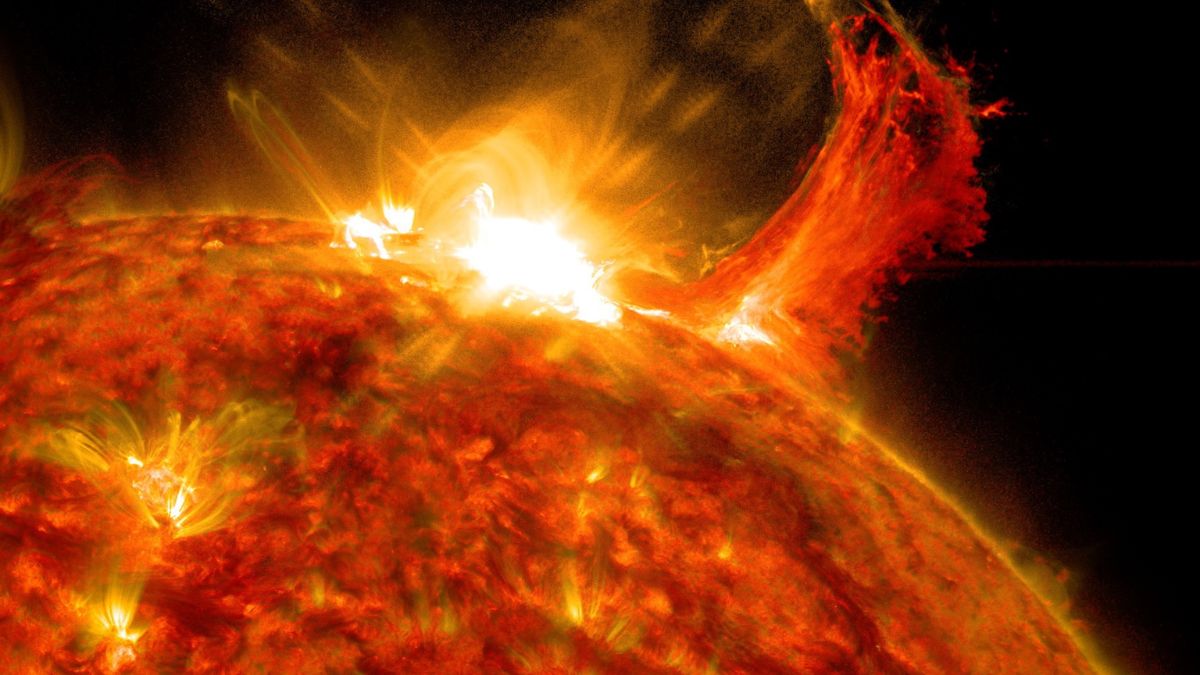
We usually think of rain as something gentle and cooling, but on the Sun, it’s a whole different story. Instead of water, it rains fire — well, plasma, to be exact. And after years of watching these strange fiery downpours, scientists finally understand what causes them.
The answer lies not in temperature, but in the Sun’s ever-changing chemistry. This breakthrough reveals a side of our star we never fully understood — until now.
Table of Contents
Mystery
Let’s be honest — the idea that the Sun “rains” anything sounds wild. But for decades, astronomers have observed streams of glowing plasma falling from high in the solar atmosphere back down to the surface. This phenomenon, known as coronal rain, looks like rivers of molten fire cascading through space. It happens after the Sun blasts off an eruption or flare. Some of the material gets thrown up along invisible magnetic loops, cools, and then drops down again.
Here’s the catch — computer models couldn’t explain it. According to simulations, plasma in the Sun’s atmosphere should stay hot and fairly uniform. So why do these thick, bright droplets form? Why do they cool down so fast and fall?
Elements
The key wasn’t temperature, but chemistry. Until now, most solar models assumed the Sun’s composition was uniform — the same mix of elements everywhere. But that’s not how the Sun really works.
Researchers from the University of Hawaii decided to try something different. They used a powerful simulation tool called HYDRAD to model the Sun’s plasma. This time, they included something new — variations in chemical composition. And boom — the mysterious rain suddenly made sense.
When certain elements like iron, magnesium, or silicon become more concentrated in some regions, the plasma starts losing heat faster. That rapid cooling causes the material to condense into heavier blobs. With gravity pulling them down, those dense fireballs fall back to the Sun’s surface. Just like rain on Earth — except a lot hotter.
Changes
This discovery flips a long-standing belief on its head: that the Sun is chemically stable. It’s not. In fact, the Sun’s chemistry is constantly changing due to the movement of materials between different layers — especially from the chromosphere to the corona. This affects how heat is trapped or released, and ultimately, how features like solar rain are formed.
In one simulation, scientists watched how hot plasma rose from the lower layers of the Sun, carrying denser elements with it. These patches of richer chemical mix cooled more rapidly, leading to condensation. Before long, those droplets collapsed downward, following magnetic pathways back to the surface.
Weather
Now, you might be thinking, “Why should I care if the Sun rains plasma?” Well, here’s why. The Sun directly affects life on Earth through what we call space weather. Solar flares and eruptions can disrupt GPS, satellites, power grids, and even airline communication.
Understanding when and how solar rain forms can help researchers better predict solar activity. It allows them to create more accurate models of solar eruptions. That means better forecasting for space weather events — and fewer surprises for our tech-heavy world.
Stars
The implications go beyond our own Sun. The same processes — with variable element concentrations driving plasma cooling — could be happening in other stars across the universe. That would explain similar “stellar rain” observed on distant stars.
So, this isn’t just a big deal for solar physicists. It’s a shift in how we know the lifecycle and activity of stars in general.
Insight
Here’s a quick comparison to break it down:
| Feature | Old Understanding | New Discovery |
|---|---|---|
| Sun’s Composition | Uniform and stable | Changes over time and location |
| Cause of Solar Rain | Temperature fluctuations | Chemical element variations |
| Plasma Behavior | Should remain evenly hot | Cools rapidly with element increase |
| Simulation Results | Failed to replicate real rain | Successfully created realistic rain |
This breakthrough also opens the door for better tools and new lines of research. Scientists can now explore how other solar events — like solar flares or coronal mass ejections — are tied to the changing chemical mix of the Sun.
Who knew a little rain could teach us so much?
The more we dig into the Sun, the more we realize how dynamic, unpredictable, and beautifully complex it really is. This new research doesn’t just solve a long-standing mystery — it redefines how we look at the very core of our solar system.
FAQs
What is solar rain?
Solar rain is cooling plasma falling along magnetic loops on the Sun.
Why does the Sun have rain?
Rain forms when plasma cools due to chemical changes and falls.
What causes the Sun’s plasma to cool?
Element buildup like iron or magnesium makes plasma lose heat.
Is the Sun chemically stable?
No, the Sun’s chemical makeup changes over time and space.
How does solar rain affect Earth?
It helps predict solar storms that impact Earth’s tech systems.