
41,000 years ago, Earth had a close call with a planetary-scale disaster. Known as the Laschamps Excursion, this event saw Earth’s magnetic field nearly vanish, leaving our planet exposed to cosmic radiation. While most people today associate the magnetic field with compasses, it’s actually our planet’s invisible shield against solar and cosmic threats.
Now, scientists warn that history might be preparing for a repeat—and this time, the stakes are even higher.
Table of Contents
Collapse
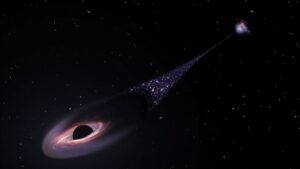
The Laschamps Excursion wasn’t a full magnetic pole reversal (where north becomes south and vice versa), but it came dangerously close. The magnetic field’s strength dropped to less than 10% of its normal level, stripping Earth of its natural defense against charged particles from space.
This temporary collapse lasted for about a thousand years. During that time, auroras—normally restricted to polar skies—were visible as far south as the Mediterranean. Sounds magical, right? Except it wasn’t.
That beautiful glow came at a cost: the radiation behind it was damaging, causing genetic mutations, increased UV exposure, skin conditions, and possibly higher death rates in animals and early humans.
Survival

So, how did our ancestors make it through? The archaeological record suggests they didn’t just survive—they adapted.
Some groups are believed to have taken shelter in caves, not just for safety but to escape increased radiation. Others used red ocher, a natural iron-rich pigment, as body paint—possibly doubling as an early form of sunscreen. Red ocher is found in ancient cave paintings, but scientists now believe it may have had a protective purpose too.
Interestingly, this period also coincides with a cultural leap. Cave art, rituals, and symbolic behavior appeared more frequently, hinting that this period of chaos may have triggered deeper thinking, creative expression, and curiosity about the heavens.
Warning
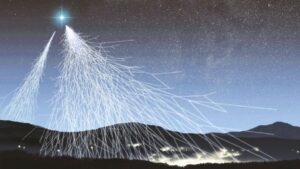
Could the Laschamps Excursion happen again? According to geophysicists, yes. Earth’s magnetic field has weakened significantly over the past 200 years. Some researchers argue we may already be entering the early stages of another magnetic event—maybe not tomorrow, but possibly within a few thousand years (or sooner, depending on how fast changes accelerate).
If another geomagnetic disturbance occurred today, the effects would go far beyond glowing skies and sunburns. Unlike ancient times, modern civilization relies heavily on electronic infrastructure: satellites, communication networks, navigation systems, and power grids.
A sudden collapse of the magnetic field could scramble GPS, shut down entire electrical grids, knock out satellites, and disrupt aircraft. In short, society could grind to a halt in hours.
Preparedness
So what are we doing about it? While no one can predict exactly when the next magnetic event will happen, space and science agencies are paying attention.
Satellites already monitor the Earth’s magnetic field in real-time. Engineers are designing hardened power grids that could withstand solar storms. Space agencies like NASA and ESA are developing protocols to protect space infrastructure in the event of a solar or geomagnetic storm.
Technology gives us an advantage our ancestors didn’t have—but the urgency remains. This isn’t science fiction. It’s a historical pattern with very real consequences.
Lesson
The Laschamps Excursion reminds us that nature doesn’t send calendar invites. One day, the sky lit up beautifully—and that beauty nearly wiped us out. It forced early humans to innovate, adapt, and perhaps even evolve in unexpected ways.
Today, we’re in a much better place in terms of knowledge, tools, and scientific awareness. But the weakening magnetic field is a cosmic whisper reminding us: Earth has been here before, and it may return to that state again.
The next time auroras dance above the equator, it won’t be a pretty Instagram moment. It’ll be a red flag. And while we hope it never comes, preparing now is the smartest thing we can do—because the universe doesn’t give second warnings.
FAQs
What is the Laschamps Excursion?
A near-collapse of Earth’s magnetic field 41,000 years ago.
Did humans survive the magnetic collapse?
Yes, using caves, clothing, and red ocher as protection.
Is the magnetic field weakening today?
Yes, it’s significantly weaker than 200 years ago.
What happens if the field collapses again?
Satellites, power grids, and communications could fail.
Can we prepare for a magnetic collapse?
Yes, through monitoring, tech upgrades, and protection protocols.