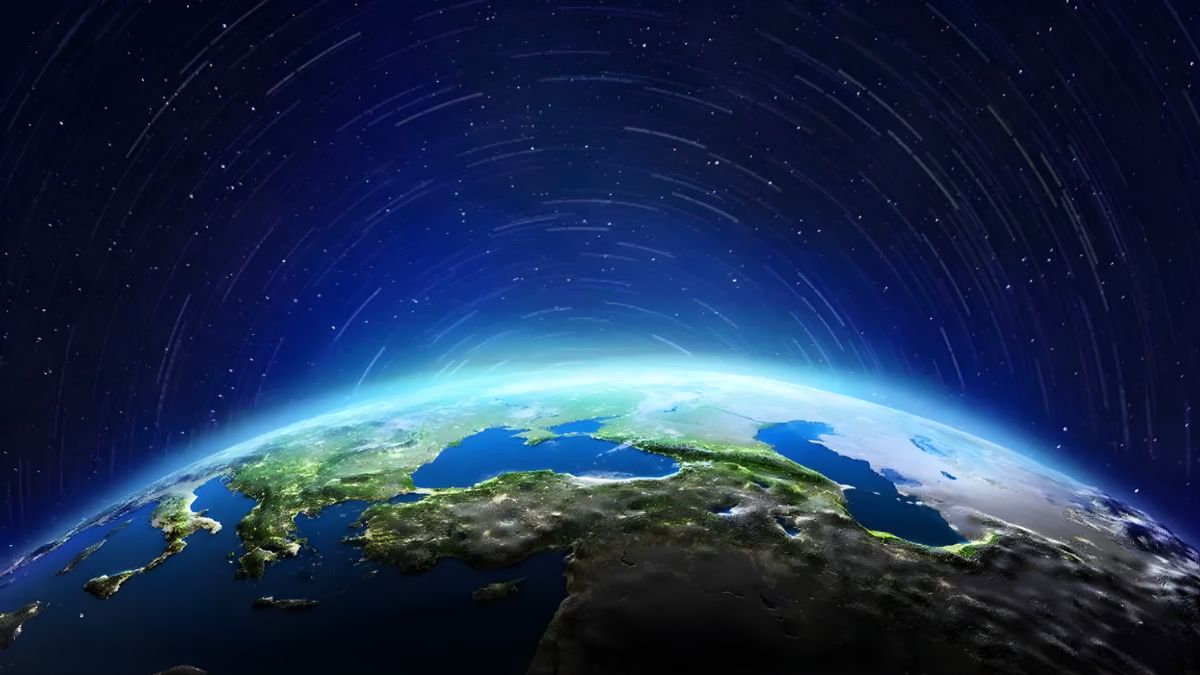
Earth is picking up the pace—and no, it’s not your imagination. According to astrophysicist Graham Jones, our planet has been spinning faster since 2020, and this acceleration could lead us to experience the shortest day in recorded history. The difference? Just 1.66 milliseconds shorter than usual. Barely the blink of an eye, but for scientists, it’s a huge deal.
Let’s look into why the Earth’s rotation is changing, what it could mean for our future, and whether we need to start worrying about the clock ticking a bit too fast.
Table of Contents
Spin
Normally, a day on Earth lasts exactly 86,400 seconds—or 24 hours. But the planet doesn’t rotate at a perfectly constant speed. It’s always shifting slightly due to gravitational forces, weather systems, and other cosmic factors.
Until recently, Earth was actually slowing down. That’s because of tidal friction—the gravitational pull from the Moon gradually acting like a brake on Earth’s spin. But then something changed in 2020. Instead of slowing, Earth started speeding up.
And this isn’t just a one-time event. The trend has continued year after year, breaking records along the way.
Records
Here’s what’s been happening:
| Year | Shortest Day Reduction |
|---|---|
| 2021 | -1.47 milliseconds |
| 2022 | -1.59 milliseconds |
| 2023 | -1.31 milliseconds |
| 2024 | -1.66 milliseconds (record) |
On July 5, 2024, Earth clocked its shortest day ever—1.66 milliseconds less than 24 hours. It’s tiny, but atomic clocks are so precise they can detect changes down to the microsecond.
Graham Jones predicts that in 2025, we might beat this record again. The possible dates? July 9, July 22, or August 5. Mark your calendars—if you can spare the milliseconds.
Causes
So, what’s speeding things up?
Scientists don’t have a confirmed explanation yet. One theory suggests it might be related to the Moon’s current position. When the Moon is at its furthest point from Earth’s equator, it slightly alters the balance of gravitational forces. That could cause subtle shifts in how fast our planet spins.
Other possibilities include changes in Earth’s core, melting glaciers shifting the planet’s mass, and seismic activity. But for now, the real reason remains a mystery.
History
Earth’s rotation has changed dramatically over billions of years. When the planet first formed, a single day may have lasted only three to six hours. Over time, the Moon’s gravitational pull slowed that spin, gradually stretching days to the 24-hour rhythm we know today.
Now, seeing Earth speed up again feels like a surprising reversal—and scientists are watching closely.
Impact
You might be thinking: so what? A couple of milliseconds doesn’t affect me.
True, you won’t feel the change, but it matters a lot in tech. Our modern world runs on systems that rely on ultra-precise timekeeping—think GPS, financial transactions, and global communication networks. Even a millisecond can cause errors if the systems aren’t adjusted.
That’s why international timekeepers sometimes add “leap seconds” to correct these shifts. But if Earth keeps speeding up, we might need to start subtracting time instead—a concept called a “negative leap second,” which has never been done before.
Future
Looking far ahead, some scientists predict that Earth and the Moon could eventually become tidally locked. That means Earth would always show the same face to the Moon—just like the Moon already does to us. If that happens, only one half of our planet would ever see the Moon, and tides as we know them would stop.
But don’t panic just yet. This would take about 50 billion years—by then, the Sun will have turned into a red giant, likely making Earth uninhabitable. So yeah, we’ll be long gone.
Perspective
The important thing here isn’t panic—it’s perspective. Earth’s behavior is always changing. We’re lucky enough to live in a time where we can measure these tiny shifts with insane accuracy and try to understand what they mean.
This phenomenon reminds us that the planet is alive—constantly shifting, spinning, moving. And while the effects might be subtle now, they could become more important over time, especially for technologies that rely on exact timing.
So no, your workday won’t get shorter. But Earth’s rotation is definitely speeding up, and we’re racing into uncharted territory—one millisecond at a time.
FAQs
How short could the day become?
Possibly 1.66 milliseconds less than 24 hours.
What dates might break the record?
July 9, July 22, or August 5, 2025.
Why is Earth spinning faster?
The exact cause is unknown, but it may involve the Moon.
Does this affect us daily?
Not directly, but it impacts technology and timing systems.
Will Earth and Moon lock rotation?
Yes, but only in about 50 billion years.