
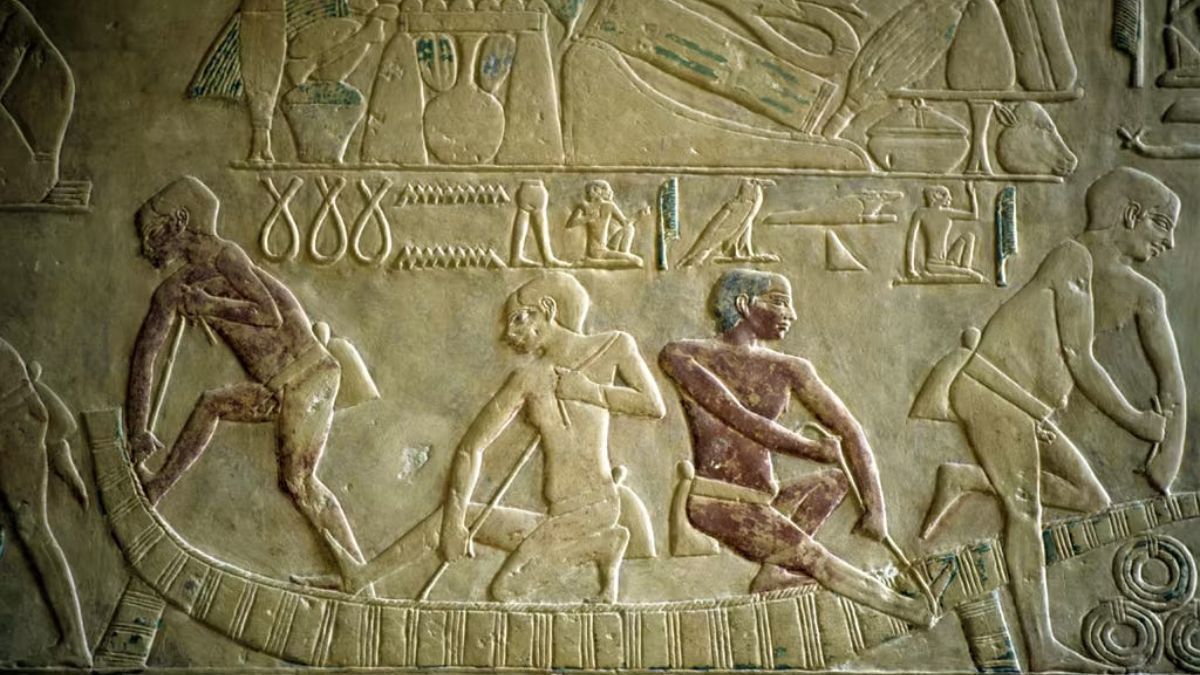
A major scientific breakthrough has revealed something truly extraordinary: the first fully sequenced DNA from an ancient Egyptian who lived during the era of the pyramids.
This isn’t some pharaoh or royal priest—it’s a humble potter whose story is now rewriting what we thought we knew about early Egyptian civilization. Forget what the old textbooks told you—this is the kind of twist even Netflix couldn’t write better.
Table of Contents
Discovery

The remains were found in Nuwayrat, an ancient city tucked 265 kilometers south of Cairo. The skeleton belonged to a man aged between 44 and 64, which is impressive considering most people back then didn’t live nearly that long—especially those doing hard labor.
He was buried inside a large ceramic jar, something usually reserved for the elite. His bones, however, told a very different story. Signs of arthritis, worn-down teeth, and specific wear in the arms and legs revealed years of intense, repetitive physical activity. It didn’t take long for researchers to figure out he was likely a potter, someone who worked endlessly with a spinning wheel and heavy materials. So, why the noble burial?
Turns out, this guy may have pulled off something remarkable in his lifetime: rising through the social ranks thanks to his craft. In a society where social mobility wasn’t common, this is as fascinating as it gets.
Genetics

Now here’s where things really start to shake the ground. For decades, Egyptologists and historians have speculated about the genetic origins of the ancient Egyptians. But hot, dry climates like Egypt’s make DNA preservation nearly impossible. Still, the team at the Francis Crick Institute in the UK cracked the code using advanced sequencing methods that avoided contamination.
What they discovered was groundbreaking. Around 80% of his DNA came from North African lineages—mostly around Mesopotamia—and the other 20% came from Western Asia, particularly present-day Turkey, Iran, and Iraq. Basically, this potter’s genome shows that Ancient Egypt was never genetically isolated. From the beginning, it was a genetic melting pot, a bridge between continents.
Here’s a quick view of the genetic breakdown:
| Region | Percentage of DNA |
|---|---|
| North Africa | 80% |
| Western Asia | 20% |

This confirms what many had only guessed before: Egypt was a cultural and genetic crossroads. The very roots of the civilization were intertwined with various peoples and cultures. It wasn’t just one group—it was many.
Diet
The team also looked at his teeth—specifically, the isotopes in his molars—to figure out what he ate and where he lived. Turns out, he grew up in the Nile Valley. His diet was typical for that time: wheat, barley, and animal proteins. This man lived through one of the most transformative periods in Egypt’s history—the birth of pyramid building—and ate like your average local.
Survival
But here’s where things get even more unbelievable. After his death in the 29th century BC, his skeleton was uncovered in 1902 and sent to the World Museum in Liverpool. During World War II, the museum was bombed during the Blitz, and most of its human remains collection was destroyed. Somehow, this man’s remains survived.
So not only did this potter live an extraordinary life in ancient times, he also survived modern history’s most devastating war bombings. That’s resilience on a whole new level.
Legacy
This discovery—published in the prestigious journal Nature—is just the beginning. With the first complete genome from the Pyramid Age now available, researchers have a whole new way of unlocking the mysteries of Ancient Egypt.
Archaeology used to rely solely on stones, tombs, and hieroglyphs. Now, DNA is stepping in to tell the stories that objects can’t. And in this case, the story isn’t about kings or warriors—it’s about a regular guy who shaped clay, not history books… until now.
The incredible burial, the surprising DNA, and the survival of his skeleton through war and time—this potter’s story shows how even the humblest individuals can change what we know about civilization.
FAQs
Who was the ancient Egyptian potter?
A middle-aged man who lived 4,800 years ago in ancient Egypt.
Where was his DNA found?
His skeleton was found in Nuwayrat, 265 km south of Cairo.
What was surprising about his burial?
He was buried like nobility despite being a laborer.
What did the DNA analysis reveal?
His ancestry was 80% North African, 20% Western Asian.
Why is this discovery important?
It’s the first complete genome from Ancient Egypt’s Pyramid Age.